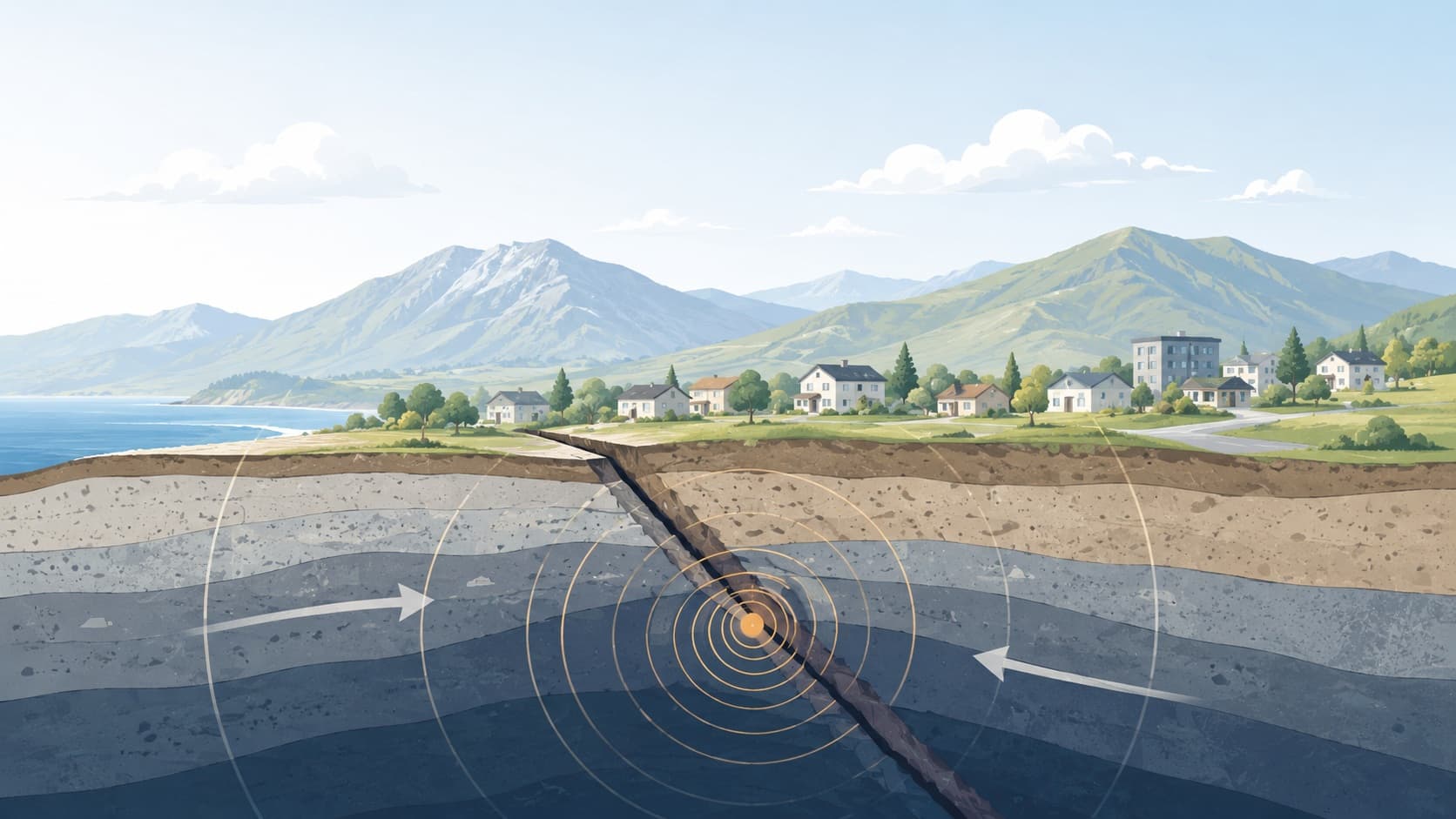
Earthquakes happen when rocks inside Earth suddenly break or slip along a fault, releasing energy that travels through the ground as seismic waves. The shaking may last only seconds, but the effects can range from barely noticeable motion to serious damage, depending on the earthquake’s size, depth, distance, local soil, building conditions, and nearby hazards.
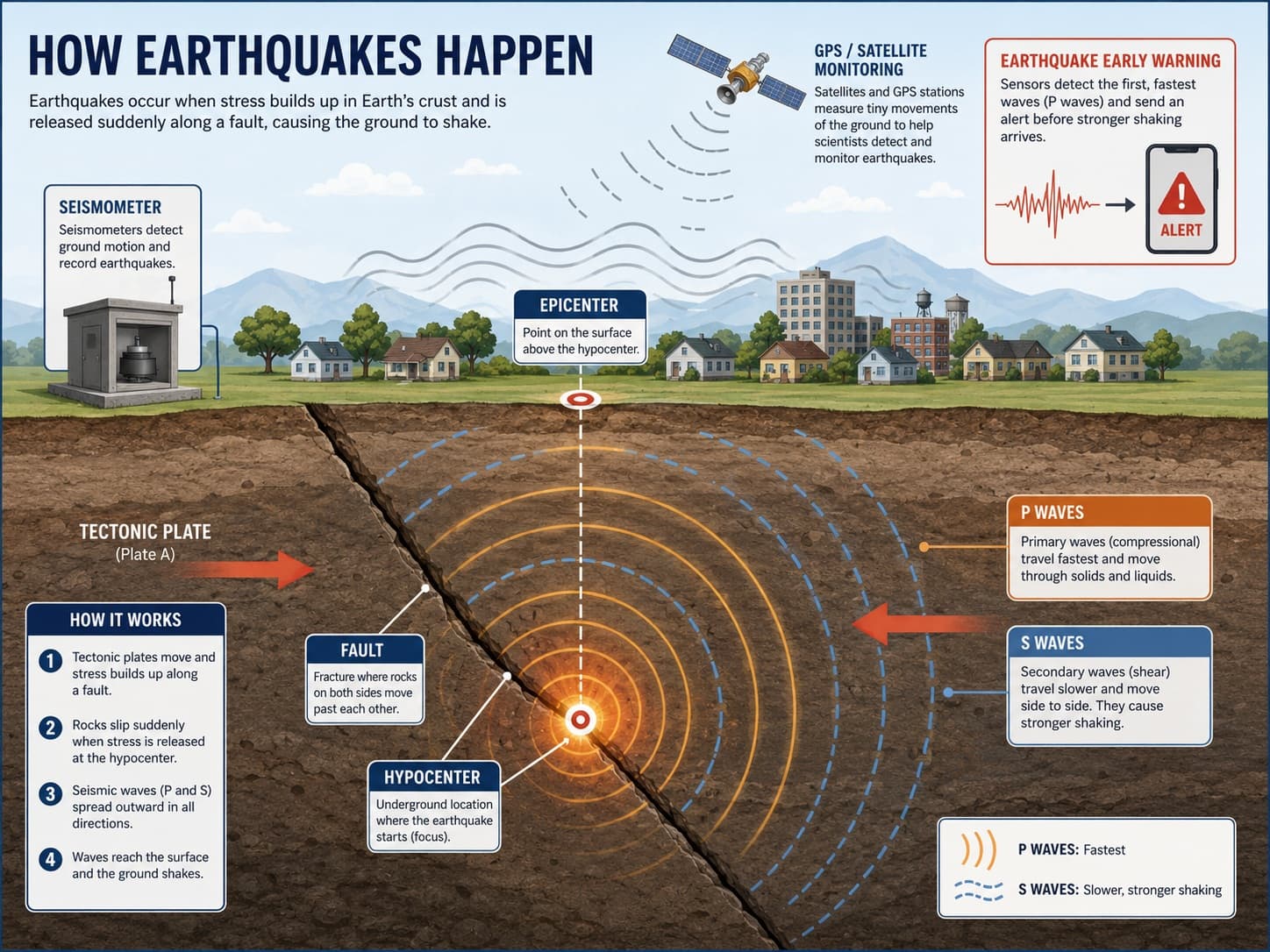
The U.S. Geological Survey explains that an earthquake happens when two blocks of Earth suddenly slip past one another. The surface where they slip is called a fault or fault plane. The underground starting point is the hypocenter or focus, and the point directly above it at the surface is the epicenter. (USGS)
Preparedness note: This page is educational. For an active earthquake, tsunami warning, or emergency situation, follow official alerts from local emergency management, the U.S. Geological Survey, NOAA Tsunami Warning Centers, local officials, and emergency services.
What Is an Earthquake?
An earthquake is shaking caused by a sudden release of energy inside Earth. Most earthquakes happen when stress builds up along a fault until rock suddenly slips. The released energy moves outward as waves, similar to ripples spreading across a pond after a stone is dropped.
A simple way to picture it:
- Tectonic forces slowly push or pull rock.
- Rock bends or locks along a fault.
- Stress builds over time.
- The fault suddenly slips.
- Energy travels outward as seismic waves.
- The ground shakes.
Earthquakes can happen near plate boundaries, within tectonic plates, near volcanoes, or in some cases because of human activities that change underground pressure, such as fluid injection.
Key Earthquake Terms
| Term | Plain-English Meaning |
|---|---|
| Fault | A break in rock where blocks can move past each other |
| Hypocenter / Focus | The underground point where an earthquake starts |
| Epicenter | The point on Earth’s surface directly above the hypocenter |
| Seismic waves | Energy waves that travel through Earth and cause shaking |
| Magnitude | A number that describes the size of the earthquake source |
| Intensity | A description of how strong shaking feels or how much damage occurs at a location |
| Aftershock | A smaller earthquake that follows a larger earthquake in the same general area |
| Foreshock | A smaller earthquake before a larger one, usually recognized only afterward |
| Plate boundary | Where two tectonic plates meet |
| Liquefaction | When water-saturated soil temporarily behaves like a liquid during shaking |
| Tsunami | A series of ocean waves often caused by sudden seafloor movement |
Earth’s Structure and Tectonic Plates
Earth is not a solid ball of rock all the way through. It has layers.
| Layer | Description | Earthquake Connection |
|---|---|---|
| Crust | Thin outer rocky shell | Most faults we experience are in the crust |
| Mantle | Hot, slowly moving rock beneath the crust | Mantle motion helps drive plate movement |
| Outer core | Liquid metal layer | Helps create Earth’s magnetic field |
| Inner core | Solid metal center | Not where normal earthquakes occur |
Earth’s outer shell is broken into large pieces called tectonic plates. These plates move slowly, usually only a few centimeters per year. That may sound tiny, but over decades, centuries, and thousands of years, the motion builds stress in rocks.
Earthquakes are common near plate boundaries because that is where plates collide, pull apart, or slide past one another. But earthquakes can also occur within plates, especially along old or hidden faults.
Types of Plate Boundaries
| Plate Boundary Type | Motion | Common Earthquake Pattern |
|---|---|---|
| Transform boundary | Plates slide past each other | Shallow earthquakes along strike-slip faults |
| Convergent boundary | Plates move toward each other | Large earthquakes, mountain building, subduction zones |
| Divergent boundary | Plates move apart | Shallow earthquakes, rifting, mid-ocean ridges |
| Intraplate region | Earthquakes within a plate | Less frequent, but still possible |
The largest earthquakes usually happen in subduction zones, where one tectonic plate dives beneath another. These zones can produce very large fault ruptures and may also generate tsunamis if the seafloor moves suddenly.
Faults: Where Earthquakes Begin
A fault is a break in Earth’s crust where rock can move. Not every fault moves often, and not every fault produces large earthquakes. But faults are important because they are the surfaces where many earthquakes start.
Main Fault Types
| Fault Type | Movement | Common Setting |
|---|---|---|
| Strike-slip fault | Blocks slide horizontally past each other | Transform boundaries |
| Normal fault | One block moves downward relative to the other | Areas where crust is being pulled apart |
| Reverse fault | One block moves upward relative to the other | Areas where crust is being compressed |
| Thrust fault | Low-angle reverse fault | Subduction zones and mountain belts |
| Oblique fault | Combination of vertical and horizontal motion | Complex plate-boundary regions |
A fault may stay locked for a long time. During that time, stress builds. When the stress becomes greater than the friction holding the fault in place, the fault slips.
Elastic Rebound: Why Faults Snap
The idea of elastic rebound helps explain earthquakes. Rocks may seem solid and stiff, but under stress they can bend slightly. If a fault is locked, the rocks on either side may slowly deform as tectonic forces continue pushing.
Eventually, the fault slips suddenly. The bent rock “rebounds” toward a less-stressed shape, releasing energy as seismic waves.
A classroom analogy is bending a stick:
- At first, the stick bends.
- Stress builds.
- If the stress becomes too great, the stick snaps.
- Energy is released suddenly.
Faults are much larger and more complex than a stick, but the basic idea is similar: stored energy is released suddenly.
Seismic Waves: How Earthquake Energy Travels
When a fault slips, it sends out seismic waves. Different types of waves move in different ways.
| Wave Type | Motion | Speed | Main Effect |
|---|---|---|---|
| P wave | Push-pull compression | Fastest | Usually first to arrive; often weaker shaking |
| S wave | Side-to-side or up-and-down shear | Slower than P waves | Often stronger shaking |
| Surface waves | Travel along Earth’s surface | Usually slower | Can cause strong, rolling motion |
| Love wave | Side-to-side surface motion | Slower surface wave | Can strongly shake structures sideways |
| Rayleigh wave | Rolling surface motion | Slower surface wave | Can feel like ocean waves moving through ground |
P waves arrive first. S waves and surface waves usually cause stronger shaking. Earthquake early warning systems use the fact that fast electronic alerts can travel faster than the slower damaging seismic waves. USGS explains that earthquake early warning works because alerts can be transmitted almost instantly, while earthquake shaking waves travel through Earth’s shallow layers at roughly one to a few kilometers per second. (USGS)
Magnitude vs. Intensity
People often confuse magnitude and intensity, but they describe different things.
| Measurement | What It Describes | Does It Change by Location? |
|---|---|---|
| Magnitude | Size of the earthquake at its source | No, one main magnitude for the earthquake |
| Intensity | Strength of shaking and effects at a specific place | Yes, varies from place to place |
Magnitude
Magnitude describes how much energy was released at the earthquake source. Modern earthquake science usually uses moment magnitude, especially for larger earthquakes.
USGS explains that each whole-number increase in magnitude represents a tenfold increase in measured wave amplitude on a seismogram. A magnitude 6.3 earthquake records waves about 10 times larger in amplitude than a magnitude 5.3 earthquake. (USGS)
| Magnitude Increase | Wave Amplitude Change | Energy Change, Approximate |
|---|---|---|
| +1.0 | 10 times larger | About 32 times more energy |
| +2.0 | 100 times larger | About 1,000 times more energy |
| +3.0 | 1,000 times larger | About 32,000 times more energy |
This is why a magnitude 7 earthquake is not “a little bigger” than a magnitude 6. It releases much more energy.
Intensity
Intensity describes what people feel and what happens at a location. The same earthquake may produce weak shaking far away and strong shaking near the fault. Local soil and geology can also amplify shaking.
Intensity is often described using the Modified Mercalli Intensity Scale, which ranges from low levels that only a few people feel to severe shaking that can cause heavy damage.
Why Two Places Feel the Same Earthquake Differently
The strength of shaking at a location depends on several factors.
| Factor | Why It Matters |
|---|---|
| Magnitude | Larger earthquakes usually release more energy |
| Distance from fault | Shaking usually weakens with distance |
| Depth | Shallow earthquakes often produce stronger surface shaking nearby |
| Fault direction | Energy may be focused more strongly in some directions |
| Local soil | Soft sediments can amplify shaking |
| Bedrock | Hard rock may shake differently than soft ground |
| Building type | Structures respond differently to shaking frequencies |
| Duration | Longer shaking can cause more damage |
| Basin effects | Sedimentary basins can trap and amplify seismic waves |
A smaller shallow earthquake nearby may feel stronger than a larger deep earthquake farther away.
Common Earthquake Hazards
Earthquakes are multi-hazard events. The shaking itself is only one part of the risk.
| Hazard | What It Is | Why It Matters |
|---|---|---|
| Ground shaking | Back-and-forth motion from seismic waves | Main cause of damage in many earthquakes |
| Surface rupture | The fault breaks through the ground surface | Can offset roads, pipes, fences, and land |
| Aftershocks | Earthquakes after a larger mainshock | Can continue for days, months, or longer |
| Liquefaction | Saturated loose soil loses strength during shaking | Can damage foundations, roads, ports, and buried pipes |
| Landslides | Slopes fail during shaking | Can block roads, damage buildings, or dam rivers |
| Tsunami | Ocean waves from sudden seafloor movement | Can affect coastlines after large offshore earthquakes |
| Fires | Broken gas or electrical systems may ignite fires | Can add risk after shaking |
| Infrastructure disruption | Damage to roads, utilities, bridges, and communications | Can slow response and recovery |
| Dam or levee damage | Shaking affects water-control structures | Can create additional flood concerns |
USGS notes that earthquake-triggered landslides and liquefaction can have significant impacts, including damage to structures, roads, ports, industrial areas, commercial facilities, and rivers blocked by unstable landslide dams. (USGS)
Surface Rupture
Surface rupture happens when a fault slip reaches the ground surface. The land may shift horizontally, vertically, or both. Surface rupture is usually most important close to the fault.
Surface rupture can affect:
- Roads
- Rail lines
- Pipelines
- Canals
- Fences
- Buildings
- Power lines
- Water systems
Not every earthquake creates visible surface rupture. Some ruptures remain underground.
Liquefaction
Liquefaction happens when loose, water-saturated soil temporarily loses strength during shaking. The soil begins to behave more like a liquid than a solid.
This can cause:
- Buildings to tilt or settle
- Roads to crack or sink
- Underground pipes to float or break
- Sand boils to appear at the surface
- Ports and waterfront areas to deform
- Foundations to lose support
Liquefaction is most common in loose sandy or silty soils with shallow groundwater, especially near rivers, bays, deltas, and reclaimed land.
Landslides and Rockfalls
Earthquake shaking can loosen slopes. Landslides may occur during or after shaking, especially where slopes are steep, rock is fractured, soil is weak, or rain has already saturated the ground.
Earthquake-triggered slope failures include:
| Type | Description |
|---|---|
| Rockfall | Rocks fall from cliffs or steep slopes |
| Landslide | Soil or rock moves downhill |
| Debris slide | Loose material slides downslope |
| Debris flow | Water, soil, rock, and debris move rapidly |
| Submarine landslide | Underwater slope failure, sometimes tsunami-related |
Mountain roads, canyons, coastal bluffs, and steep hillsides may be especially vulnerable.
Tsunamis
Some earthquakes can generate tsunamis. A tsunami is not a normal wind wave. It is a series of long waves usually caused by sudden movement of the seafloor.
USGS explains that tsunamis can be generated when the seafloor experiences rapid vertical displacement, such as during large shallow earthquakes or submarine landslides. (USGS)
Tsunamis are most likely when:
- The earthquake occurs under or near the ocean.
- The earthquake is large.
- The rupture is shallow.
- The seafloor moves vertically.
- The earthquake occurs in a subduction zone.
NOAA’s Tsunami Warning Centers use seismic and sea-level networks with tsunami forecast models to refine warning messages. (NOAA)
Aftershocks
Aftershocks are earthquakes that follow a larger earthquake. They happen because the crust is adjusting after the main fault slip.
Aftershocks usually:
- Are most frequent soon after the mainshock
- Become less frequent over time
- Can continue for weeks, months, or longer
- May be strong enough to cause additional damage
- Can occur on the same fault or nearby faults
USGS provides aftershock forecasts that estimate expected aftershock numbers and the probability of larger aftershocks after some earthquakes. These forecasts are for situational awareness, not exact predictions of individual aftershocks. (USGS Earthquake Hazards Program)
Foreshocks
A foreshock is an earthquake that happens before a larger earthquake in the same area. The tricky part is that scientists usually cannot know an earthquake is a foreshock until after the larger earthquake happens.
Most small earthquakes are not followed by large earthquakes. That is one reason exact earthquake prediction is so difficult.
Can Scientists Predict Earthquakes?
No reliable method can currently predict the exact time, location, and magnitude of a future major earthquake.
USGS states that neither USGS nor any other scientists have ever predicted a major earthquake and that a true prediction would need three elements: date and time, location, and magnitude. USGS scientists can calculate probabilities of significant earthquakes in specific areas over certain time periods, but that is not the same as exact prediction. (USGS)
| Term | Meaning | Example |
|---|---|---|
| Prediction | Exact time, place, and magnitude of a future earthquake | “A magnitude 7.2 earthquake will happen here tomorrow at 3:00 p.m.” |
| Forecast | Probability over a period of time | “This region has a higher chance of strong shaking over the next 30 years.” |
| Aftershock forecast | Probability after a known earthquake | “There is a chance of one or more aftershocks above a certain magnitude this week.” |
| Early warning | Alert after an earthquake has already started | “Shaking may arrive in a few seconds.” |
| Hazard model | Long-term estimate of possible shaking | “This area is more likely to experience damaging shaking over a building’s lifetime.” |
This distinction is important. Earthquake forecasting is real. Earthquake early warning is real in some areas. Exact earthquake prediction is not currently possible.
Earthquake Early Warning
Earthquake early warning does not predict earthquakes before they start. It detects an earthquake that has already begun.
USGS describes ShakeAlert as a system that detects an earthquake that has already started, estimates location, magnitude, and shaking intensity, and issues a message if the earthquake is large enough to meet alert thresholds. (USGS)
How Early Warning Works
- An earthquake begins underground.
- Nearby sensors detect fast-arriving P waves.
- Computers estimate the earthquake’s location and size.
- The system estimates where strong shaking may occur.
- Alerts are sent to people and automated systems before stronger shaking arrives, when possible.
| Step | What Happens |
|---|---|
| Detect | Seismometers sense the first waves |
| Estimate | Algorithms estimate location, magnitude, and expected shaking |
| Deliver | Alerts move through communication systems |
| Protect | People and systems may have seconds to take protective action |
The warning time may be only a few seconds, and some people very close to the epicenter may receive no warning before shaking begins. But even a few seconds can be useful for alerts, slowing trains, pausing machinery, opening firehouse doors, or prompting people to take protective action where systems are set up.
The ShakeAlert system monitors for significant earthquakes and issues alerts for expected strong shaking. In the United States, USGS describes ShakeAlert coverage as being developed for California, Oregon, and Washington. (USGS Earthquake Hazards Program)
How Earthquakes Are Detected
Earthquakes are detected by instruments called seismometers. A seismometer measures ground motion. The recorded ground motion is called a seismogram.
Modern earthquake detection uses networks of instruments. A single station can record shaking, but a network helps scientists locate the earthquake and estimate its size.
Basic Detection Process
- Seismic waves reach several stations.
- Computers identify P-wave and S-wave arrivals.
- Arrival-time differences help locate the earthquake.
- Wave amplitudes and other measurements help estimate magnitude.
- Results are reviewed and updated as more data arrives.
USGS says the National Earthquake Information Center determines the location and size of significant earthquakes worldwide, disseminates information quickly, maintains an online database, and performs research. (USGS)
Seismic Networks
A seismic network is a group of seismometers connected to data systems. Networks may be local, regional, national, or global.
| Network Type | Purpose |
|---|---|
| Local network | Detects small earthquakes in a specific area |
| Regional network | Monitors a larger earthquake-prone region |
| National network | Supports countrywide earthquake monitoring |
| Global network | Detects significant earthquakes worldwide |
| Strong-motion network | Measures strong shaking near populated areas and infrastructure |
| Borehole network | Places sensors underground to reduce surface noise |
| Ocean-bottom network | Measures earthquakes beneath the ocean |
USGS describes the Global Seismographic Network as a permanent digital network with approximately 150 modern seismic stations distributed globally, providing near-uniform worldwide monitoring. (USGS)
How Scientists Locate an Earthquake
Scientists locate an earthquake by comparing when seismic waves arrive at different stations.
P waves travel faster than S waves. The farther a station is from the earthquake, the bigger the time gap between P-wave and S-wave arrival.
A simplified process:
- Station A detects P and S waves.
- Station B detects P and S waves.
- Station C detects P and S waves.
- The time gaps estimate distance from each station.
- Circles from multiple stations overlap near the epicenter.
- Computer models refine the hypocenter depth and location.
This is similar to triangulation, though real earthquake location uses more advanced math and Earth models.
Earthquake Maps and Public Reports
Modern earthquake information is not just instrument-based. Public reports also help scientists understand how shaking was felt.
USGS’s Did You Feel It? system collects information from people who felt an earthquake and creates maps showing what people experienced and the extent of damage. (USGS Earthquake Hazards Program)
| Data Source | What It Adds |
|---|---|
| Seismometers | Objective ground-motion records |
| Strong-motion sensors | Shaking measurements in populated areas |
| GPS/GNSS | Permanent ground displacement |
| InSAR satellites | Broad deformation patterns |
| Public felt reports | Human experience and local intensity |
| Damage reports | Real-world impacts |
| Tsunami gauges | Sea-level changes after offshore events |
Public reports are especially useful because local soil, buildings, and distance can make shaking feel different from one neighborhood to another.
ShakeMap and PAGER
After significant earthquakes, scientists and emergency managers need rapid information about where shaking was strongest.
ShakeMap estimates shaking intensity across a region. PAGER estimates potential impacts based on shaking, population exposure, and vulnerability information.
USGS explains that PAGER products are generally available online within 20–30 minutes for earthquakes larger than magnitude 5.5, and in some domestic regions, especially California, ShakeMap and PAGER results can be produced within about 10 minutes. (USGS Earthquake Hazards Program)
| Product | Main Purpose |
|---|---|
| ShakeMap | Maps estimated shaking after an earthquake |
| Did You Feel It? | Maps public reports of felt shaking |
| PAGER | Estimates likely population exposure and potential impact |
| Earthquake Catalog | Stores earthquake locations, magnitudes, and times |
| Earthquake Notification Service | Sends earthquake information after events |
USGS notes that the Earthquake Notification Service is not an early warning system; its messages generally arrive after shaking would be felt. (USGS)
Earthquake Forecasting and Hazard Modeling
Since scientists cannot predict exact earthquakes, they focus on hazard forecasting and risk reduction. Hazard models estimate where damaging shaking is more likely over long periods.
The USGS National Seismic Hazard Model relies on updated datasets, models, maps, source code, and documentation for seismic hazard assessments. (USGS)
Earthquake hazard models may include:
- Known faults
- Past earthquake records
- Plate motion
- Geologic slip rates
- Ground-motion models
- Soil and rock conditions
- Subduction zone behavior
- Historical shaking
- Probability estimates
- Uncertainty ranges
| Model Type | Main Question |
|---|---|
| Long-term hazard model | Where is strong shaking more likely over decades? |
| Scenario model | What could happen if a specific fault ruptured? |
| Ground-motion model | How strong might shaking be at different distances? |
| Site-response model | How might local soil amplify shaking? |
| Aftershock model | How many aftershocks are likely after a mainshock? |
| Tsunami model | Where might tsunami waves travel and arrive? |
| Loss model | What impacts could shaking produce? |
Hazard models are not guarantees. They help communities understand relative risk and prepare for likely shaking patterns over time.
Technology Used to Study Fault Movement
Earthquake science is not limited to seismometers. Scientists also measure how the ground slowly moves between earthquakes.
| Tool | What It Measures | Why It Helps |
|---|---|---|
| GPS/GNSS stations | Slow ground movement over time | Shows plate motion and crustal strain |
| Creepmeters | Tiny movement across faults | Tracks slow fault slip |
| Strainmeters | Small changes in crustal deformation | Helps study stress and fault behavior |
| Tiltmeters | Ground tilt | Often used near volcanoes and faults |
| InSAR satellites | Ground deformation from space | Maps broad surface movement |
| LiDAR | Detailed ground elevation | Reveals fault scarps and surface rupture |
| Borehole sensors | Motion below surface noise | Improves local monitoring |
| Ocean-bottom sensors | Offshore earthquakes | Helps monitor subduction zones |
USGS uses GPS, creepmeters, and strainmeters to monitor deformation in regions such as the San Francisco Bay Area. (USGS)
InSAR, or Interferometric Synthetic Aperture Radar, uses radar images from satellites to map ground deformation. USGS explains that radar can work through most weather clouds and in darkness, making it useful for tracking deformation from space. (USGS)
How Earthquake Technology Has Changed Over Time
Earthquake science has changed from human observation and simple instruments to digital global networks, satellites, real-time alerts, and advanced models.
| Era | Main Technology | What Changed |
|---|---|---|
| Ancient and early history | Human reports, damage descriptions, early seismoscopes | People could tell that shaking happened, but not precisely locate or measure it |
| 1800s | Early seismographs, geology mapping | Scientists began recording ground motion more systematically |
| Early 1900s | Improved seismographs, global earthquake catalogs | Earthquake locations and wave behavior became better understood |
| Mid-1900s | Analog seismic networks, paper records, nuclear-test monitoring | Global seismic monitoring expanded |
| 1960s–1970s | World-Wide Standardized Seismograph Network, plate tectonics revolution | Earthquake science became more global and connected |
| 1980s–1990s | Digital seismometers, stronger computers, GPS geodesy | Faster analysis and better deformation measurements |
| 2000s | Real-time networks, ShakeMap, web maps, InSAR growth | Earthquake information became faster and more visual |
| 2010s | Earthquake early warning, smartphones, dense sensor networks, high-resolution models | Alerts and public reporting improved |
| 2020s | Machine learning, cloud processing, distributed acoustic sensing, near-real-time satellite deformation research | Scientists process more data faster and explore new sensor types |
USGS has scanned World-Wide Standardized Seismograph Network records from 1962–1978, showing how older paper and microfilm seismic records are being preserved and digitized for modern research. (USGS)
From Analog Seismographs to Digital Networks
Early seismographs recorded motion on paper or photographic film. Scientists had to read records manually, compare arrival times, and calculate locations.
Modern systems are different:
- Sensors record digital data.
- Data streams in real time.
- Computers detect events automatically.
- Magnitudes are estimated quickly.
- Maps update as more data arrives.
- Public alerts and data products can be distributed online.
The USGS Earthquake Hazards Program monitors and reports earthquakes, assesses impacts and hazards, and conducts research on earthquake causes and effects. (USGS)
Smartphones, Crowdsourcing, and Citizen Science
Smartphones can contribute to earthquake awareness in two ways:
- People can report shaking.
- Phone sensors may detect motion in some systems.
USGS’s Did You Feel It? is a major example of crowdsourced shaking reports. Smartphone apps and citizen-science projects can also help collect felt reports and sometimes sensor data, though official earthquake monitoring still depends heavily on scientific seismic networks.
Crowdsourced reports are not a replacement for seismometers, but they can provide valuable detail about what people experienced.
Artificial Intelligence and Machine Learning
AI and machine learning are increasingly used in earthquake research and monitoring. They can help process large amounts of seismic data, identify small earthquakes, detect seismic phases, estimate earthquake parameters, and reduce noise.
Possible uses include:
- Detecting small earthquakes in noisy data
- Picking P-wave and S-wave arrival times
- Estimating magnitude more quickly
- Recognizing aftershock patterns
- Improving early warning algorithms
- Analyzing satellite deformation data
- Sorting public reports
- Finding hidden fault activity in large datasets
AI does not make exact earthquake prediction possible. It is best understood as a tool for faster detection, better pattern recognition, and improved data processing.
Tsunami Warning Technology
Earthquakes under the ocean can create tsunamis, so tsunami warning systems combine seismic and ocean data.
NOAA describes the U.S. tsunami warning system as using tsunami forecast models combined with data from seismic and sea-level networks to refine messages. (NOAA)
| Tool | What It Does |
|---|---|
| Seismic networks | Detect earthquake location, depth, and magnitude |
| Coastal tide gauges | Measure sea-level changes near shore |
| Deep-ocean sensors | Detect pressure changes from tsunami waves |
| Satellite communications | Send data from remote ocean sensors |
| Tsunami models | Estimate wave travel times and possible impacts |
| Alert systems | Send warnings, advisories, watches, or information statements |
NOAA’s Tsunami Program includes observation systems to rapidly detect tsunami-generating earthquakes and tsunamis, forecast models, messaging, decision-support services, and preparedness activities. (Tsunami.gov)
Why Earthquake Modeling Is Difficult
Earthquake systems are complex. Faults are buried, rocks are uneven, stress is hard to measure directly, and small changes underground can matter.
| Challenge | Why It Matters |
|---|---|
| Faults are underground | Scientists cannot directly see most fault surfaces |
| Stress is hard to measure | We cannot easily measure all forces on a fault |
| Rocks are complex | Different rocks break and slide differently |
| Faults interact | One earthquake can change stress on nearby faults |
| Long time scales | Large earthquakes may repeat over centuries or longer |
| Limited records | Instrumental records are short compared with geologic time |
| Local soil effects | Shaking can vary sharply over short distances |
| Rare large events | The most damaging events may have little modern data |
| Offshore faults | Ocean areas are harder to instrument |
| Human activity | Some earthquakes are affected by underground fluid changes |
This is why earthquake science focuses heavily on probabilities, scenarios, monitoring, and building knowledge over time rather than exact prediction.
Earthquakes and Human Activity
Most earthquakes are natural, but some can be induced or triggered by human activity that changes underground stress or pressure.
Possible human-related causes include:
- Wastewater injection
- Geothermal energy operations
- Reservoir filling
- Mining
- Underground fluid extraction or injection
- Some industrial activities
Human-induced earthquakes are still earthquakes: they involve fault slip and seismic waves. The difference is that human activity may change stress or pressure enough to make a fault slip earlier than it otherwise would have.
Earthquakes Away From Plate Boundaries
Not all earthquakes happen in California, Alaska, Japan, Chile, or other famous plate-boundary regions. Earthquakes can happen within tectonic plates too.
Intraplate earthquakes may occur along old faults that are reactivated by modern stress. They can be surprising because they happen in places where earthquakes are less frequent. Also, seismic waves can sometimes travel efficiently through older, colder continental crust, so earthquakes in some central and eastern regions may be felt over wide areas.
How Local Ground Conditions Affect Shaking
Local ground conditions can strongly affect shaking.
| Ground Type | Possible Effect |
|---|---|
| Hard bedrock | May transmit shorter, sharper shaking |
| Soft sediment | Can amplify shaking |
| Artificial fill | May settle or liquefy |
| River deposits | May increase liquefaction risk if saturated |
| Basin sediments | Can trap and prolong shaking |
| Steep slopes | May increase landslide risk |
| Coastal lowlands | May face liquefaction and tsunami hazards |
This is why earthquake hazard maps consider more than just distance to a fault.
Earthquake Science and Buildings
Earthquake shaking affects buildings differently depending on design, height, materials, soil, and shaking frequency.
| Building Factor | Why It Matters |
|---|---|
| Height | Tall and short buildings respond differently to wave periods |
| Materials | Wood, steel, concrete, brick, and masonry behave differently |
| Connections | Weak connections can fail during shaking |
| Foundation | Soil and foundation type affect movement |
| Age | Older buildings may predate modern seismic design |
| Shape | Irregular shapes can twist or concentrate stress |
| Nonstructural parts | Ceilings, shelves, chimneys, and equipment can fall |
This page does not provide engineering advice. For building-specific questions, use qualified professionals and local building authorities.
Comparing Earthquake Size, Shaking, and Damage
| Concept | What It Means | Common Confusion |
|---|---|---|
| Magnitude | Size of earthquake source | Bigger magnitude does not always mean stronger shaking everywhere |
| Intensity | Shaking at a specific place | Can vary widely for the same earthquake |
| Damage | Physical impact on structures or land | Depends on shaking plus vulnerability |
| Risk | Possible harm to people and property | Depends on hazard, exposure, and vulnerability |
| Hazard | Natural shaking potential | A remote area may have high hazard but lower human exposure |
| Exposure | People and assets in harm’s way | More development can increase potential losses |
| Vulnerability | How easily things are damaged | Stronger construction can reduce vulnerability |
A large earthquake far away may cause less local damage than a smaller earthquake directly beneath a city.
Earthquake Forecast Products
| Product | Time Scale | What It Helps With |
|---|---|---|
| Long-term hazard maps | Years to decades | Understanding where strong shaking is more likely |
| Earthquake scenarios | Hypothetical events | Planning and education |
| Aftershock forecasts | Days to months after a mainshock | Situational awareness after an event |
| Earthquake early warning | Seconds after rupture begins | Alerts before strong shaking arrives, when possible |
| ShakeMap | Minutes after an earthquake | Mapping estimated shaking |
| PAGER | Minutes after an earthquake | Estimating possible impacts |
| Tsunami forecasts | Minutes to hours after offshore earthquakes | Coastal warning and guidance |
Common Earthquake Misunderstandings
| Misunderstanding | Better Explanation |
|---|---|
| “Scientists can predict earthquakes exactly.” | They cannot reliably predict exact time, location, and magnitude. They can estimate probabilities and hazards. |
| “Small earthquakes prevent big ones.” | Small earthquakes release far too little energy to reliably prevent large earthquakes. |
| “The epicenter is always where damage is worst.” | Damage depends on depth, fault direction, soil, buildings, and distance from the fault rupture, not just the epicenter. |
| “Magnitude tells me what I will feel.” | Magnitude describes the earthquake source; local intensity describes shaking where you are. |
| “After the main earthquake, the danger is over.” | Aftershocks can continue and may be damaging. |
| “Only California has earthquakes in the U.S.” | Earthquakes occur in many parts of the United States, including Alaska, the Pacific Northwest, Hawaii, the Intermountain West, and parts of the central and eastern U.S. |
| “Doorways are always the safest place.” | Modern guidance usually emphasizes Drop, Cover, and Hold On; follow official safety guidance for your location. |
| “Tsunamis are just big normal waves.” | Tsunamis are long waves caused by sudden water displacement and can arrive as multiple waves. |
| “Earthquake weather is real.” | Weather does not reliably predict earthquakes. Earthquakes happen in many weather conditions. |
| “If I did not feel it, it was not important.” | Instruments detect many earthquakes people do not feel, and offshore quakes may matter for tsunami evaluation. |
Earthquake Vocabulary
| Term | Plain-English Meaning |
|---|---|
| Earthquake | Sudden shaking caused by released energy in Earth |
| Fault | Break in rock where movement occurs |
| Hypocenter | Underground starting point of an earthquake |
| Epicenter | Surface point above the hypocenter |
| Seismometer | Instrument that measures ground motion |
| Seismogram | Record of ground motion |
| P wave | Fast compression wave |
| S wave | Slower shear wave |
| Surface wave | Wave traveling near Earth’s surface |
| Magnitude | Size of an earthquake source |
| Intensity | Strength of shaking at a location |
| Moment magnitude | Modern magnitude scale based on fault slip and energy |
| Aftershock | Earthquake following a larger event |
| Foreshock | Earthquake before a larger event, recognized afterward |
| Liquefaction | Saturated soil losing strength during shaking |
| Surface rupture | Fault movement breaking the ground surface |
| Subduction zone | Area where one plate dives beneath another |
| Tsunami | Long ocean waves from sudden water displacement |
| ShakeMap | Map of estimated shaking after an earthquake |
| PAGER | System estimating possible earthquake impacts |
| ShakeAlert | Earthquake early warning system for parts of the U.S. West Coast |
| InSAR | Satellite radar method for measuring ground deformation |
| GNSS / GPS | Satellite positioning used to measure ground movement |
Technology Summary
Earthquake technology has changed enormously over time. Earlier earthquake knowledge came mainly from human observations, damage descriptions, and simple instruments. Later, seismographs allowed scientists to record shaking. Global seismic networks made it possible to locate earthquakes around the world. Digital sensors and computers made earthquake information faster and more accurate.
Modern earthquake science now uses:
- Dense seismic networks
- Strong-motion sensors
- Global digital seismographic stations
- GPS/GNSS ground-motion monitoring
- Creepmeters and strainmeters
- Satellite InSAR deformation mapping
- Earthquake early warning systems
- ShakeMap and PAGER impact products
- Tsunami warning networks
- Public felt reports
- Cloud computing
- Machine learning and automated detection
- Long-term seismic hazard models
These tools do not allow exact earthquake prediction, but they do help scientists detect earthquakes faster, understand faults better, estimate hazards more clearly, model shaking more realistically, and communicate information more quickly.
Science Summary
Earthquakes happen when stress builds in Earth’s crust and a fault suddenly slips. The energy travels outward as seismic waves. P waves arrive first, followed by S waves and surface waves that often produce stronger shaking. Magnitude describes the size of the earthquake source, while intensity describes shaking and effects at a specific location.
Earthquake hazards include ground shaking, surface rupture, aftershocks, liquefaction, landslides, tsunamis, fires, and infrastructure disruption. The amount of damage depends not only on the earthquake, but also on distance, depth, soil, building conditions, population exposure, and local geography.
Earthquake forecasting is different from prediction. Scientists cannot reliably predict the exact time, location, and magnitude of a future major earthquake. They can estimate long-term probabilities, produce hazard maps, issue aftershock forecasts, detect earthquakes quickly, and provide early warning in some places after an earthquake has already begun.
The most important science lesson is that earthquakes are sudden, complex geologic events. Modern technology gives us better detection, better maps, better models, faster alerts, and stronger understanding—but not perfect certainty.