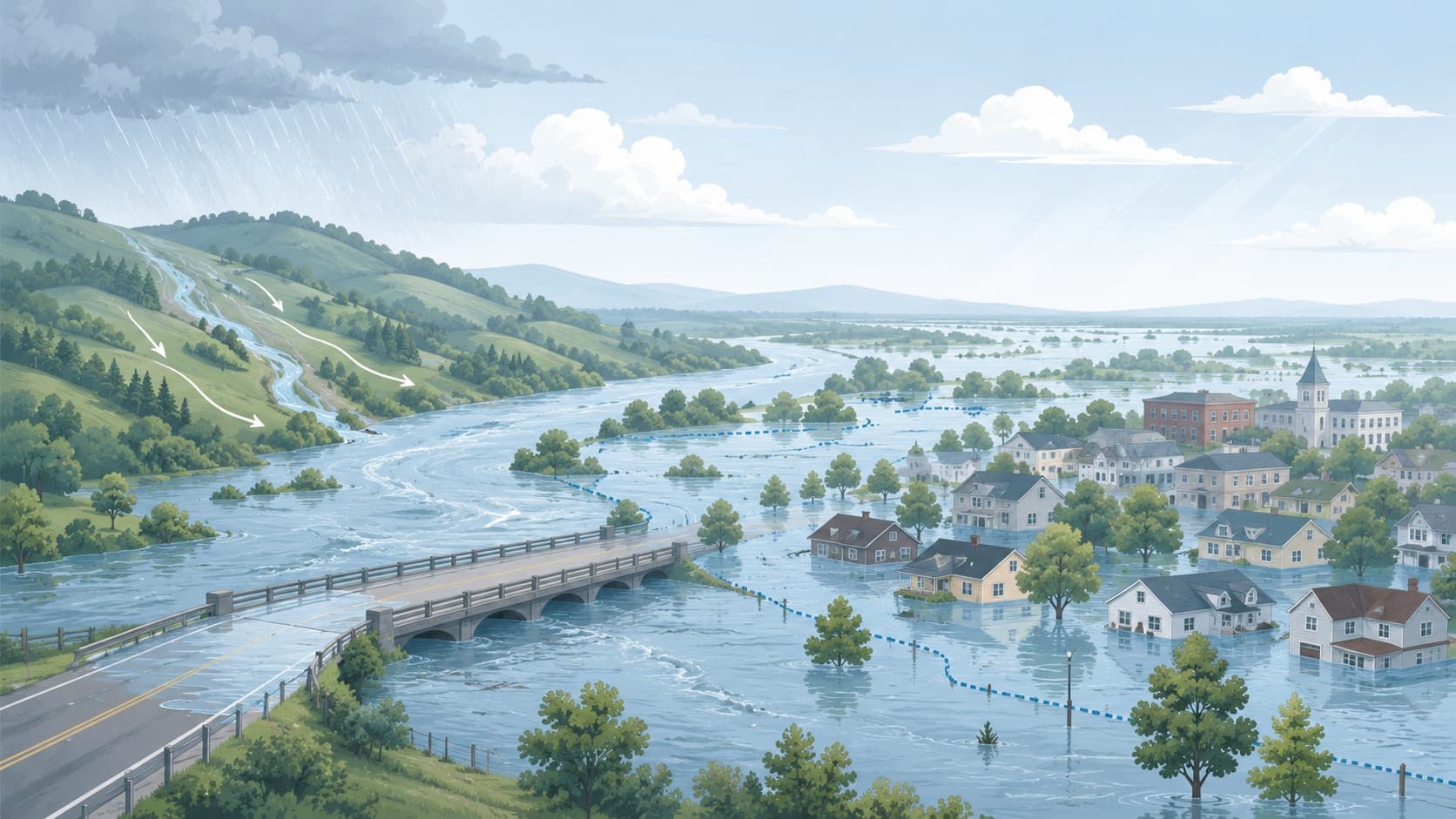
Floods happen when water covers land that is normally dry. They can develop slowly over days or weeks, or they can rise in minutes. Flooding may come from heavy rain, overflowing rivers, storm surge, melting snow, ice jams, broken dams or levees, poor drainage, or a combination of several causes.
Floods are one of the most common natural hazards because water is part of almost every weather system and every landscape. A flood is not just “too much water.” It is the result of how rainfall, soil, rivers, land shape, drainage systems, tides, and human development all interact.
Preparedness note: This page is educational. For an active flood threat, follow local emergency management, the National Weather Service, official alerts, road closure notices, and local instructions.
What Is a Flood?
A flood is an overflow of water onto land that is usually dry. Flooding can occur when rain falls faster than the ground can absorb it, when rivers rise above their banks, when coastal water is pushed inland, or when built systems such as drains, dams, or levees are overwhelmed.
NOAA’s National Severe Storms Laboratory explains that flash floods can happen when heavy rainfall exceeds the ground’s ability to absorb water, fills normally dry creeks or streams, or causes water to collect faster than drainage systems can remove it. (NOAA National Severe Storms Laboratory)
Floods can be shallow or deep, slow or fast, local or widespread. Some floods affect a single street after a storm drain backs up. Others cover entire river valleys after days of rain.
Why Floods Matter
Floods can damage homes, roads, bridges, farms, utilities, vehicles, and public buildings. They can also interrupt transportation, drinking water, power, communications, and emergency services.
Floodwater is especially dangerous because it can hide washed-out roads, sharp debris, open drains, contamination, unstable ground, or moving currents. Fast-moving water can be much stronger than it looks.
Flooding is also not limited to places near rivers or coastlines. Urban neighborhoods, desert washes, mountain valleys, burned hillsides, and low-lying roads can all flood under the right conditions.
The Basic Science of Flooding
Flooding begins with a simple question:
Where does the water go?
When rain or melting snow reaches the ground, several things can happen:
- Some water soaks into the soil.
- Some water evaporates.
- Some water is taken up by plants.
- Some water flows downhill as runoff.
- Some water enters streams, rivers, lakes, drains, or reservoirs.
A flood becomes more likely when water enters an area faster than it can leave.
Key Flood Science Terms
| Term | Plain-English Meaning |
|---|---|
| Watershed | An area of land where water drains toward the same river, lake, bay, or low point |
| Runoff | Water that flows over the land surface instead of soaking into the ground |
| Infiltration | Water soaking into soil |
| Saturated soil | Soil that is already full of water and cannot absorb much more |
| Streamflow | The amount of water flowing in a stream or river |
| Discharge | The volume of water moving past a point in a river, often measured in cubic feet per second |
| River stage | The height of the water surface at a specific river gauge |
| Floodplain | Low land near a river or stream that can flood |
| Flash flood | A rapid flood that develops quickly, often from intense rainfall |
| Storm surge | Coastal water pushed inland by a storm |
| Inundation | Flooding of normally dry land |
The Water Cycle and Floods
Flooding is part of the larger water cycle, also called the hydrologic cycle.
The water cycle includes:
- Evaporation: Liquid water becomes water vapor.
- Condensation: Water vapor forms clouds.
- Precipitation: Rain, snow, sleet, or hail falls.
- Infiltration: Water soaks into the ground.
- Runoff: Water flows across land.
- Storage: Water collects in rivers, lakes, reservoirs, groundwater, ice, or oceans.
Floods usually happen when part of the water cycle speeds up or becomes unbalanced. For example, a thunderstorm may drop rain faster than soil and storm drains can handle, or a long wet period may saturate the ground so that new rain quickly becomes runoff.
Main Types of Floods
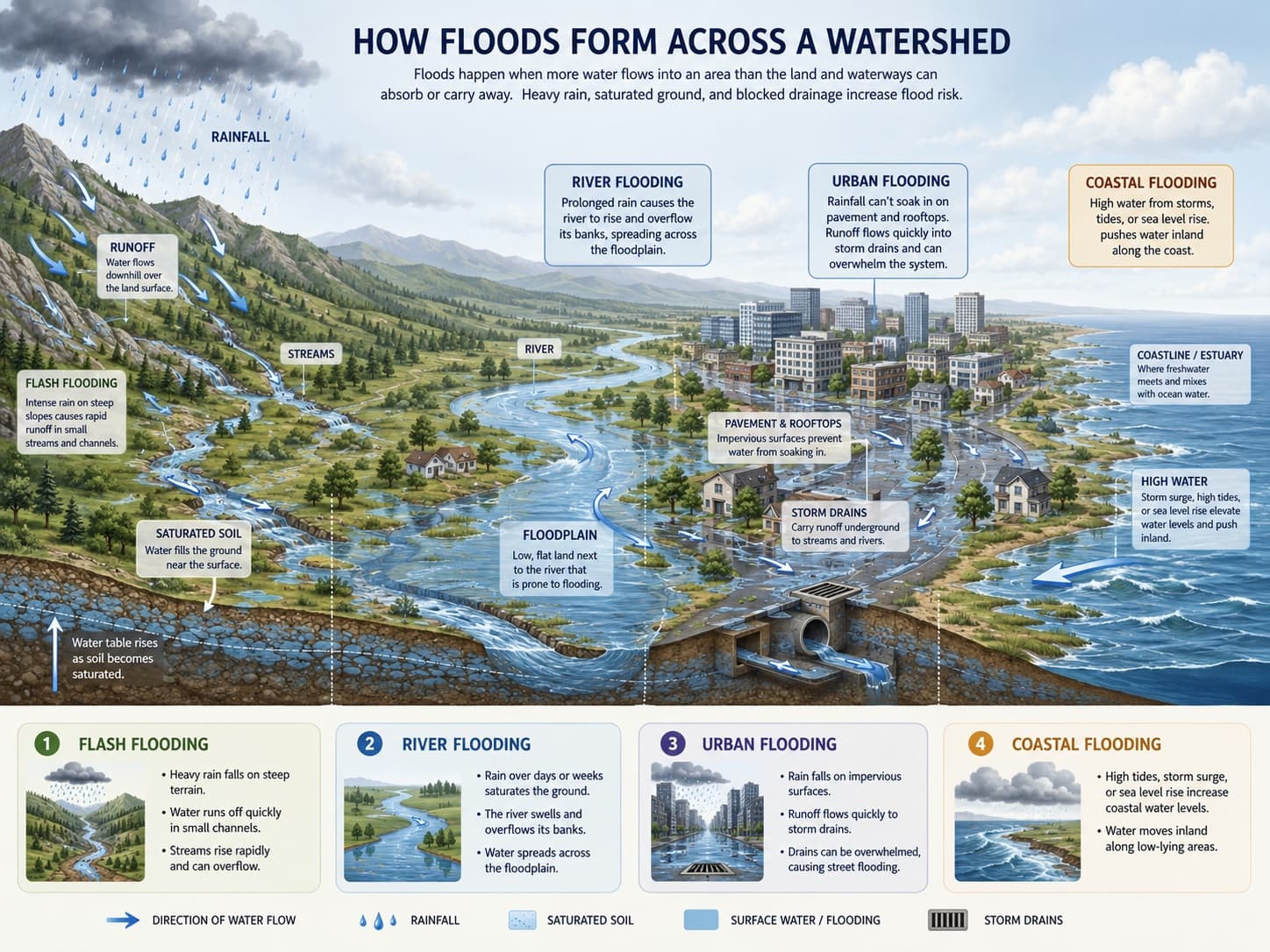
Floods are often grouped by where they happen and what causes them.
| Flood Type | Main Cause | Typical Speed | Common Locations |
|---|---|---|---|
| River flood | Rivers or streams rise over their banks | Slow to moderate | River valleys, floodplains |
| Flash flood | Intense rain or sudden water release | Very fast | Small streams, urban streets, canyons, low-water crossings |
| Urban flood | Rain overwhelms pavement, drains, or sewers | Fast to moderate | Cities, suburbs, roads, underpasses |
| Coastal flood | Ocean, bay, or lake water moves inland | Moderate to fast | Coastlines, bays, tidal rivers |
| Storm surge flood | Storm winds push seawater inland | Moderate to fast | Coastal zones during tropical or coastal storms |
| Snowmelt flood | Melting snow adds water to rivers | Slow to moderate | Cold regions, mountain watersheds |
| Ice jam flood | Ice blocks a river and backs up water | Fast or sudden | Cold-region rivers |
| Dam or levee-related flood | Water is suddenly released or protection fails | Fast to very fast | Downstream areas |
| Groundwater flood | Water table rises above the surface or into basements | Slow | Low-lying areas, places with shallow groundwater |
NOAA defines flash flooding as flooding caused by heavy or excessive rainfall over a short period, generally less than six hours, though it can also happen after dam or levee failure or a sudden release caused by debris or ice. (NOAA National Severe Storms Laboratory)
River Floods
A river flood happens when a river or stream carries more water than its channel can hold. The extra water spreads onto nearby low land called the floodplain.
River floods often develop after:
- Several days of steady rain
- Heavy rain over a large watershed
- Rain falling on already saturated soil
- Snowmelt
- Ice jams
- Water released from reservoirs
- Multiple storms close together
River floods can be easier to forecast than flash floods because water often takes time to move downstream. However, river flood behavior depends on the size of the watershed, the amount of rain, soil conditions, land slope, and river shape.
Flash Floods
Flash floods are fast-developing floods. They can happen within minutes or hours of heavy rain.
Flash floods are especially likely when:
- Rainfall is very intense
- The ground is already wet
- The ground is dry, hard, or unable to absorb water quickly
- Rain falls on steep terrain
- Water is funneled into narrow valleys, canyons, or small streams
- Pavement prevents water from soaking in
- Storm drains are blocked or overwhelmed
- A dam, levee, debris jam, or ice jam suddenly releases water
Flash floods can be dangerous because they leave little time to react. A small creek can become a fast-moving channel, and a low road crossing can become unsafe quickly.
Urban Floods
Urban flooding happens when rain falls faster than a built environment can drain it.
Cities and suburbs have many hard surfaces:
- Roads
- Parking lots
- Roofs
- Sidewalks
- Driveways
- Compacted soil
These surfaces reduce infiltration and increase runoff. Water moves quickly into gutters, storm drains, ditches, and low spots. If the drainage system cannot handle the water, streets, underpasses, basements, and buildings may flood.
Urban floods can happen far from major rivers. A neighborhood can flood simply because rainfall intensity exceeds drainage capacity.
Coastal Floods
Coastal flooding occurs when ocean, bay, lake, or tidal water moves onto normally dry land.
Causes include:
- Storm surge
- High tides
- Strong onshore winds
- Large waves
- Coastal storms
- Sea level rise
- Heavy rainfall that cannot drain because tides are high
Coastal flooding can occur during hurricanes, nor’easters, tropical storms, strong winter storms, or even sunny-day high tide events in some places.
Storm Surge Flooding
Storm surge is an abnormal rise of water caused by a storm. It is different from normal tide. When storm surge combines with the tide, the total water level is called storm tide.
| Term | Meaning |
|---|---|
| Storm surge | Extra water pushed toward land by a storm |
| Tide | Regular rise and fall of ocean water caused mainly by the moon and sun |
| Storm tide | Storm surge plus the normal tide |
| Wave runup | Waves pushing water even higher onto shore |
| Coastal inundation | Coastal water covering normally dry land |
Storm surge depends on storm size, wind speed, forward speed, angle of approach, coastline shape, seafloor shape, and tide timing. A large storm can create serious surge even if its wind category is not the highest.
Snowmelt Floods
Snowmelt flooding happens when stored winter snow melts and flows into streams and rivers.
It is more likely when:
- A large snowpack builds during winter
- Temperatures warm quickly
- Warm rain falls on snow
- Soil is frozen or saturated
- Rivers are already high
- Ice blocks river channels
Snowmelt floods may develop more slowly than flash floods, but they can affect large areas.
Ice Jam Floods
An ice jam forms when chunks of river ice pile up and block the flow of water. Water can back up behind the ice and flood upstream areas. If the ice jam suddenly breaks, water can rush downstream quickly.
Ice jams are difficult because they can change suddenly. They often happen during freeze-thaw periods when river ice weakens, breaks, and moves.
Dam and Levee-Related Floods
Dams and levees are built to manage or hold back water. They can reduce some flood risks, but they do not remove risk completely.
Flooding can happen when:
- A dam releases water to protect the structure
- A spillway carries excess water
- A levee is overtopped
- A levee is damaged
- A dam or levee fails
- Water seeps under or through a structure
Dam or levee-related flooding can be sudden. People in areas downstream or behind levees should follow local emergency instructions and official alerts.
Groundwater Floods
Groundwater flooding happens when the water table rises close to or above the ground surface. It can also enter basements, crawlspaces, or underground structures.
This type of flooding often develops more slowly than flash flooding. It may follow long wet periods, snowmelt, or repeated storms. Because the source is underground, water can remain after surface rain has stopped.
How Rain Becomes a Flood
Rain does not automatically create a flood. The outcome depends on how quickly water enters the system and how quickly it can drain away.
| Factor | How It Affects Flooding |
|---|---|
| Rainfall intensity | Heavy rain in a short time creates fast runoff |
| Rainfall duration | Long-lasting rain can saturate soil and raise rivers |
| Soil moisture | Wet soil absorbs less additional water |
| Soil type | Clay soils absorb water more slowly than sandy soils |
| Slope | Steep land moves water downhill faster |
| Vegetation | Plants slow runoff and help water soak in |
| Pavement | Hard surfaces increase runoff |
| River shape | Narrow or shallow channels overflow more easily |
| Drainage systems | Blocked or undersized drains increase local flooding |
| Tide level | High tide can slow drainage near coasts |
| Snowpack | Melting snow adds water to rivers |
| Burn scars | Areas burned by wildfire may shed water quickly and produce debris flows |
Floodplains
A floodplain is the low, flat area near a river, stream, lake, or coast that can flood. Floodplains exist because rivers naturally spread out during high-water periods.
Floodplains can be beneficial because they:
- Store excess water
- Slow floodwater
- Recharge groundwater
- Support wetlands and wildlife
- Spread sediment and nutrients
However, buildings and roads in floodplains can be exposed to flooding. Development can also reduce the natural storage space that floodplains provide.
What Does “100-Year Flood” Mean?
A “100-year flood” does not mean a flood happens only once every 100 years. FEMA explains that the 100-year floodplain is more accurately called the 1-percent annual chance floodplain, meaning there is a 1 percent chance of that level of flooding being equaled or exceeded in any given year. (floodmaps.fema.gov)
| Common Phrase | Better Meaning |
|---|---|
| 100-year flood | A flood level with a 1% chance of being equaled or exceeded in any year |
| 500-year flood | A flood level with a 0.2% chance of being equaled or exceeded in any year |
| Annual chance | The probability of a flood level happening in a single year |
| Flood risk | The chance of flooding over time, not just in one year |
Because probability resets each year, a place can experience more than one “100-year flood” within a short period.
Flood Watches, Warnings, and Advisories
Flood alerts are issued to communicate different levels of concern.
| Alert Type | General Meaning |
|---|---|
| Flood Watch | Conditions are favorable for flooding; flooding is possible |
| Flood Warning | Flooding is imminent or already occurring |
| Flash Flood Warning | Rapidly rising water poses an immediate hazard |
| Flood Advisory | Minor flooding or nuisance flooding is occurring or expected |
The National Weather Service explains that a Flood Warning means flooding is imminent or occurring, while a Flood Watch means conditions are favorable and flooding is possible. (National Weather Service)
For an active alert, people should use official local instructions, because flood impacts vary by location.
How Flood Forecasting Works
Flood forecasting combines weather science and water science.
Meteorologists forecast the weather. Hydrologists forecast how water will move through the landscape.
A simplified flood forecast process looks like this:
- Observe current conditions
- Rainfall
- * River levels
- * Soil moisture
- * Snowpack
- * Reservoir levels
- * Tide levels
- Forecast future weather
- How much rain may fall
- * Where it may fall
- * How intense it may be
- * How long it may last
- Estimate runoff
- How much water will soak in?
- * How much will flow over land?
- * How fast will it reach streams?
- Model river response
- How high will rivers rise?
- * When will the crest arrive?
- * Which areas may flood?
- Communicate uncertainty
- Forecasts include timing, location, severity, and confidence.
Flood forecasting is difficult because a small change in rainfall location or intensity can change which stream or neighborhood floods.
Tools Used to Detect and Forecast Floods
Modern flood forecasting uses many tools at once.
| Tool | What It Measures or Shows | Why It Helps |
|---|---|---|
| Rain gauges | Rainfall at specific locations | Provides direct local measurements |
| Weather radar | Rainfall intensity and storm movement | Shows where heavy rain is falling between gauges |
| Streamgages | River height and flow | Shows how rivers are responding |
| Soil moisture sensors | How wet the ground is | Helps estimate how much rain will become runoff |
| Snow sensors | Snow depth and water content | Helps forecast snowmelt floods |
| Satellites | Rain, clouds, surface water, soil moisture, snow, land cover | Provides wide-area views, including remote regions |
| Tide gauges | Coastal water levels | Helps monitor coastal flooding |
| Computer models | Future rainfall, runoff, river flow, and inundation | Helps forecast what may happen next |
| GIS maps | Floodplain and elevation data | Helps show where water may spread |
| Cameras and reports | Real-world confirmation | Helps verify what models and sensors suggest |
Streamgages: Measuring Rivers in Real Time
A streamgage is a monitoring station placed along a river or stream. It measures water level, and many streamgages estimate streamflow.
USGS streamgages provide important information used by water managers, emergency responders, utilities, environmental agencies, researchers, and the public. (USGS)
The USGS operated more than 12,000 continuous surface-water monitoring locations across the United States in 2024, and about 90 percent of USGS streamgages provide streamflow information in real time on the web. (USGS)
Streamgages help answer questions such as:
- How high is the river now?
- Is the river rising or falling?
- How fast is water moving?
- Has the river reached flood stage?
- When might the river crest?
- How does this flood compare with past floods?
Weather Radar and Flood Detection
Weather radar sends out energy pulses and measures what returns from raindrops, snowflakes, hail, and other particles. Radar helps meteorologists see where precipitation is falling and how intense it is.
Radar is especially useful for flash flooding because it can show intense rainfall over small areas, even where there are few rain gauges.
However, radar has limits:
- It estimates rainfall indirectly.
- Mountains can block radar beams.
- Heavy rain can affect the signal.
- Radar beams rise higher above the ground with distance.
- Rainfall may vary sharply over short distances.
Forecasters often combine radar with rain gauges to improve rainfall estimates.
Satellites and Flood Mapping
Satellites help scientists monitor floods from above. They can show clouds, rainfall, snow cover, soil moisture, land changes, and flood extent.
NASA explains that flood-related satellite data can help predict flood occurrence, calculate flood extent, and support response planning. (NASA Earthdata)
Different satellite tools have different strengths:
| Satellite Type | What It Can Help With | Main Strength |
|---|---|---|
| Optical imagery | Visible images of flooded land | Easy to interpret when skies are clear |
| Infrared imagery | Cloud-top temperature and storm structure | Useful day and night for weather systems |
| Microwave sensors | Rainfall, soil moisture, ocean and land surface data | Can provide data through some cloud conditions |
| Synthetic Aperture Radar, or SAR | Water extent and surface changes | Can observe at night and through clouds |
| Altimetry | Water surface height | Useful for rivers, lakes, reservoirs, and oceans |
Synthetic Aperture Radar is especially useful for flood mapping because it can work through clouds and does not need sunlight. This matters because floods often happen during cloudy storms.
Computer Models: Turning Data Into Forecasts
Flood models are computer programs that simulate how water moves. They use math, physics, maps, and observations.
There are two major model types:
| Model Type | Main Question | Example |
|---|---|---|
| Hydrologic model | How much water will become runoff and enter streams? | Rain falls on a watershed and flows into a river |
| Hydraulic model | Where will water go once rivers, channels, or coastal waters rise? | A river rises and spreads across a floodplain |
A hydrologic model is like estimating how much water enters a bathtub. A hydraulic model is like estimating where the water spills once the bathtub overflows.
Flood models often use:
- Rainfall forecasts
- Soil moisture
- Land cover
- Slope
- River channels
- Reservoirs
- Snowpack
- Elevation data
- Drainage systems
- Historical streamflow
- Tide or storm surge data near coasts
NOAA’s National Water Model
NOAA’s National Water Model is a major modern flood forecasting tool. It uses weather model data and hydrologic science to simulate streamflow and other water conditions across many waterways.
NOAA’s National Water Prediction Service provides water forecast information and flood inundation mapping products. NOAA states that its flood inundation mapping services are available for 60 percent of the U.S. population. (National Water Prediction Service)
Flood inundation mapping is important because it can help show not only that a river may flood, but where water may spread on the landscape.
Flood Inundation Mapping
Flood inundation maps show areas that may be covered by water at different flood levels. These maps can help connect a river gauge reading to real-world impacts.
For example, a river stage number may not mean much to most people. A flood inundation map can show whether water may cover nearby roads, parks, fields, or low-lying neighborhoods.
Flood inundation mapping often uses:
- River stage data
- Elevation models
- Hydraulic models
- Floodplain maps
- Real-time streamgage readings
- Forecast river levels
- GIS mapping tools
USGS describes its Flood Inundation Mapping Program as providing tools and information to help communities understand local flood risks. (USGS)
How Flood Forecasting Technology Has Changed Over Time
Flood forecasting has changed from local observation and simple river measurements to a connected system of sensors, satellites, computer models, and digital maps.
| Era | Main Technology | What Changed |
|---|---|---|
| Before modern instruments | Local knowledge, river marks, weather signs, simple observation | People judged floods from experience, visible water levels, and past high-water marks |
| 1800s | Early rain gauges, river gauges, telegraph communication | River and rainfall data could be measured and shared more widely |
| Late 1800s–early 1900s | Organized streamgaging networks | Systematic river measurements helped compare floods over time; USGS notes early streamgaging efforts began in the late 1800s (USGS) |
| Mid-1900s | Weather radar, improved river forecasting, telephone and radio alerts | Forecasters could track storms and communicate warnings faster |
| 1960s–1970s | Weather satellites, early computer models | Scientists gained broader views of storms, snow cover, and large weather patterns |
| 1980s–1990s | Doppler radar, better hydrologic models, digital databases | Rainfall estimates and river forecasts improved |
| 2000s | GIS mapping, higher-resolution elevation data, web-based stream data | Flood information became easier to map and share publicly |
| 2010s | National-scale water modeling, improved satellites, mobile alerts | Forecasting became more detailed, connected, and accessible |
| 2020s | Flood inundation mapping, machine learning, remote sensing fusion, cloud computing | Forecasters can combine many datasets and produce more visual, location-based flood information |
From River Marks to Real-Time Data
Historically, people often recorded floods by marking water levels on buildings, bridges, trees, or riverbanks. These high-water marks were useful, but they were mostly local and backward-looking.
Today, flood monitoring can include:
- Real-time river gauges
- Radar rainfall estimates
- Satellite rainfall data
- Soil moisture observations
- Snowpack sensors
- Tide gauges
- Reservoir sensors
- Digital elevation models
- Forecast models
- Automated alerts
This does not make flood forecasting perfect, but it gives forecasters a much clearer picture than earlier generations had.
How Elevation Data Improved Flood Science
Flood mapping depends heavily on knowing land elevation. Water flows downhill and collects in low places, so even small elevation differences matter.
Older flood maps often relied on limited surveys and broad estimates. Modern maps can use high-resolution elevation data, including LiDAR, a technology that uses laser pulses from aircraft or drones to measure the ground surface.
LiDAR can help identify:
- Low-lying roads
- Riverbanks
- levees
- drainage paths
- shallow depressions
- floodplain boundaries
- coastal elevation changes
Better elevation data helps scientists model where floodwater may spread.
The Role of GIS in Flood Mapping
GIS stands for Geographic Information System. It is software used to store, analyze, and display map-based information.
Flood-related GIS layers may include:
- Rivers and streams
- Watershed boundaries
- Elevation
- Land use
- Soil type
- Roads and bridges
- Buildings
- Floodplains
- Rainfall
- Streamgage locations
- Forecast inundation areas
GIS helps turn raw data into maps that people can understand.
Artificial Intelligence and Machine Learning
Artificial intelligence and machine learning are increasingly used in flood science, especially for pattern recognition and large datasets.
Potential uses include:
- Detecting flooded areas from satellite images
- Estimating flood extent where gauges are limited
- Improving rainfall-runoff predictions
- Identifying flood-prone road segments
- Combining sensor, radar, satellite, and model data
- Rapidly classifying damage or water extent from images
AI is not a replacement for official forecasts or expert judgment. It is another tool that can help process large amounts of information.
Recent research has shown growing use of deep learning with Sentinel-1 Synthetic Aperture Radar data for flood detection, because SAR can observe the surface even when clouds are present. (Springer Link)
Why Flood Forecasting Is Difficult
Flood forecasting is challenging because many variables interact.
| Challenge | Why It Matters |
|---|---|
| Rainfall location | A storm shifting a few miles can affect a different creek or neighborhood |
| Rainfall intensity | Short bursts of heavy rain can overwhelm drainage quickly |
| Soil moisture | Wet ground produces more runoff |
| Land use | Pavement and compacted soil change water flow |
| Terrain | Steep slopes speed up runoff |
| Small watersheds | Small streams can rise very quickly |
| Blocked drains | Local flooding may occur even if regional forecasts are accurate |
| River timing | Water from different tributaries may arrive at the same time |
| Coastal tides | High tide can slow river drainage near the coast |
| Human systems | Reservoir operations, levees, culverts, and drainage networks affect outcomes |
A forecast may correctly predict heavy rain over a county but still be uncertain about which exact streets or streams will flood.
Floods and Climate Change
A warmer atmosphere can hold more moisture, which can lead to heavier precipitation events in some situations. EPA explains that extreme precipitation occurs when a location receives much more rain or snow than normal during a short period, and what counts as extreme depends on location and season. (US EPA)
NOAA notes that sudden heavy rainfall can exceed stormwater drainage capacity and lead to flooding that disrupts highways, transportation routes, and businesses. (NOAA)
Climate change does not mean every flood has one simple cause. Flooding depends on rainfall, land use, drainage, soil moisture, rivers, tides, development, and local geography. But heavier rainfall, sea level rise, and changing storm patterns can increase some flood risks.
| Climate-Related Factor | How It Can Affect Flooding |
|---|---|
| Warmer air | Can hold more moisture, supporting heavier rainfall |
| Heavier downpours | Can increase flash flooding and urban flooding |
| Sea level rise | Raises the starting water level for coastal flooding |
| Warmer winters | Can change snowpack, snowmelt timing, and rain-on-snow events |
| More intense storms in some regions | Can increase runoff and drainage stress |
| Land-use change | Development in flood-prone areas can increase exposure |
The practical lesson is that flood risk changes over time. A map, drainage system, or past experience may not fully describe future risk.
Natural Landscapes That Reduce Flooding
Some natural features help slow, store, or absorb water.
| Natural Feature | Flood Benefit |
|---|---|
| Wetlands | Store water and slow runoff |
| Forests | Intercept rainfall and improve infiltration |
| Floodplains | Give rivers room to spread during high flows |
| Healthy soils | Absorb and hold more water |
| Dunes and marshes | Reduce some coastal flood impacts |
| Vegetated slopes | Slow runoff and reduce erosion |
When natural storage areas are filled, paved, drained, or disconnected from rivers, water may move faster into developed areas.
Human Changes That Can Increase Flooding
Human development can change how water moves.
Examples include:
- Paving over land
- Building in floodplains
- Straightening streams
- Removing wetlands
- Undersizing culverts or drains
- Blocking natural drainage paths
- Compacting soil
- Removing vegetation
- Building levees that shift risk downstream
- Expanding development into low-lying areas
Flood risk is not only a weather issue. It is also a land-use, engineering, and planning issue.
Flood Maps and Risk Information
Flood maps help identify areas with different levels of flood risk. FEMA’s Flood Map Service Center is the official public source for flood hazard information produced for the National Flood Insurance Program. (FEMA Flood Map Service Center)
Flood maps are useful, but they have limits:
- They may not show every possible flood source.
- They may not fully represent very local drainage problems.
- They may not reflect future development or future climate conditions.
- They can be updated as better data becomes available.
- Flooding can happen outside mapped high-risk zones.
A flood map is a starting point for understanding risk, not a guarantee that flooding will or will not happen.
Flood Safety Science: Why Moving Water Is So Strong
Water is heavy. One cubic foot of water weighs about 62 pounds. When water moves, it carries force. The faster and deeper it gets, the stronger it becomes.
Moving floodwater can:
- Push vehicles
- Knock people off balance
- Lift loose objects
- Undermine roadbeds
- Erode streambanks
- Break pavement
- Move debris
Floodwater can also hide hazards. A road may look passable while the base underneath has been washed away.
For safety during real events, follow official instructions and never use this educational page as a substitute for emergency guidance.
Comparing Flood Types by Warning Time
| Flood Type | Typical Warning Time | Why |
|---|---|---|
| Flash flood | Minutes to hours | Small watersheds respond quickly to heavy rain |
| Urban flood | Minutes to hours | Drainage systems can be overwhelmed quickly |
| River flood | Hours to days | Water often takes time to move downstream |
| Snowmelt flood | Days to weeks | Snowpack and temperature trends can be monitored |
| Coastal flood | Hours to days | Tides, winds, surge, and waves can often be forecast |
| Ice jam flood | Minutes to hours | Ice blockages and breaks can change suddenly |
| Dam or levee-related flood | Minutes to hours | Sudden releases or failures can happen quickly |
| Groundwater flood | Days to weeks | Water tables usually rise more slowly |
Comparing Flood Forecast Tools
| Tool | Best For | Main Limitation |
|---|---|---|
| Rain gauges | Exact rainfall at one point | Misses rain between gauges |
| Radar | Mapping rainfall over wide areas | Estimates rainfall indirectly |
| Streamgages | Measuring river response | Only measures specific locations |
| Satellites | Large-area monitoring | Some sensors affected by clouds or revisit time |
| SAR satellites | Flood extent through clouds and at night | Interpretation can be complex, especially in cities |
| Hydrologic models | Estimating runoff and streamflow | Depends on rainfall forecast and soil data |
| Hydraulic models | Mapping inundation areas | Needs detailed elevation and channel data |
| Flood maps | Understanding long-term risk | May not show every local or future condition |
| Human reports | Confirming real-world impacts | Can be incomplete or delayed |
Common Flood Misunderstandings
| Misunderstanding | Better Explanation |
|---|---|
| “I’m not near a river, so I can’t flood.” | Urban flooding, flash flooding, poor drainage, and groundwater flooding can happen away from rivers. |
| “A 100-year flood happens only once every 100 years.” | It means a 1% chance in any given year, not a fixed schedule. |
| “Floodwater is just rainwater.” | Floodwater can contain debris, chemicals, sewage, sharp objects, and hidden hazards. |
| “A shallow flooded road is safe.” | The road surface may be damaged or missing, and moving water can be stronger than it looks. |
| “Flood maps show every possible flood.” | Maps are useful, but flooding can happen outside mapped zones. |
| “The rain stopped, so the flood is over.” | Rivers may continue rising after rain ends, especially downstream. |
| “Only major storms cause floods.” | Slow storms, stalled thunderstorms, snowmelt, drainage problems, and high tides can also cause flooding. |
Science Summary
Floods happen when water reaches land faster than it can soak in, drain away, flow downstream, or be safely stored. The same rainfall can produce different flooding depending on soil, slope, pavement, rivers, vegetation, drainage systems, snowpack, tides, and previous weather.
Some floods rise slowly, especially large river floods. Others, such as flash floods and urban floods, can rise quickly. Coastal flooding depends on tides, waves, wind, storm surge, and sea level. Snowmelt and ice jams add seasonal flood risks in colder regions.
Flood forecasting has changed dramatically over time. What once depended mostly on local observations and river marks now uses rain gauges, radar, satellites, streamgages, tide gauges, soil and snow sensors, computer models, GIS maps, high-resolution elevation data, flood inundation maps, and sometimes machine learning.
Even with advanced technology, floods remain difficult to forecast exactly because rainfall and runoff can vary sharply over short distances. The best understanding comes from combining weather forecasts, river data, flood maps, local conditions, and official alerts.