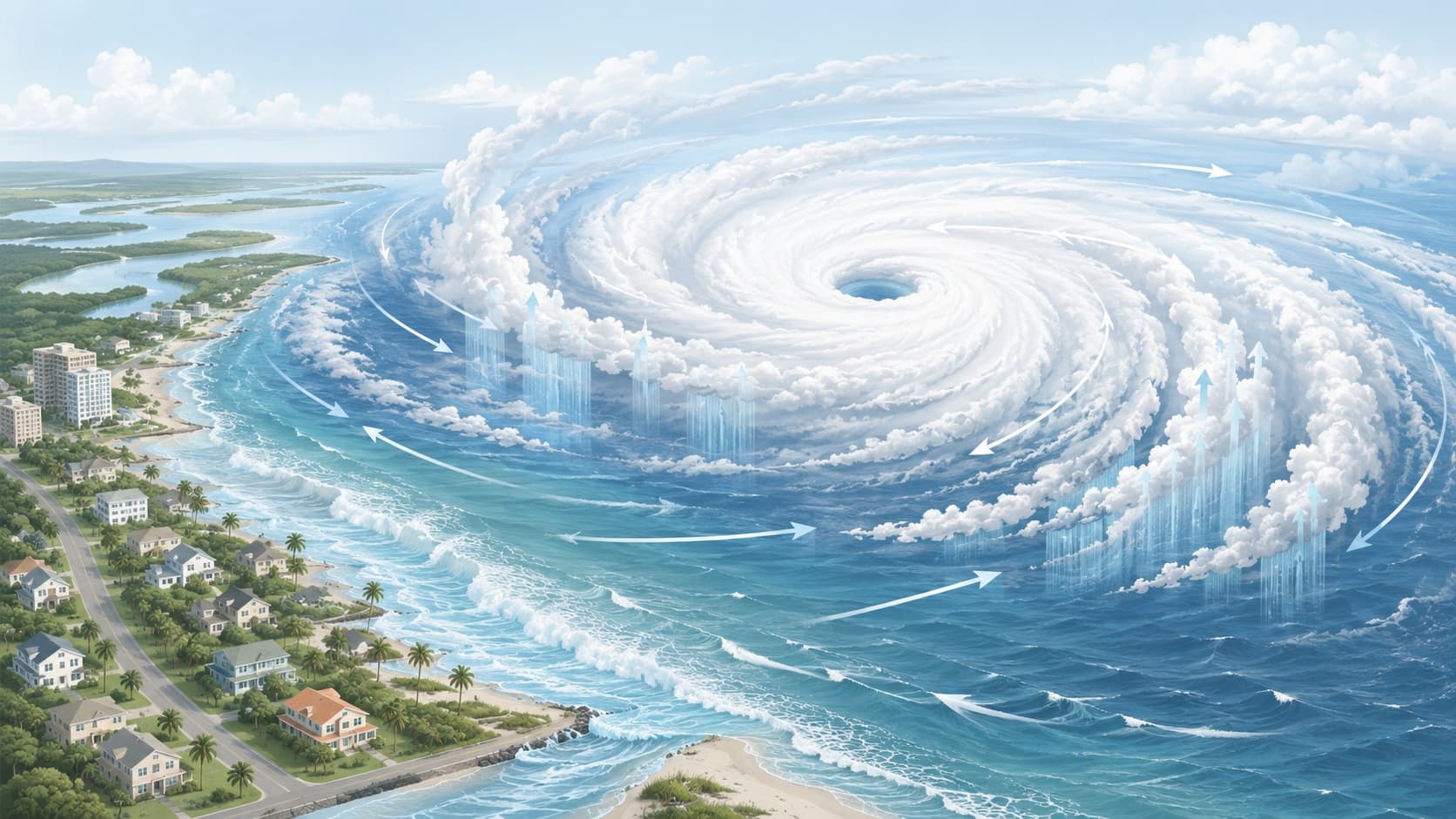
Hurricanes are large rotating storm systems that form over warm tropical or subtropical ocean water. They are called hurricanes in the Atlantic and parts of the eastern and central Pacific, typhoons in the western North Pacific, and tropical cyclones in some other parts of the world. The names are different, but the basic storm type is the same: a powerful low-pressure system with organized thunderstorms and strong rotating winds.
This page explains hurricanes at a high school science level: what they are, how they form, why they strengthen, what hazards they bring, and how modern technology helps forecasters detect and predict them.
Preparedness note: This page is educational. For an active storm, use official alerts from local emergency management, the National Weather Service, the National Hurricane Center, and local officials.
What Is a Hurricane?
A hurricane is a type of tropical cyclone. A tropical cyclone is a rotating storm system that forms over warm ocean water, has a closed circulation near the surface, and is powered by heat and moisture from the ocean. When maximum sustained winds reach 74 mph or higher, the storm is classified as a hurricane.
A simple way to picture a hurricane is as a giant heat engine:
- Warm ocean water evaporates.
- Warm, moist air rises.
- Rising air cools and condenses into clouds and rain.
- Condensation releases heat.
- That heat helps lower pressure and strengthen rising motion.
- More air rushes inward, rises, and keeps the storm going.
The storm can continue strengthening as long as it has the right ingredients: warm ocean water, moist air, low wind shear, and enough spin from Earth’s rotation.
Hurricane Classification
Meteorologists classify tropical systems by wind speed. These wind speeds are based on maximum sustained surface winds, which means the strongest average wind over a short period, not the strongest gust.
| Stage | Maximum Sustained Wind | What It Means |
|---|---|---|
| Tropical disturbance | Not yet a tropical cyclone | An organized area of clouds and thunderstorms that may or may not develop |
| Tropical depression | 38 mph or less | A tropical cyclone with a closed circulation but relatively weak winds |
| Tropical storm | 39–73 mph | A stronger tropical cyclone; this is when storms usually receive names |
| Hurricane | 74 mph or higher | A tropical cyclone with hurricane-force winds |
| Major hurricane | Category 3 or higher | A hurricane with winds of at least 111 mph |
The Saffir-Simpson Hurricane Wind Scale rates hurricanes from Category 1 to Category 5 based only on wind speed. It does not measure storm surge, rainfall flooding, tornadoes, or the total size of the storm. (National Hurricane Center)
| Category | Sustained Wind Speed | General Meaning |
|---|---|---|
| Category 1 | 74–95 mph | Very dangerous winds; some damage possible |
| Category 2 | 96–110 mph | Extremely dangerous winds; extensive damage possible |
| Category 3 | 111–129 mph | Major hurricane; devastating wind damage possible |
| Category 4 | 130–156 mph | Catastrophic wind damage possible |
| Category 5 | 157 mph or higher | Catastrophic wind damage possible |
A lower-category hurricane can still be extremely dangerous if it brings major storm surge, slow-moving rainfall, river flooding, or tornadoes. A category number is useful, but it is not the whole story.
The Ingredients Hurricanes Need
Hurricanes do not form just anywhere. They need several conditions to come together.
| Ingredient | Why It Matters |
|---|---|
| Warm ocean water | Hurricanes draw energy from warm water. NOAA describes water of at least about 26.5°C, or 80°F, over a sufficient depth as an important hurricane ingredient. (National Ocean Service) |
| Moist air | Moisture feeds thunderstorms. When water vapor condenses into cloud droplets, it releases heat that helps power the storm. |
| Pre-existing disturbance | Many hurricanes begin as tropical waves or clusters of thunderstorms. |
| Low vertical wind shear | Wind shear means wind changes speed or direction with height. Strong shear can tilt or tear apart developing storms. |
| Coriolis effect | Earth’s rotation helps storms spin. This is why hurricanes usually do not form right at the equator. |
| Unstable atmosphere | Warm air near the surface and cooler air above help air rise, forming deep thunderstorms. |
Think of these ingredients like parts of a recipe. Warm water is the fuel, thunderstorms are the engine, and low wind shear gives the storm a chance to organize.
How Hurricanes Form
Most hurricanes begin as ordinary-looking clusters of thunderstorms over tropical ocean water. Over time, some of these clusters become more organized.
1. A disturbance forms
A tropical disturbance may begin as a tropical wave, a broad area of low pressure, or a group of thunderstorms. At this point, the system may look messy and disorganized.
2. Air begins to rise
Warm ocean water evaporates into the air. That warm, moist air rises because it is less dense than cooler surrounding air. As it rises, more air moves in near the surface to replace it.
3. Thunderstorms grow
As the rising air cools, water vapor condenses into cloud droplets. This releases heat, which makes the air rise even more. The more rising air there is, the more thunderstorms can grow.
4. Pressure drops
As air rises away from the surface, surface pressure can drop. Lower pressure pulls more air inward. That inward-moving air also begins to rotate because of Earth’s rotation.
5. The storm organizes
If wind shear is low and ocean water remains warm, thunderstorms can wrap around the center. The storm may become a tropical depression, then a tropical storm, and eventually a hurricane.
6. An eye may form
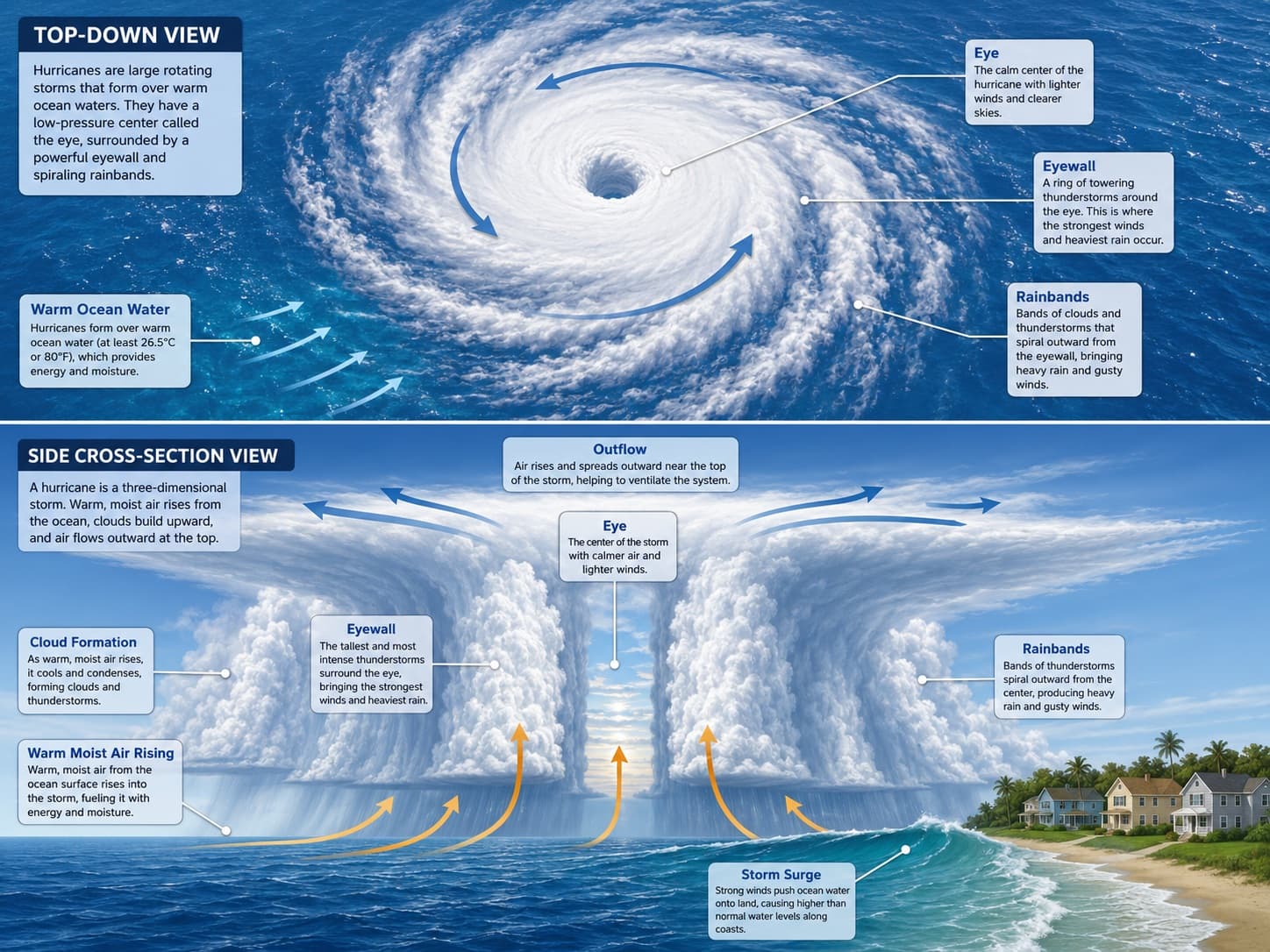
Strong hurricanes often develop an eye, a calmer center surrounded by the intense thunderstorms of the eyewall. The eye forms because air sinks in the center while the strongest rising motion occurs around it. (NOAA)
Main Parts of a Hurricane
NOAA describes the main parts of a tropical cyclone as the rainbands, eye, and eyewall. Air spirals inward near the surface, rises in thunderstorms, and flows outward high in the atmosphere. (NOAA)
| Part | Description | Why It Matters |
|---|---|---|
| Eye | The relatively calm center of a strong hurricane | Conditions can briefly improve if the eye passes over a location, but dangerous winds can return from the opposite direction after the eye passes |
| Eyewall | Ring of intense thunderstorms around the eye | Usually contains the strongest winds and heaviest rain near the center |
| Rainbands | Spiral bands of thunderstorms extending outward | Can produce heavy rain, gusty winds, and tornadoes far from the center |
| Outflow | Air spreading outward high above the storm | Healthy outflow helps air continue rising below, supporting the storm |
| Surface inflow | Air moving inward near the ocean surface | Brings warm, moist air toward the storm’s center |
Why Hurricanes Spin
Hurricanes spin because of the Coriolis effect, which comes from Earth’s rotation. In the Northern Hemisphere, tropical cyclones rotate counterclockwise. In the Southern Hemisphere, they rotate clockwise. (NOAA)
The Coriolis effect is weak near the equator, so hurricanes usually form several degrees away from it. As air rushes inward toward low pressure, Earth’s rotation curves the moving air. Once the storm is organized, this rotation can tighten.
A helpful comparison is a figure skater. When a skater pulls in their arms, they spin faster. In a hurricane, air moving inward toward the center also spins faster as it gets closer to the low-pressure core.
Why Hurricanes Strengthen
A hurricane strengthens when its engine becomes more efficient. That usually means:
- The ocean is warm enough and warm water extends deep below the surface.
- The atmosphere is moist.
- Wind shear is low.
- Air can flow outward at the top of the storm.
- Thunderstorms stay organized around the center.
- Dry air does not disrupt the storm’s core.
The strongest hurricanes often have a clear eye, a symmetric shape, and very intense thunderstorms wrapped around the center. Satellite images can help forecasters judge these features. NOAA notes that stronger hurricanes often appear more circular and organized when wind shear is low, while higher wind shear can distort a storm and push thunderstorms to one side. (NOAA Satellite Services)
Rapid Intensification
Rapid intensification means a tropical cyclone’s maximum sustained winds increase by at least 30 knots in 24 hours. That is about 35 mph in one day.
Rapid intensification is one of the hardest hurricane forecast problems because it can happen quickly. A storm may become much stronger between forecast updates, especially if it crosses very warm water, has low wind shear, and develops a well-organized inner core.
Forecasters watch for signs such as:
- A more circular storm shape
- Very cold cloud tops in satellite imagery
- A forming or clearing eye
- Bursts of lightning near the eyewall
- Falling central pressure
- Stronger winds measured by aircraft or satellites
- Better organization in microwave satellite imagery
Modern satellites, aircraft observations, ocean measurements, and computer models have improved rapid-intensification forecasting, but it remains difficult because small changes inside the storm can make a big difference.
Why Hurricanes Weaken
Hurricanes weaken when their fuel supply or structure is disrupted.
| Weakening Factor | What Happens |
|---|---|
| Land interaction | The storm loses its warm ocean energy source and friction disrupts circulation |
| Cooler water | Less evaporation means less fuel for thunderstorms |
| Dry air | Dry air can weaken thunderstorms and disrupt the storm core |
| Strong wind shear | The storm may tilt, become lopsided, or lose its central thunderstorm structure |
| Eyewall replacement cycles | A new outer eyewall can temporarily weaken the storm before it reorganizes |
| Upwelling | A slow-moving hurricane can churn cooler water to the surface, reducing available heat |
A hurricane can still be dangerous after weakening. Former hurricanes can continue producing heavy rain, strong winds, coastal flooding, and tornadoes even after losing tropical characteristics.
Hurricane Hazards
Hurricanes are multi-hazard events. Wind is only one part of the risk.
| Hazard | What It Is | Why It Matters |
|---|---|---|
| Strong wind | Sustained winds and gusts from the storm circulation | Can damage trees, roofs, power lines, signs, and weak structures |
| Storm surge | Abnormal rise of sea level caused by a storm | Can push water inland along coasts, bays, rivers, and estuaries |
| Heavy rainfall | Large amounts of rain from rainbands and the storm core | Can cause flash flooding, river flooding, and landslides in some regions |
| Tornadoes | Small, fast-developing rotating storms within rainbands | Can occur well away from the eye, especially in outer bands |
| High surf and rip currents | Dangerous waves and currents before, during, and after storms | Can affect beaches far from the storm center |
| Inland flooding | Flooding far from the coast | Slow-moving storms can drop heavy rain over large areas |
Storm surge is especially important because it is not measured by the hurricane category. The NHC defines storm surge as an abnormal rise in sea level caused by a storm, separate from the normal tide.
Storm Surge vs. Storm Tide
These two terms are related but not exactly the same.
| Term | Meaning |
|---|---|
| Storm surge | The extra rise in sea level caused by the storm |
| Storm tide | Storm surge plus the normal astronomical tide |
| Inundation | Flooding of normally dry land |
A storm arriving at high tide can produce worse coastal flooding than the same storm arriving at low tide. The shape of the coastline, depth of the seafloor, storm size, storm angle, and forward speed all affect how much water is pushed inland.
Why Rainfall Can Be Dangerous Far Inland
Hurricane rain does not stop at the beach. Rainbands can move far inland, and a slow-moving storm can rain over the same area for many hours.
Rainfall flooding depends on:
- How fast the storm moves
- How much moisture the storm carries
- Local terrain
- Soil conditions before the storm
- River and drainage conditions
- Urban pavement and drainage limits
A Category 1 hurricane or tropical storm can produce severe inland flooding if it moves slowly and drops a large amount of rain.
Hurricane Season and Where Hurricanes Form
In the Atlantic basin, the official hurricane season runs from June 1 to November 30. The peak of the Atlantic season is around September 10, with most activity usually occurring from mid-August through mid-October. Average activity varies by basin and year. (NOAA)
Hurricanes usually form over warm tropical waters, but they do not all form in the same place. Some begin near Africa as tropical waves and travel westward across the Atlantic. Others form in the Caribbean, Gulf region, or closer to the southeastern United States.
Tropical cyclones forming between about 5° and 30° north latitude often move generally west at first. Later, winds in the middle and upper atmosphere may steer them north, northwest, or northeast. (NOAA)
What Steers a Hurricane?
A hurricane does not choose its own path. It is pushed along by larger wind patterns around it.
Important steering influences include:
- Trade winds: These often push tropical systems from east to west.
- High-pressure ridges: A strong ridge can block a storm from turning north.
- Troughs: Dips in the jet stream can pull a storm north or northeast.
- Nearby weather systems: Other lows, highs, or tropical cyclones can affect motion.
- Storm strength: Stronger storms extend higher into the atmosphere, where steering winds may differ from winds near the surface.
This is why two storms forming in similar places can take very different tracks.
Forecasting Hurricanes: What Forecasters Try to Predict
Hurricane forecasting is not one prediction. It is several predictions at once.
| Forecast Question | What Forecasters Estimate |
|---|---|
| Formation | Will a disturbance become a tropical depression or storm? |
| Track | Where will the center go? |
| Intensity | How strong will the winds become? |
| Size | How far will tropical-storm-force or hurricane-force winds extend? |
| Rainfall | Where will the heaviest rain fall? |
| Storm surge | Where could water rise along the coast? |
| Timing | When will conditions begin and end? |
| Uncertainty | How much confidence is there in the forecast? |
The National Hurricane Center issues official forecasts for the storm center position and maximum one-minute sustained wind speed every six hours for active tropical cyclones in its Atlantic and eastern North Pacific areas of responsibility. These forecasts include projections out to 120 hours, or five days.
Understanding the Forecast Cone
The hurricane forecast cone shows the probable track of the storm’s center, not the full size of the storm and not the full area of hazards. The cone is built from historical forecast errors, so it is a way to show uncertainty in the center track. (National Hurricane Center)
Important points:
- The cone does not show the full wind field.
- Dangerous rain, storm surge, tornadoes, and high surf can occur outside the cone.
- The center line is not a promise.
- Forecast uncertainty usually grows farther into the future.
- A small shift in track can make a big difference for local impacts.
For safety decisions, people should look at official watches, warnings, local forecasts, storm surge products, rainfall forecasts, and local emergency instructions, not just the cone.
How Hurricane Forecasting Technology Has Changed Over Time
Hurricane forecasting has improved because scientists can now observe storms from space, fly into them, measure the ocean below them, and run advanced computer models. But forecasting still involves uncertainty because the atmosphere is complex.
| Era | Main Tools | What Changed |
|---|---|---|
| Before modern instruments | Ship reports, coastal observations, barometers, local experience | Many storms were not detected until they were near land or encountered by ships |
| Early 1900s | Telegraph reports, surface weather maps, early radio, pressure readings | Weather information could be shared faster across larger areas |
| 1940s | Aircraft reconnaissance | U.S. military aircraft began flying into tropical cyclones, giving direct measurements from storms over the ocean (AOML) |
| 1950s | Organized hurricane research flights, radar, improved aircraft instruments | The National Hurricane Research Project began in 1955 to improve scientific understanding and forecasting (AOML) |
| 1960s | First weather satellites | TIROS-1 launched in 1960 and gave forecasters their first view of cloud formations from space, proving satellites could help monitor global weather (NOAA Satellite Services) |
| 1970s–1980s | More satellites, better radar, early numerical models | Forecasters gained broader ocean coverage and improved computer guidance |
| 1990s | GPS dropsondes, better data assimilation, improved global models | Aircraft could release instruments that measured temperature, humidity, pressure, and wind as they fell through storms |
| 2000s | Microwave satellites, Doppler radar, higher-resolution models | Forecasters could see through clouds, estimate structure, and improve track forecasts |
| 2010s | GOES-R satellites, JPSS, lightning mapping, ensemble modeling | Satellites provided faster, sharper imagery and more atmospheric data |
| 2020s | Higher-resolution hurricane models, AI-assisted guidance, better data fusion | Forecasting increasingly combines satellites, aircraft, ocean data, radar, ensembles, machine learning, and expert human interpretation |
One major improvement is track forecasting. NOAA notes that forecast accuracy has improved so much that a modern five-day forecast can be better than a three-day forecast from 2005. (NOAA Satellite Services)
Satellites: Watching Storms From Space
Satellites are essential because hurricanes spend much of their lives over oceans, where there are fewer weather stations.
Geostationary satellites
Geostationary satellites orbit at the same rate Earth rotates, so they appear to stay over the same region. They provide frequent images of clouds, storm shape, eye formation, and thunderstorm bursts.
NOAA’s GOES-R series satellites can provide high-resolution monitoring and rapid updates. Their Advanced Baseline Imager can scan targeted areas as often as every 30 seconds, helping forecasters monitor storm centers and cloud-top changes. (NOAA Satellite Services)
Polar-orbiting satellites
Polar-orbiting satellites circle Earth from pole to pole. They pass over different parts of the planet and provide detailed measurements of temperature, moisture, ocean conditions, and clouds.
These satellites help feed global weather models, which are especially important for forecasting where a hurricane may go several days later.
Microwave imagery
Visible and infrared satellite images show cloud tops, but microwave imagery can help forecasters see through upper cloud layers. This can reveal hidden eyewalls, rainbands, and inner-core structure. NOAA notes that microwave imagery is important because it can provide early information about whether a tropical storm is intensifying. (NOAA Satellite Services)
Lightning detection
The Geostationary Lightning Mapper, or GLM, detects lightning activity from space. Rapid increases in lightning can signal strengthening thunderstorms, including changes in hurricane structure and intensity. GLM updates far more frequently than many radar scans and is useful over open oceans where radar coverage is limited. (NOAA Satellite Services)
Aircraft Reconnaissance: Flying Into the Storm
Satellites are powerful, but they do not measure everything directly. That is why aircraft reconnaissance is still important.
NOAA Hurricane Hunter aircraft fly into and around storms to measure conditions directly. Scientists release GPS dropsondes, which fall through the storm and transmit pressure, humidity, temperature, wind speed, and wind direction. Aircraft radar systems also scan the storm vertically and horizontally, giving forecasters a real-time look inside the storm. (omao.noaa.gov)
Aircraft data helps answer questions such as:
- Where is the exact center?
- What is the central pressure?
- How strong are the surface winds?
- How large is the wind field?
- Is the eyewall forming, weakening, or replacing itself?
- What is the surrounding atmosphere doing?
Dropsonde data can improve many parts of tropical cyclone forecasts when the data are properly added into models, especially wind-radius forecasts that help define the area affected by hazardous winds. (AOML)
Radar: Seeing Storms Near Land
Weather radar is especially useful when a hurricane approaches land. Radar can show:
- Rainband location
- Eyewall structure
- Tornado-producing storms within rainbands
- Heavy rainfall rates
- Movement of the storm center near landfall
Doppler radar can estimate motion inside storms by measuring how precipitation particles move toward or away from the radar. This helps meteorologists identify rotation, wind patterns, and areas of intense rainfall.
Radar coverage is limited over open ocean because radar beams are based on land stations or aircraft. That is why radar, satellites, aircraft, buoys, and models all work together.
Ocean Observations: Measuring the Fuel
Because hurricanes are powered by ocean heat, forecasters also pay attention to ocean conditions.
Important ocean measurements include:
- Sea surface temperature
- Ocean heat content below the surface
- Wave height
- Currents
- Water levels near coasts
- Pressure and wind observations from buoys
A shallow layer of warm water may not support a strong hurricane for long because the storm can churn cooler water upward. A deep layer of warm water can provide more fuel.
Aircraft can also deploy probes called bathythermographs to measure sea temperature below the surface. NOAA notes that these instruments help scientists understand the ocean conditions beneath a storm. (omao.noaa.gov)
Computer Models: Simulating the Atmosphere
A weather model is a computer program that uses math and physics to simulate the atmosphere. Models divide the atmosphere into a three-dimensional grid and calculate how air, moisture, pressure, temperature, and wind may change over time.
Hurricane models use data from:
- Satellites
- Aircraft
- Dropsondes
- Radar
- Buoys
- Weather balloons
- Surface stations
- Ships
- Ocean sensors
Before a model can forecast the future, it needs the best possible estimate of the current atmosphere. This process is called data assimilation. It combines observations with model information to create a starting point for the forecast.
Types of Hurricane Forecast Models
Forecasters do not rely on one model. They compare many forms of guidance.
| Model Type | What It Does | Strengths | Limits |
|---|---|---|---|
| Global models | Simulate weather patterns across the whole planet | Useful for large steering patterns and multi-day track forecasts | May not capture hurricane inner-core details as well as specialized models |
| Regional hurricane models | Focus on a smaller area at higher resolution | Better detail for storm structure and intensity | Depend on good starting data and boundary conditions |
| Statistical models | Use past storm behavior and current conditions | Fast and useful for pattern-based guidance | Limited when storms behave unlike past cases |
| Dynamical models | Use physics equations to simulate the atmosphere | Can represent complex weather interactions | Require large computing power and still contain uncertainty |
| Ensemble models | Run many forecasts with small differences | Show a range of possible outcomes | Can be confusing if viewed without context |
| Consensus models | Combine several models | Often more reliable than one model alone | Can still miss sudden changes or unusual storms |
| AI and machine-learning guidance | Looks for patterns in large datasets | Can help with specific problems like rapid intensification | Needs careful testing and expert interpretation |
The NHC explains that many objective forecast aids are available to hurricane specialists, but official forecasts reflect all available model guidance plus forecaster experience. NHC also cautions users to consult official forecasts instead of relying only on model output.
Why Forecasts Have Improved
Hurricane forecasts have improved for several reasons:
- Better observations: Satellites, aircraft, radar, buoys, and dropsondes provide more detailed data.
- Better computers: Faster computers can run higher-resolution models.
- Better physics: Models represent clouds, ocean interaction, and storm structure more realistically than before.
- Better data assimilation: Observations are added into models more effectively.
- Better ensembles: Forecasters can see multiple possible futures instead of one single answer.
- Better communication: Forecast products now show timing, probabilities, storm surge, rainfall, watches, warnings, and uncertainty more clearly.
Track forecasts have improved more than intensity forecasts. Predicting where a storm will go depends heavily on large-scale steering patterns, which models often handle well. Predicting how strong a storm will become depends on small inner-core changes, ocean heat, eyewall cycles, and bursts of thunderstorms, which are harder to simulate.
Why Forecasts Still Have Uncertainty
Even with modern technology, hurricane forecasts are not perfect.
Uncertainty comes from:
- Small errors in the starting data
- Limited observations over the ocean
- Rapid changes inside the eyewall
- Hard-to-predict wind shear changes
- Ocean heat variations
- Dry air intrusions
- Land interaction
- Model differences
- Communication challenges
A small track error over the ocean can become a major difference near land. For example, a shift of 30 or 50 miles can change which communities experience the strongest winds, storm surge, or rainbands.
That is why hurricane forecasts usually show probabilities and ranges, not just a single line.
Hurricanes and Climate Change
Climate change does not mean every hurricane will happen because of climate change, and it does not mean every season will have more storms. Hurricanes are influenced by many natural patterns, including ocean temperatures, wind shear, El Niño and La Niña, Saharan dust, and long-term climate cycles.
However, warmer oceans and a warmer atmosphere can affect hurricane hazards. NOAA’s Geophysical Fluid Dynamics Laboratory summarizes research showing that tropical cyclone rainfall rates are projected to increase as the atmosphere holds more moisture, and average tropical cyclone intensities are projected to increase globally in a warmer climate. NOAA also notes that sea level rise should make coastal inundation from tropical cyclones higher, all else being equal. (gfdl.noaa.gov)
A careful summary is:
| Climate-Related Factor | Expected Effect |
|---|---|
| Warmer ocean water | More energy available for storms that do form |
| Warmer atmosphere | More moisture available for heavier rainfall |
| Sea level rise | Higher baseline water levels, which can worsen coastal flooding |
| Rapid intensification | Projected to become more likely in some research |
| Total number of storms | More uncertain; not simply “more hurricanes everywhere” |
| Strongest storms | A larger proportion of very intense storms is projected globally |
The most practical takeaway is that hurricane risk is not only about how many storms form. It is also about rainfall, surge, intensity, speed, size, exposure, and how prepared communities are.
Common Hurricane Misunderstandings
| Misunderstanding | Better Explanation |
|---|---|
| “The cone shows who will be affected.” | The cone mainly shows uncertainty in the center track. Hazards can extend far outside it. |
| “A Category 1 hurricane is not serious.” | Category only measures wind. Rainfall, surge, and tornadoes can still be dangerous. |
| “The eye means the storm is over.” | If the eye passes overhead, the second half of the storm may arrive with strong winds from another direction. |
| “Only coastal areas need to pay attention.” | Inland flooding, wind damage, and tornadoes can occur far from the coast. |
| “One model run tells the answer.” | Forecasters compare many models, observations, and trends. |
| “A weaker storm always means lower risk.” | A large or slow storm can produce major flooding even if winds weaken. |
Key Vocabulary
| Term | Plain-English Meaning |
|---|---|
| Atmospheric pressure | The weight of air above a location |
| Low pressure | An area where air tends to rise and surrounding air flows inward |
| Convection | Rising warm air that forms clouds and storms |
| Condensation | Water vapor changing into liquid droplets, releasing heat |
| Coriolis effect | Curving of moving air due to Earth’s rotation |
| Wind shear | Change in wind speed or direction with height |
| Eye | Calm or relatively calm center of a strong hurricane |
| Eyewall | Ring of intense storms around the eye |
| Rainband | Curving band of thunderstorms spiraling around the storm |
| Storm surge | Abnormal rise of sea level caused by the storm |
| Landfall | When the center of a tropical cyclone crosses the coastline |
| Rapid intensification | Wind increase of at least 30 knots in 24 hours |
| Ensemble forecast | A group of model forecasts showing possible outcomes |
| Data assimilation | Combining observations and model data to create a forecast starting point |
Science Summary
A hurricane is a rotating tropical storm powered by warm ocean water and rising moist air. It forms when thunderstorms organize around low pressure and Earth’s rotation helps the storm spin. If conditions stay favorable, the storm can strengthen from a disturbance into a depression, tropical storm, hurricane, or major hurricane.
The strongest part of a hurricane is usually the eyewall, not the eye. The category tells you about wind speed, but not the full danger. Storm surge, rainfall flooding, tornadoes, rip currents, and inland flooding are also important hazards.
Forecasting has improved greatly because of satellites, aircraft reconnaissance, dropsondes, radar, buoys, ocean sensors, computer models, ensembles, and expert forecasters. Modern technology gives scientists a much better view of hurricanes than they had in the past, but uncertainty remains because hurricanes are complex, changing systems.
The best way to understand a hurricane forecast is to look at the whole picture: track, size, intensity, timing, rainfall, storm surge, watches, warnings, and local official guidance.