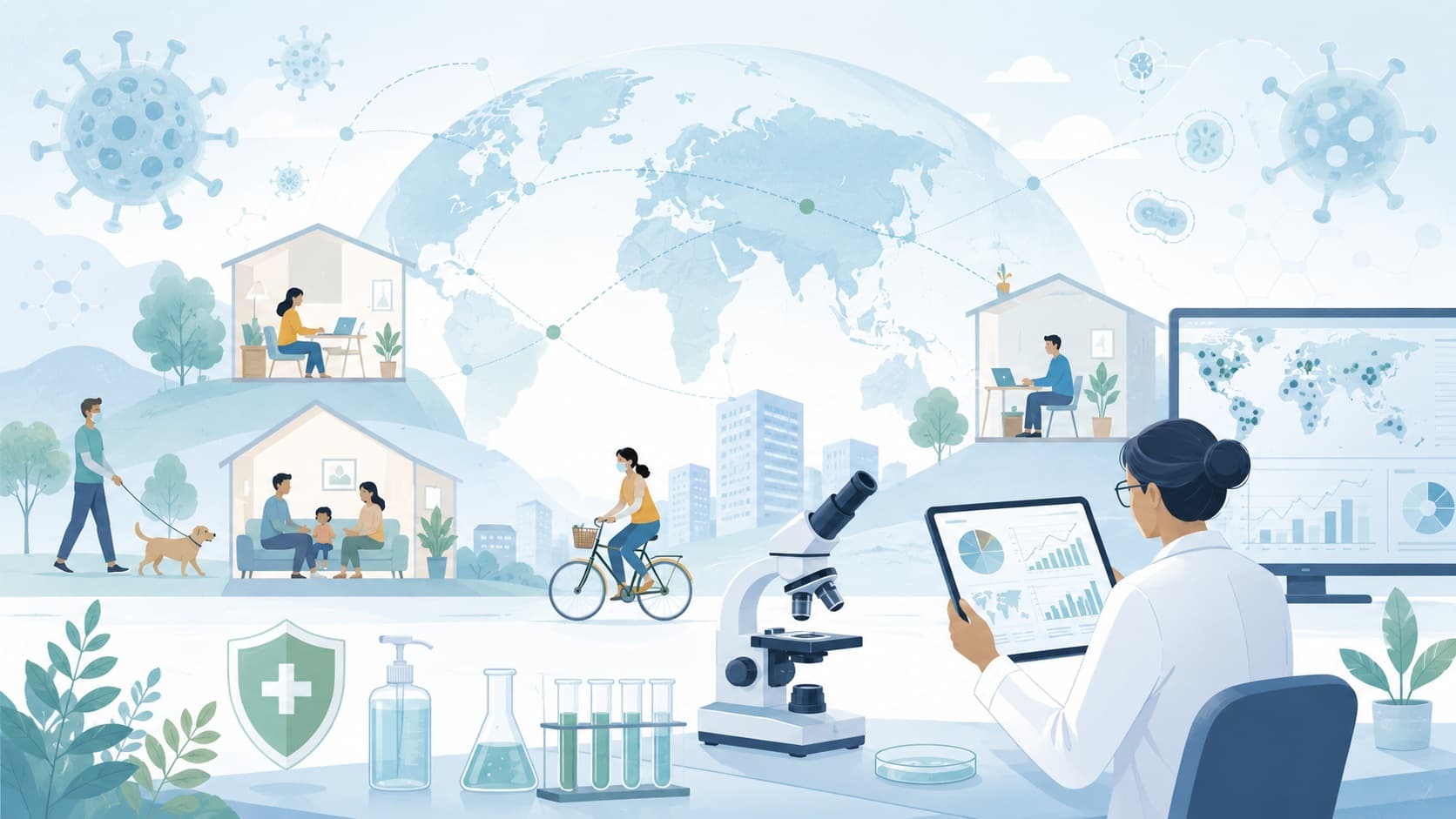
A pandemic is the worldwide spread of a new disease. The World Health Organization describes a pandemic as the worldwide spread of a new disease, and CDC defines a pandemic as an epidemic that has spread over several countries or continents and usually affects many people. (World Health Organization)
Pandemics are different from hurricanes, earthquakes, or wildfires because the hazard is not wind, water, shaking, or flame. The hazard is a pathogen: a disease-causing organism, such as a virus, bacterium, fungus, parasite, or rarely a prion. Pandemics unfold through biology, human behavior, travel, public health systems, environment, and time. (NCBI)
Preparedness note: This page is educational. It is not medical advice. For an active disease outbreak or public health emergency, follow guidance from local public health agencies, healthcare professionals, CDC, WHO, and other official sources.
What Is a Pandemic?
A pandemic is a large-scale infectious disease event that spreads across countries or continents. A disease does not become a pandemic just because it is serious; it becomes a pandemic when it spreads widely across populations and regions.
| Term | Plain-English Meaning | Example Pattern |
|---|---|---|
| Endemic | A disease is regularly present in a place or population | Seasonal patterns or steady local presence |
| Outbreak | More cases than expected in a specific place or group | A school, workplace, city, or region has unusual cases |
| Epidemic | A larger increase in cases in a community, region, or country | A disease spreads beyond a small cluster |
| Pandemic | An epidemic spreads across multiple countries or continents | A new disease spreads internationally |
A pandemic is usually caused by an infectious disease that can spread efficiently among people, especially when many people have little or no immunity to it.
What Causes Infectious Diseases?
Infectious diseases are caused by pathogens. These are germs or infectious agents that enter a host, multiply, and may cause illness. The main types include viruses, bacteria, fungi, parasites, and prions. (NCBI)
| Pathogen Type | What It Is | Pandemic Connection |
|---|---|---|
| Virus | Tiny genetic material inside a protein shell; must use host cells to copy itself | Many modern pandemics and major epidemics have been viral |
| Bacterium | Single-celled organism | Some bacteria can cause large outbreaks; antibiotics may help some bacterial infections |
| Fungus | Organism such as yeast or mold | Usually less likely to cause fast global pandemics, but can cause serious outbreaks |
| Parasite | Organism that lives on or inside another organism | Some spread through insects, food, water, or close contact |
| Prion | Misfolded infectious protein | Rare; not a typical pandemic cause |
Viruses are common pandemic threats because they can spread from person to person, mutate, and sometimes jump from animals into humans.
Infection vs. Disease
These words are related, but they do not mean exactly the same thing.
| Term | Meaning |
|---|---|
| Exposure | A person comes into contact with a pathogen |
| Infection | The pathogen enters the body and begins multiplying |
| Disease | The infection causes symptoms or harm |
| Asymptomatic infection | A person is infected but does not have noticeable symptoms |
| Pre-symptomatic infection | A person is infected and will later develop symptoms |
| Contagious period | Time when an infected person can spread the pathogen |
A pandemic can spread more easily when people can transmit the pathogen before they know they are sick or without ever developing obvious symptoms.
How Diseases Spread
Different pathogens spread in different ways. Understanding the transmission route helps public health experts decide which tools may reduce spread.
| Transmission Route | How It Works | Examples of Settings |
|---|---|---|
| Respiratory | Germs travel in droplets or small particles when people breathe, talk, cough, sneeze, sing, or shout | Homes, schools, workplaces, transportation |
| Direct contact | Germs spread through physical contact | Close caregiving, household contact |
| Surface contact | Germs land on surfaces and are later picked up by hands | Shared objects, high-touch surfaces |
| Foodborne | Germs spread through contaminated food | Food preparation, storage, distribution |
| Waterborne | Germs spread through contaminated water | Drinking water, floodwater, poor sanitation |
| Vector-borne | Insects or ticks carry pathogens between hosts | Mosquitoes, ticks, fleas |
| Bloodborne | Germs spread through blood or certain body fluids | Needles, transfusion safety, medical exposure |
| Animal-to-human | Germs jump from animals to people | Farms, wildlife contact, markets, pets, livestock |
CDC explains that COVID-19 spreads when infected people breathe out droplets and very small particles that contain the virus, and others breathe them in or those particles contact the eyes, nose, or mouth. (CDC) WHO defines vector-borne diseases as human illnesses caused by parasites, viruses, and bacteria transmitted by vectors such as mosquitoes and ticks. (World Health Organization)
The Chain of Infection
Public health workers often describe disease spread as a chain of infection. If one link in the chain is broken, spread can slow.
| Chain Link | Plain-English Meaning |
|---|---|
| Infectious agent | The pathogen that causes disease |
| Reservoir | Where the pathogen lives, such as people, animals, water, soil, or surfaces |
| Portal of exit | How the pathogen leaves the reservoir |
| Mode of transmission | How the pathogen travels |
| Portal of entry | How it enters another host |
| Susceptible host | A person or animal that can become infected |
For example, a respiratory virus may leave one person’s body through breathing, coughing, or talking, travel through air or droplets, and enter another person through the nose, mouth, or eyes.
How a Pandemic Begins
A pandemic usually begins when a pathogen gains the ability to spread efficiently in a population that does not have strong immunity to it.
A simplified sequence looks like this:
- A pathogen exists in humans, animals, or the environment.
- It infects a person or a small group.
- It spreads to more people.
- Clusters become outbreaks.
- Outbreaks become epidemics in multiple regions.
- International spread occurs.
- If spread becomes widespread across countries or continents, it may be called a pandemic.
Not every outbreak becomes a pandemic. Many outbreaks are contained, fade out, or remain local.
Zoonotic Spillover: When Animal Diseases Reach Humans
Many pandemic threats begin as zoonotic diseases, meaning diseases that can spread between animals and people. WHO defines a zoonosis as an infectious disease that has jumped from a non-human animal to humans; zoonotic pathogens may be bacterial, viral, parasitic, or other types. (World Health Organization)
| Step | What Happens |
|---|---|
| Animal reservoir | A pathogen circulates in wildlife, livestock, or another animal population |
| Spillover | The pathogen infects a human |
| Limited spread | A few people may become infected, but spread may stop |
| Adaptation | The pathogen changes or finds conditions that help it spread better |
| Human-to-human spread | Sustained transmission becomes possible |
| Wider spread | Travel, close contact, and networks help the disease move farther |
The One Health approach recognizes that human health, animal health, plants, and the environment are connected. CDC describes One Health as a collaborative approach that can help prevent outbreaks of zoonotic disease in animals and people. (CDC)
Why Some Diseases Spread Faster Than Others
Disease spread depends on both the pathogen and the setting.
| Factor | Why It Matters |
|---|---|
| Infectiousness | How easily the pathogen spreads |
| Route of transmission | Respiratory spread can move quickly in crowded indoor settings |
| Incubation period | Longer incubation can allow travel before symptoms appear |
| Asymptomatic spread | People may spread disease without knowing they are infected |
| Population immunity | Prior infection or vaccination can reduce spread or severity |
| Human behavior | Travel, gatherings, work patterns, and caregiving affect contacts |
| Environment | Ventilation, sanitation, climate, and housing conditions matter |
| Healthcare access | Testing, care, and public health support affect detection and response |
| Pathogen evolution | Mutations can change transmissibility, immune escape, or severity |
Pandemics are not only biological events. They are also social and environmental events.
R0 and Rt: Measuring Spread
Two important public health numbers are R0 and Rt.
| Term | Meaning | Plain-English Interpretation |
|---|---|---|
| R0, pronounced “R naught” | The average number of people one infected person would infect in a fully susceptible population | A starting estimate of contagiousness |
| Rt | The average number of people one infected person infects at a specific time under current conditions | A real-time estimate of whether spread is growing or shrinking |
CDC describes R0 as an indicator of contagiousness or transmissibility. (CDC) CDC also estimates current epidemic trends using the time-varying reproductive number, Rt, for respiratory diseases at national, state, and health-service-area levels. (CDC)
| Rt Value | What It Suggests |
|---|---|
| Rt greater than 1 | Cases may increase |
| Rt equal to 1 | Cases may stay roughly stable |
| Rt less than 1 | Cases may decrease |
R0 and Rt are useful, but they are not magic numbers. They depend on behavior, immunity, population structure, testing, reporting, and public health measures.
Exponential Growth
In the early phase of an outbreak, cases can grow exponentially. That means the number of cases multiplies over time instead of increasing by the same amount each day.
Example:
| Time Period | Cases if Each Period Doubles |
|---|---|
| Start | 10 |
| After 1 period | 20 |
| After 2 periods | 40 |
| After 3 periods | 80 |
| After 4 periods | 160 |
| After 5 periods | 320 |
This is why early detection matters. A delay of a few doubling periods can mean many more cases.
Epidemic Curves
An epidemic curve, often called an epi curve, is a graph showing new cases over time. It helps scientists see whether an outbreak is growing, peaking, declining, or occurring in waves.
| Curve Shape | Possible Meaning |
|---|---|
| Sharp rise | Rapid spread or improved detection |
| Slow rise | Gradual transmission or delayed reporting |
| Peak | Cases reached a high point |
| Decline | Spread may be slowing |
| Multiple peaks | Waves, variants, behavior changes, seasonality, or reporting changes |
| Long tail | Ongoing transmission at lower levels |
Epi curves help public health agencies compare timing, evaluate interventions, and plan resources.
Pandemic Waves
Pandemics often occur in waves. A wave is a period when cases rise, peak, and fall.
Waves can happen because of:
- Changes in human behavior
- Travel patterns
- School or work schedules
- Seasonality
- New variants
- Waning immunity
- Uneven vaccination or prior immunity
- Public health measures changing
- Testing and reporting changes
A pandemic wave is not like an ocean wave that follows a fixed schedule. It is the result of changing biology and behavior.
Severity: More Than Just Case Counts
A pandemic’s impact depends on more than how many people are infected.
| Measure | What It Shows |
|---|---|
| Case count | Number of detected infections |
| Test positivity | Share of tests that are positive |
| Hospitalizations | Number of people needing hospital care |
| ICU use | Severe pressure on critical care |
| Deaths | Most severe outcome measure |
| Case fatality ratio | Share of confirmed cases that result in death |
| Infection fatality ratio | Share of all infections, detected and undetected, that result in death |
| Long-term effects | Health impacts that continue after acute infection |
| Healthcare capacity | Whether systems can manage demand |
| Social disruption | Effects on schools, work, supply chains, and services |
A disease can be highly contagious but less severe for most people, or less contagious but more severe. A pandemic can still be serious if a small percentage of a very large number of infections leads to many hospitalizations.
Public Health Surveillance
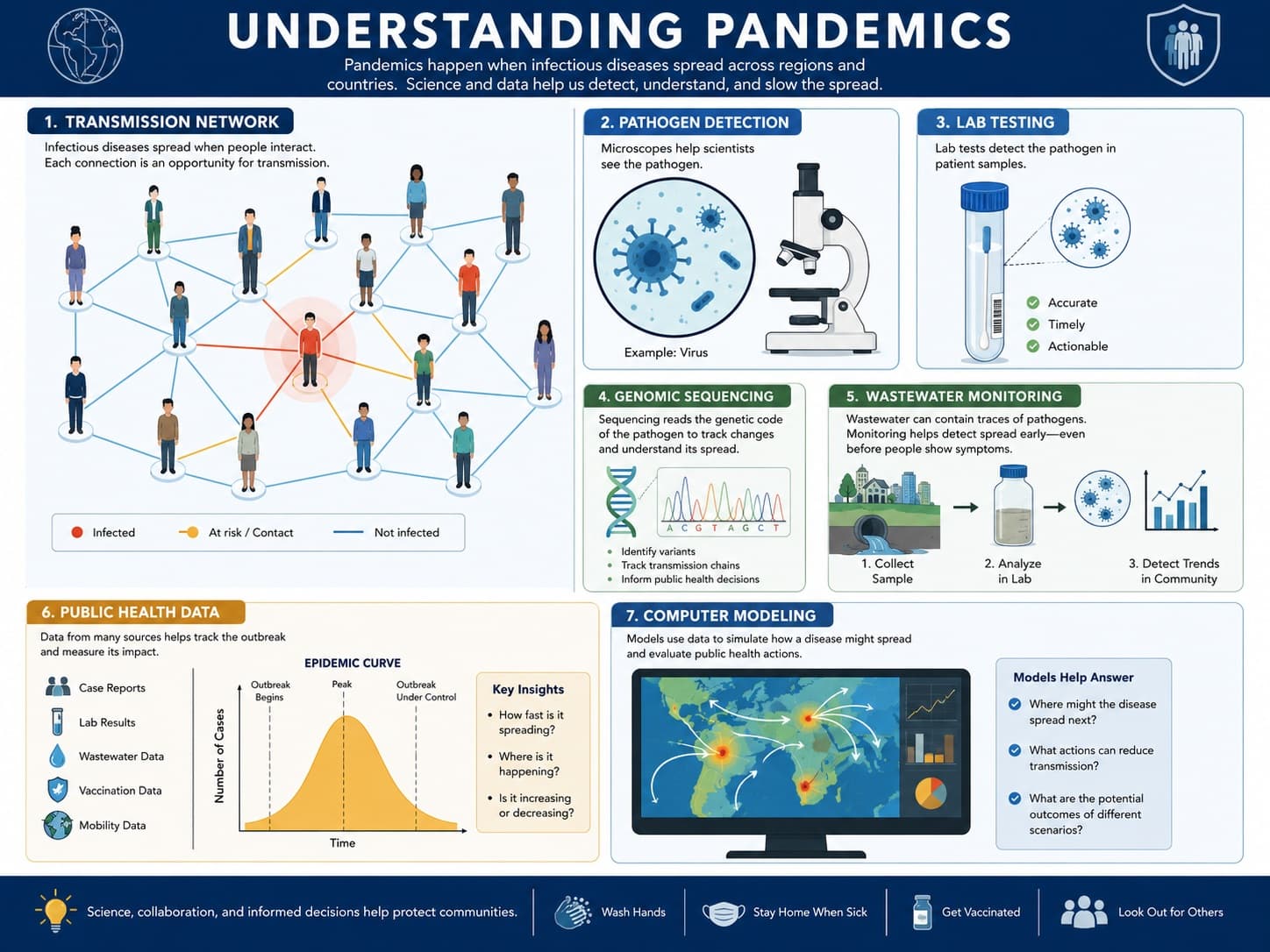
Public health surveillance means systematically collecting, analyzing, interpreting, and sharing health data so public health agencies can act. CDC describes surveillance as ongoing collection, management, analysis, interpretation, and dissemination of data to support public health action. (CDC)
Surveillance helps answer questions such as:
- Is a disease spreading?
- Where are cases increasing?
- Which groups are most affected?
- Are hospitalizations rising?
- Is a new variant appearing?
- Are public health actions working?
- Are healthcare systems under pressure?
Surveillance is like a weather radar for disease, but less exact. It does not see every infection. It uses multiple data sources to estimate what is happening.
Types of Disease Surveillance
| Surveillance Type | What It Uses | Strength |
|---|---|---|
| Case reporting | Diagnosed cases from healthcare providers or labs | Direct link to confirmed illness |
| Laboratory surveillance | Test results from clinical or public health labs | Identifies pathogens and variants |
| Syndromic surveillance | Symptoms reported in emergency departments or clinics | Can detect unusual illness patterns early |
| Sentinel surveillance | Selected sites report detailed data | Useful for trends when full reporting is not possible |
| Wastewater surveillance | Sewage samples tested for pathogen markers | Can detect trends even when people do not test |
| Genomic surveillance | Sequencing pathogen genomes | Tracks variants and transmission patterns |
| Animal surveillance | Monitoring livestock, wildlife, or pets | Helps identify zoonotic risks |
| Digital/event-based surveillance | News, reports, search trends, or alerts | Can identify unusual signals, but needs verification |
No single surveillance system is perfect. Public health experts compare multiple signals.
Laboratory Testing
Laboratory testing helps identify whether a person or sample contains evidence of a pathogen.
| Test Type | What It Detects | Common Use |
|---|---|---|
| PCR / molecular test | Genetic material from a pathogen | Detects current infection with high sensitivity |
| Antigen test | Proteins from a pathogen | Often faster, sometimes less sensitive |
| Culture | Grows live bacteria or virus in lab conditions | Useful for some pathogens and further testing |
| Serology / antibody test | Immune response from past infection or vaccination | Helps estimate past exposure or immune response |
| Sequencing | Genetic code of the pathogen | Tracks variants and relationships between samples |
PCR stands for polymerase chain reaction. MedlinePlus explains that PCR tests check for small amounts of genetic material from a pathogen in samples such as blood, saliva, mucus, or tissue. (MedlinePlus)
Genomic Surveillance
Genomic surveillance studies the genetic code of pathogens. It helps scientists see how a virus, bacterium, or parasite is changing and how different samples are related.
WHO describes genomic surveillance as constantly monitoring pathogens and analyzing their genetic similarities and differences. (World Health Organization) CDC uses genomic surveillance to identify and track SARS-CoV-2 variants by collecting specimens for sequencing and analyzing how genetic sequences are related. (CDC)
Genomic surveillance can help answer:
- Is a new variant appearing?
- Is a variant spreading faster?
- Are cases in different places connected?
- Are mutations affecting tests, treatments, or vaccines?
- Is a pathogen moving between regions?
- Is an outbreak from one source or multiple sources?
Genomic data is powerful, but it must be interpreted with epidemiology, clinical data, and local context.
Wastewater Surveillance
People infected with some pathogens may shed genetic material into wastewater. Testing sewage can help public health agencies track disease trends at the community level.
CDC’s National Wastewater Surveillance System provides infrastructure to monitor infectious diseases through wastewater across the United States. CDC notes that wastewater data can help identify outbreak trends early, direct prevention efforts, provide insight into disease spread, and complement other surveillance data. (CDC)
| Wastewater Surveillance Strength | Limitation |
|---|---|
| Can detect trends even when people do not seek testing | Usually cannot identify exactly who is infected |
| Can provide early warning of increases | Data can be affected by sewer system design |
| Can monitor multiple pathogens | Interpretation requires lab and public health expertise |
| Useful for community-level trends | Rural areas without centralized wastewater may be harder to monitor |
Wastewater is a community signal, not an individual diagnosis.
Contact Tracing
Contact tracing is the process of identifying people who may have been exposed to an infected person so they can receive guidance from public health officials.
It usually involves:
- Confirming a case.
- Interviewing the person about recent contacts and locations.
- Notifying exposed people while protecting privacy.
- Providing instructions based on the disease and local guidance.
- Tracking whether more cases appear.
Contact tracing works best when case numbers are manageable and when people can be reached quickly. During a large pandemic surge, public health agencies may shift to broader guidance instead of tracing every case.
Forecasting vs. Prediction
Pandemic science can forecast possibilities, but it cannot perfectly predict the future.
| Term | Meaning | Example |
|---|---|---|
| Detection | Finding evidence that disease is present | Lab tests identify a pathogen |
| Surveillance | Watching disease patterns over time | Case, wastewater, and hospital trends |
| Forecasting | Estimating what may happen soon | Cases may rise over the next few weeks |
| Scenario modeling | Comparing possible futures | What happens if transmission increases? |
| Risk assessment | Judging likelihood and impact | Is a variant concerning? |
| Exact prediction | Saying exactly what will happen, where, and when | Usually not possible for pandemics |
Pandemic models are like hurricane forecast models in one way: they help estimate possible futures, but they depend on data quality and assumptions.
How Pandemic Models Work
Pandemic models are computer or mathematical tools that simulate disease spread.
| Model Type | Plain-English Description | Useful For |
|---|---|---|
| Compartmental model | Divides people into groups such as susceptible, infected, and recovered | Broad disease spread patterns |
| Agent-based model | Simulates individuals and their contacts | Schools, workplaces, cities, detailed scenarios |
| Network model | Focuses on connections between people or places | Travel, social contact, transmission pathways |
| Statistical model | Uses observed data to estimate trends | Short-term forecasting |
| Genomic model | Uses pathogen genetic data | Tracking variants and spread |
| Ensemble model | Combines multiple models | Showing uncertainty and ranges |
A simple SIR model has three groups:
| Group | Meaning |
|---|---|
| S: Susceptible | People who can become infected |
| I: Infectious | People who can spread the pathogen |
| R: Removed / Recovered | People who are no longer spreading it, often because they recovered, isolated, or died |
Real pandemic models are much more complex. They may include age groups, vaccination, waning immunity, variants, travel, school schedules, hospital capacity, seasonality, and behavior changes.
What Models Need
A model is only as good as its data and assumptions.
| Data Input | Why It Matters |
|---|---|
| Case counts | Shows detected infections |
| Testing levels | Helps interpret whether case changes are real |
| Hospitalizations | Shows severe disease trends |
| Deaths | Tracks the most severe outcomes |
| Wastewater data | Adds community-level trend information |
| Genomic data | Tracks variants |
| Mobility or contact data | Helps estimate opportunities for spread |
| Vaccine coverage | Helps estimate immunity |
| Prior infection estimates | Helps estimate population susceptibility |
| Demographics | Age and health patterns affect severity |
| Public health measures | Policies and behavior affect transmission |
Models can be wrong if the starting data are incomplete, if behavior changes suddenly, or if the pathogen evolves in unexpected ways.
Vaccines and Immunity
Vaccines are one of the most important technologies used to reduce the impact of some infectious diseases. CDC explains that vaccines work by imitating an infection to engage the body’s natural defenses and help the body learn how to defend itself without the dangers of full-blown infection. (CDC)
| Immunity Type | What It Means |
|---|---|
| Natural immunity | Immune response after infection |
| Vaccine-induced immunity | Immune response after vaccination |
| Hybrid immunity | Immune response shaped by both vaccination and infection |
| Community protection | When enough immunity in a group makes spread harder |
| Waning immunity | Protection decreases over time |
| Immune escape | A pathogen changes in ways that reduce recognition by existing immunity |
Different vaccines work in different ways. CDC explains that mRNA vaccines use laboratory-made mRNA to teach cells how to make a protein, or part of a protein, that triggers an immune response. (CDC)
This page does not recommend specific vaccines or schedules. For personal decisions, follow healthcare professionals and official public health guidance.
Treatments, Antivirals, and Medical Countermeasures
Pandemic response may also involve medical countermeasures.
| Tool | Purpose |
|---|---|
| Vaccines | Help prevent infection, severe disease, or spread, depending on the disease and vaccine |
| Antivirals | Treat some viral infections |
| Antibiotics | Treat bacterial infections, not viral infections |
| Monoclonal antibodies | Lab-made antibodies for some diseases, depending on variant and availability |
| Supportive care | Helps the body while it fights infection |
| Diagnostic tests | Identify infection and guide public health response |
| Personal protective equipment | Helps reduce exposure in healthcare or high-risk settings |
Technology helps, but it must match the pathogen. Antibiotics do not treat viral infections, and vaccines are not available for every disease.
How Pandemic Detection and Forecasting Technology Has Changed Over Time
Pandemic science has changed from simple observation and handwritten records to global surveillance networks, molecular testing, genomic sequencing, dashboards, wastewater monitoring, and AI-assisted analysis.
| Era | Main Tools | What Changed |
|---|---|---|
| Before germ theory | Observation, symptoms, quarantine, local reports | People saw disease patterns but often misunderstood causes |
| 1800s | Microscopes, early statistics, disease mapping | John Snow’s 1854 cholera work used mapping to connect cases to contaminated water, a classic early epidemiology example (CDC Archive) |
| Late 1800s–early 1900s | Germ theory, bacterial culture, public health laboratories | Scientists could identify specific microbes more reliably |
| 1918 influenza era | Telegraph, newspapers, military and public health reports | International spread was recognized, but data were slower and less standardized |
| Mid-1900s | Antibiotics, vaccines, serology, disease reporting systems | Public health response became more laboratory-based |
| 1951 onward | CDC Epidemic Intelligence Service | CDC established EIS in 1951 to train “disease detectives” for outbreak investigation and response (CDC) |
| 1970s–1990s | Computers, PCR, electronic databases | Molecular testing and digital records improved speed and accuracy |
| 2000s | International Health Regulations, global networks, web reporting | WHO’s IHR require countries to prevent, detect, assess, report, and respond to public health risks (World Health Organization) |
| 2010s | Genomic sequencing, mobile data, dashboards, cloud computing | Scientists could track pathogen evolution faster |
| 2020s | Wastewater surveillance, real-time dashboards, AI tools, rapid sequencing, mRNA platforms | Disease trends, variants, and community spread can be monitored with more data streams |
The biggest shift is from seeing pandemics only through sick patients to seeing them through many signals at once: labs, hospitals, genomes, wastewater, mobility, public reports, and models.
From John Snow’s Map to Digital Dashboards
In 1854, John Snow mapped cholera deaths in London and helped show that contaminated water was connected to the outbreak. CDC describes Snow’s cholera map as an early example of using geographic distribution of cases to investigate disease. (CDC Archive)
Today, the same basic idea still matters: where are cases happening, when are they happening, and what do they have in common?
Modern tools add:
- Electronic case reports
- Lab databases
- Geographic information systems
- Interactive dashboards
- Genomic sequencing
- Wastewater sampling
- Hospital capacity data
- Statistical and machine-learning models
The question is still similar to Snow’s question: What pattern explains the spread?
Artificial Intelligence and Machine Learning
AI and machine learning can help public health scientists process large datasets, but they do not replace public health judgment.
Possible uses include:
- Detecting unusual disease trends
- Sorting large numbers of reports
- Estimating epidemic curves
- Improving short-term forecasts
- Comparing genomic sequences
- Identifying possible outbreak clusters
- Analyzing wastewater trends
- Supporting hospital demand forecasts
- Translating technical information into public-facing summaries
AI systems can also make mistakes if data are incomplete, biased, delayed, or misunderstood. Public health experts still need to verify signals and interpret them in context.
Why Pandemic Forecasting Is Difficult
Pandemic forecasting is difficult because both pathogens and people change.
| Challenge | Why It Matters |
|---|---|
| Delayed reporting | Cases may be reported days or weeks after infection |
| Undetected infections | Some people do not test or have no symptoms |
| Behavior changes | People change travel, gatherings, masking, testing, or isolation habits |
| Variant evolution | A pathogen may mutate |
| Immunity changes | Immunity can rise after infection or vaccination and may decline over time |
| Uneven risk | Spread differs by age, occupation, housing, region, and healthcare access |
| Data gaps | Not all countries or regions have the same testing and reporting systems |
| Policy changes | Public health actions can alter trends |
| Seasonality | Weather and indoor behavior may affect some diseases |
| Misinformation | Confusing or false information can affect behavior |
A model may show a likely path, but a new variant, behavior change, or testing change can shift the real outcome.
Pandemics and Society
Pandemics affect more than the immune system. They can affect schools, work, travel, supply chains, healthcare systems, families, and communities.
| Area | Possible Pandemic Impact |
|---|---|
| Healthcare | More clinic visits, hospitalizations, staffing pressure |
| Schools | Absences, schedule changes, learning disruptions |
| Workplaces | Sick leave, remote work, staffing shortages |
| Transportation | Travel restrictions, reduced service, supply delays |
| Economy | Business disruption, demand shifts, supply chain stress |
| Mental health | Stress, isolation, grief, uncertainty |
| Public trust | Importance of clear, consistent communication |
| Equity | Some communities may face higher exposure or fewer resources |
Public health planning tries to reduce harm while keeping essential services functioning.
Common Pandemic Control Concepts
Different diseases require different strategies. Public health agencies choose tools based on the pathogen, severity, transmission route, available medical tools, and local conditions.
| Concept | Plain-English Meaning |
|---|---|
| Testing | Finding infections |
| Isolation | Keeping infected people away from others while contagious |
| Quarantine | Separating people who were exposed, depending on disease guidance |
| Contact tracing | Finding and notifying exposed people |
| Vaccination | Training the immune system to recognize a pathogen |
| Ventilation | Bringing in cleaner air and reducing indoor buildup of respiratory particles |
| Masking / respirators | Reducing inhalation or release of infectious particles in some settings |
| Hygiene and sanitation | Reducing spread through hands, surfaces, food, or water |
| Vector control | Reducing mosquitoes, ticks, or other disease-carrying organisms |
| Travel measures | Slowing movement of disease between regions |
| Risk communication | Helping the public understand what is known, uncertain, and changing |
This page does not tell people which measures to use during a specific outbreak. The right combination depends on official guidance and local conditions.
Variants and Mutation
Pathogens can change over time. For viruses, these changes are often called mutations. A group of viruses with shared mutations may be called a variant.
| Term | Meaning |
|---|---|
| Mutation | A change in genetic code |
| Variant | A version of a pathogen with a set of genetic changes |
| Variant of interest | A variant being watched because of possible public health importance |
| Variant of concern | A variant with stronger evidence of important public health impact |
| Immune escape | Changes that help a pathogen avoid existing immune protection |
| Fitness | How well a pathogen spreads or survives in a given environment |
Not every mutation matters. Most changes have little effect. Some changes can affect transmission, severity, immune recognition, tests, or treatments.
One Health and Pandemic Prevention
Pandemic risk often sits at the intersection of people, animals, and the environment. A One Health approach brings together human medicine, veterinary medicine, environmental science, agriculture, wildlife biology, and public health.
| One Health Area | Why It Matters |
|---|---|
| Wildlife monitoring | Some pathogens circulate in wildlife before reaching humans |
| Livestock health | Farm animals can be reservoirs or mixing hosts |
| Environmental change | Land-use changes can alter human-animal contact |
| Food systems | Food production and trade can spread pathogens |
| Vector ecology | Mosquitoes and ticks respond to climate and habitat |
| Antimicrobial resistance | Drug-resistant infections can spread across humans, animals, and environments |
| Global travel | Pathogens can move quickly between regions |
CDC notes that One Health collaboration can help protect global health security and reduce antimicrobial-resistant infections. (CDC)
Common Pandemic Misunderstandings
| Misunderstanding | Better Explanation |
|---|---|
| “Pandemic means the disease is always deadly.” | Pandemic describes geographic spread, not only severity. |
| “If a disease becomes less visible, it is gone.” | Lower reporting or lower testing can hide ongoing spread. |
| “Only viruses cause pandemics.” | Viruses are common pandemic threats, but other pathogens can also cause major outbreaks. |
| “A model is a prediction of exactly what will happen.” | Models estimate possible futures based on data and assumptions. |
| “The first wave is always the worst.” | Later waves can be larger if conditions change. |
| “If I feel healthy, I cannot spread disease.” | Some infections can spread before symptoms or without symptoms. |
| “Variants always become more dangerous.” | Many mutations do little; some matter; public health agencies monitor the evidence. |
| “Technology alone stops pandemics.” | Technology helps, but behavior, trust, access, communication, and healthcare capacity also matter. |
| “Wastewater data tells who is sick.” | Wastewater shows community-level trends, not individual diagnoses. |
| “A vaccine works only if it prevents every infection.” | Vaccines may reduce infection, severe illness, spread, or complications depending on the disease and vaccine. |
Key Pandemic Vocabulary
| Term | Plain-English Meaning |
|---|---|
| Pathogen | Disease-causing organism or agent |
| Host | Person, animal, or organism infected by a pathogen |
| Reservoir | Where a pathogen normally lives |
| Transmission | How a pathogen spreads |
| Incubation period | Time between infection and symptoms |
| Infectious period | Time when a person can spread the pathogen |
| Asymptomatic | Infected without noticeable symptoms |
| Zoonosis | Disease that spreads between animals and humans |
| Spillover | Pathogen moves from animals into humans |
| R0 | Average spread in a fully susceptible population |
| Rt | Average spread at a specific time under current conditions |
| Epidemic curve | Graph of cases over time |
| Surveillance | Ongoing disease monitoring |
| PCR | Lab method that detects genetic material |
| Antigen test | Test that detects pathogen proteins |
| Serology | Test that detects antibodies |
| Genomic sequencing | Reading pathogen genetic code |
| Variant | Version of a pathogen with genetic changes |
| Wastewater surveillance | Testing sewage for disease markers |
| Contact tracing | Identifying people who may have been exposed |
| Isolation | Separating infected people while contagious |
| Quarantine | Separating exposed people when recommended |
| Forecast | Estimate of what may happen |
| Scenario | Possible future based on assumptions |
| One Health | Approach connecting human, animal, and environmental health |
Technology Summary
Pandemic science has advanced because detection and forecasting now use many tools together.
Modern pandemic technology may include:
- Laboratory testing
- PCR and rapid diagnostic tests
- Electronic case reporting
- Public health surveillance systems
- Syndromic surveillance
- Contact tracing tools
- Genomic sequencing
- Wastewater monitoring
- Hospital capacity dashboards
- International disease reporting
- Mathematical models
- Ensemble forecasts
- Digital maps
- Vaccine platforms
- AI-assisted data analysis
- Public alert and communication systems
These tools do not guarantee perfect prediction or complete safety. They help scientists detect disease earlier, understand spread, track variants, estimate future trends, and guide public health decisions.
Science Summary
A pandemic is the worldwide spread of a new disease. Pandemics happen when a pathogen spreads efficiently across populations and regions, especially when many people have little immunity. Some pandemic threats begin with zoonotic spillover, when a pathogen moves from animals into humans.
Pandemic science combines biology, epidemiology, statistics, medicine, social behavior, environmental science, and technology. Scientists study how pathogens spread, how quickly cases grow, how severe disease is, how immunity changes, and how public health tools affect transmission.
Technology has changed pandemic science dramatically. Earlier public health depended on visible symptoms, local reports, and simple maps. Modern systems use laboratory testing, genomic sequencing, electronic reporting, wastewater surveillance, dashboards, global health regulations, computer models, and AI-assisted analysis.
The most important lesson is that pandemics are complex, changing events. Science can detect, explain, model, and reduce risk, but it cannot remove all uncertainty. During real outbreaks, people should use official public health guidance, healthcare professionals, and trusted local sources rather than relying on rumors, outdated information, or a single data point.