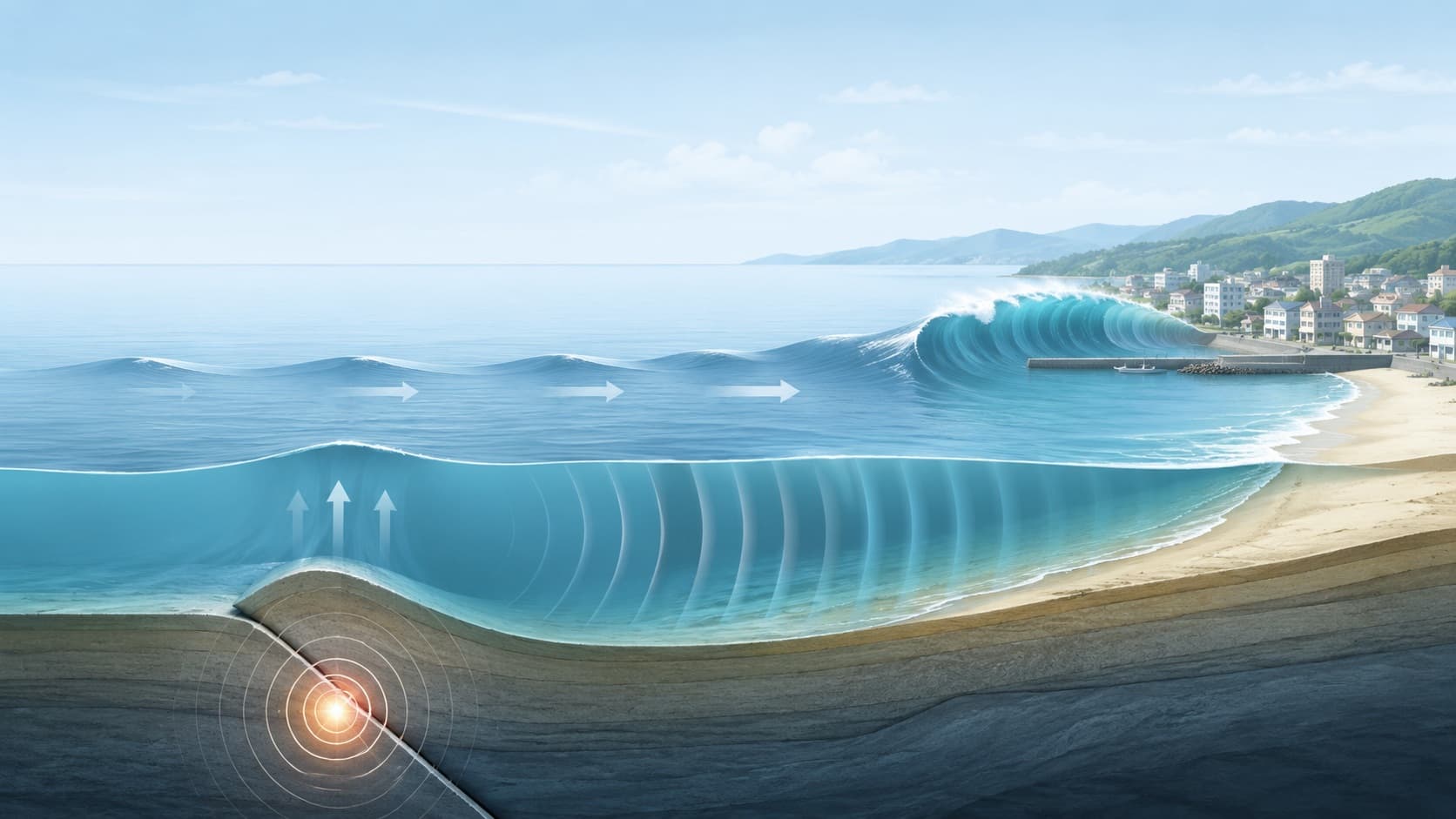
A tsunami is a series of very long ocean waves caused by a large and sudden displacement of water. Most tsunamis are caused by major earthquakes below or near the ocean floor, but they can also be caused by underwater landslides, volcanic eruptions, coastal landslides, or, very rarely, meteor impacts. NOAA describes a tsunami as a series of extremely long waves caused by a large and sudden displacement of the ocean, usually from an earthquake below or near the ocean floor. (NOAA)
Tsunamis are sometimes called “tidal waves,” but that name is misleading. Tsunamis are not caused by tides. Tides are mostly caused by the gravity of the Moon and Sun. Tsunamis are caused by sudden movement of water.
Preparedness note: This page is educational. For an active tsunami warning, advisory, watch, earthquake, or coastal emergency, follow official alerts from NOAA Tsunami Warning Centers, local emergency management, coastal officials, emergency services, and evacuation instructions.
What Is a Tsunami?
A tsunami is not one single wave. It is usually a series of waves that can arrive over minutes, hours, or longer. The first wave may not be the largest.
In the deep ocean, a tsunami may be only a small rise or fall in sea level, so ships at sea may barely notice it. But as the wave approaches shallower coastal water, it slows down, compresses, and can grow much higher.
A simple way to picture a tsunami:
- A large underwater event suddenly moves water.
- Energy spreads outward across the ocean.
- The wave travels very fast in deep water.
- Near shore, the wave slows down.
- The water piles up, rises, rushes inland, or rapidly drains away.
- Multiple waves and strong currents may continue for hours.
NOAA explains that in deep water, tsunamis can travel over 500 mph and cross entire oceans in less than a day; near land, they slow to about 20 or 30 mph but can grow in height. (Tsunami.gov)
Key Tsunami Vocabulary
| Term | Plain-English Meaning |
|---|---|
| Tsunami | A series of long ocean waves caused by sudden water displacement |
| Wave train | A series of tsunami waves, not just one wave |
| Source | The event that generated the tsunami, such as an earthquake |
| Run-up | How high the water reaches above normal sea level on land |
| Inundation | How far and where water floods normally dry land |
| Drawdown | Rapid lowering or retreat of water before or during a tsunami |
| Arrival time | When the first tsunami wave is expected to reach a location |
| Wave amplitude | Height of the tsunami wave above normal sea level |
| Bathymetry | Shape and depth of the seafloor |
| Subduction zone | Plate boundary where one tectonic plate dives beneath another |
| DART | Deep-ocean Assessment and Reporting of Tsunamis system |
| Tide gauge | Coastal instrument that measures water level |
| Tsunami forecast model | Computer model that estimates arrival time, wave height, currents, and flooding |
| Natural warning signs | Clues such as strong shaking, sudden ocean change, or ocean roar |
Tsunami vs. Regular Ocean Waves
Tsunamis behave very differently from wind-generated waves at the beach.
| Feature | Regular Wind Waves | Tsunami Waves |
|---|---|---|
| Main cause | Wind blowing across the ocean surface | Sudden movement of a large amount of water |
| Wavelength | Often tens to hundreds of feet | Can be tens to hundreds of miles |
| Wave period | Seconds | Minutes to more than an hour |
| Depth affected | Mostly near the surface | Can involve the whole water column from seafloor to surface |
| Speed in deep ocean | Usually much slower | Can exceed 500 mph in deep water |
| Beach appearance | Breaking waves | May appear as a fast-rising flood, surge, wall of water, or rapid retreat |
| Duration | Individual waves pass quickly | Dangerous waves and currents may continue for hours |
A regular beach wave is mostly surface motion. A tsunami is more like the ocean itself moving in a long pulse.
What Causes Tsunamis?
Tsunamis need a sudden displacement of water. Not every earthquake creates a tsunami, and not every tsunami is caused by an earthquake.
| Cause | How It Can Create a Tsunami |
|---|---|
| Undersea earthquake | Sudden seafloor movement pushes water upward or downward |
| Submarine landslide | A large underwater mass slides and displaces water |
| Coastal landslide | Rock, ice, or soil falls into water and pushes waves outward |
| Volcanic eruption | Explosion, collapse, landslide, or underwater movement displaces water |
| Meteor impact | A large object hits the ocean and displaces water |
| Glacier or ice collapse | Ice falls into a fjord or bay and creates local waves |
USGS explains that tsunamis are often generated when the seafloor experiences rapid vertical displacement during large shallow earthquakes or when large masses shift in submarine landslides. (USGS)
Earthquake-Generated Tsunamis
Most major ocean-wide tsunamis are linked to large undersea earthquakes, especially in subduction zones.
A tsunami-generating earthquake is more likely when:
- The earthquake is large.
- The earthquake is shallow.
- The fault is under or near the ocean.
- The seafloor moves vertically.
- A large area of seafloor shifts.
- The earthquake occurs in a subduction zone.
Why Vertical Movement Matters
If two plates slide sideways past each other, they may cause strong shaking but move less water. If the seafloor suddenly moves upward or downward, it can lift or drop the water above it. That displacement creates the tsunami.
| Earthquake Feature | Tsunami Potential |
|---|---|
| Large magnitude | More likely to move a large area |
| Shallow depth | More likely to affect the seafloor |
| Under ocean | Can directly displace seawater |
| Vertical fault motion | More effective at creating tsunami waves |
| Strike-slip motion | Usually less efficient, but can still trigger landslides |
| Subduction zone | Major source of large tsunamis |
Landslide Tsunamis
A tsunami can also form when a large mass of rock, sediment, ice, or debris moves suddenly into or under water.
Landslide tsunamis may happen in:
- Fjords
- Lakes
- Reservoirs
- Coastal cliffs
- Volcanic islands
- Submarine canyons
- Continental slopes
Landslide tsunamis can be very dangerous close to the source because waves may arrive quickly. They may not always travel across entire oceans the way some earthquake-generated tsunamis do, but locally they can be severe.
Volcanic Tsunamis
Volcanoes can generate tsunamis in several ways.
| Volcanic Process | Tsunami Connection |
|---|---|
| Underwater eruption | Pushes water upward |
| Explosive eruption | Displaces water and air |
| Caldera collapse | A volcanic structure collapses and moves water |
| Pyroclastic flow into ocean | Hot volcanic material enters water rapidly |
| Volcanic landslide | Part of a volcano collapses into water |
| Shock wave or pressure wave | Can disturb water over distance in unusual cases |
Volcanic tsunamis can be complex because eruption style, landslides, underwater topography, and air-pressure waves may all interact.
How a Tsunami Travels Across the Ocean
Tsunamis behave as shallow-water waves even in the deep ocean because their wavelengths are so long that they interact with the seafloor. Their speed depends mainly on water depth.
| Ocean Setting | Tsunami Behavior |
|---|---|
| Deep ocean | Very fast, long wavelength, low wave height |
| Continental shelf | Slows down and begins to grow |
| Near shore | Slower speed, shorter wavelength, higher water level |
| Bays and harbors | Currents can become strong and chaotic |
| Rivers and estuaries | Water may move inland upstream |
| Low coastal plains | Inundation may extend far inland |
NOAA describes tsunami propagation as very fast in deep water, comparable to a jet plane, and much slower as waves enter shallow coastal water. (NOAA)
Why Tsunamis Grow Near Shore
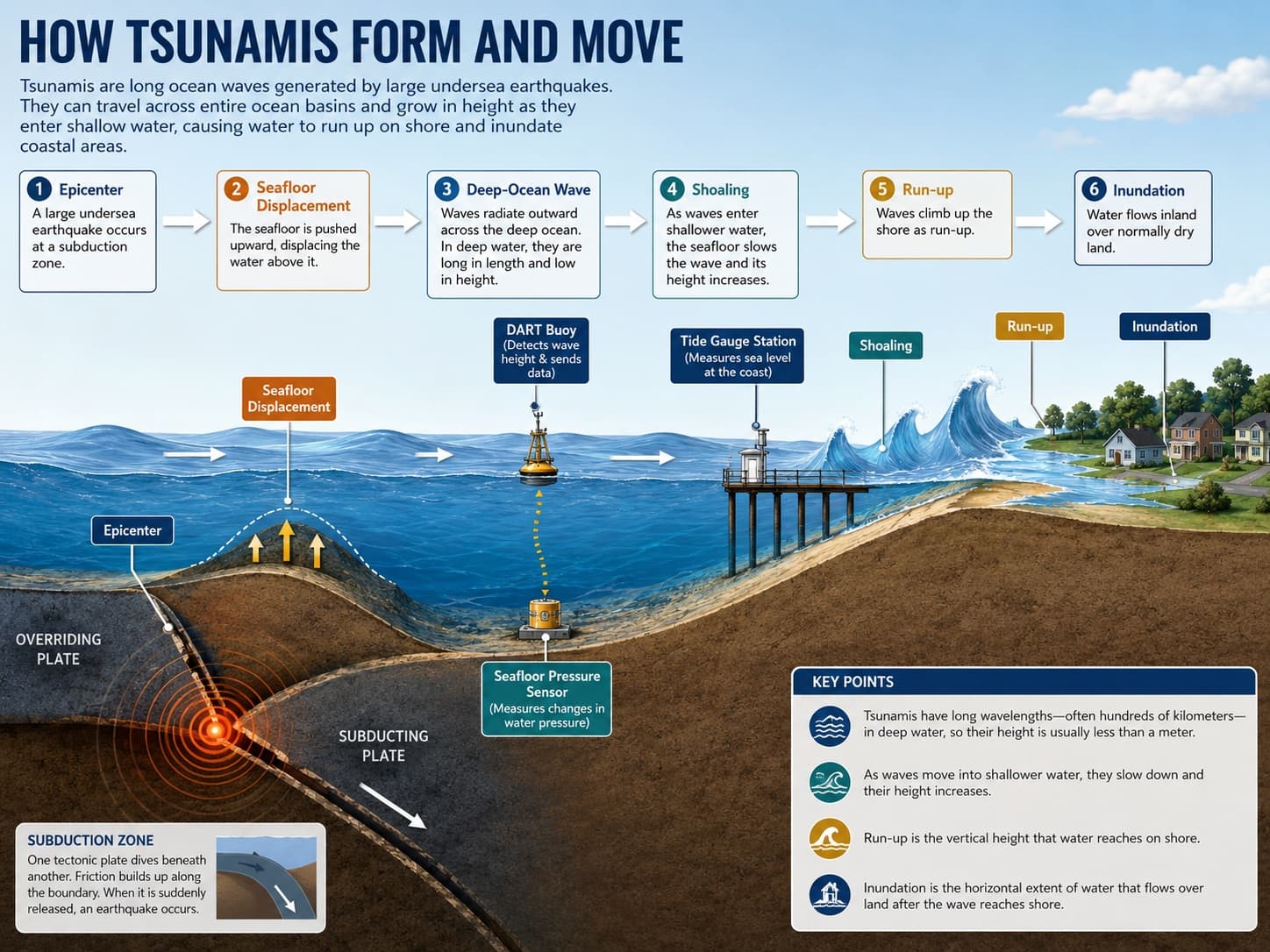
As a tsunami enters shallow water, the bottom of the wave “feels” the seafloor more strongly. The wave slows down. But the energy is still moving forward, so the water compresses into a shorter, taller wave.
This process is called shoaling.
A simple analogy is traffic on a highway:
- Cars move fast when the road is open.
- If traffic slows ahead, cars bunch closer together.
- The same number of cars now occupies less space.
For a tsunami, the energy bunches up as the wave slows, and water level can rise dramatically.
Tsunami Arrival Is Not Always a Breaking Wave
Movies often show tsunamis as one giant curling wave. That can happen in some places, but many tsunamis look different.
A tsunami may arrive as:
- A sudden rise in water level
- A fast-moving flood
- A wall or bore of turbulent water
- A series of surges
- A rapid ocean retreat followed by incoming water
- Strong currents in harbors and channels
- Repeated flooding and draining
The water can move with great force, carrying debris and creating dangerous currents.
The First Wave May Not Be the Largest
Tsunamis arrive as a wave train. Later waves can be larger than the first. The danger can continue for several hours or even longer, especially in harbors, bays, and channels where waves reflect and currents continue.
| Tsunami Wave Pattern | Meaning |
|---|---|
| First wave small | Larger waves may still follow |
| Water recedes first | A trough may arrive before a crest |
| Water rises first | A crest may arrive first |
| Waves hours apart | The threat can continue long after first arrival |
| Currents continue | Harbors and channels may remain dangerous even after visible flooding decreases |
This is why people should rely on official all-clear messages, not only what they see at the beach.
Tsunami Hazards
Tsunamis are dangerous because of moving water, not just wave height.
| Hazard | What It Means |
|---|---|
| Coastal flooding | Water covers normally dry land |
| Strong currents | Water moves powerfully through harbors, bays, rivers, and channels |
| Debris impact | Water carries wood, vehicles, boats, rocks, and other objects |
| Erosion | Fast water removes sand, soil, and road material |
| Repeated waves | Flooding may occur multiple times |
| Drawdown | Water rapidly pulls away from shore, exposing seafloor |
| River surges | Tsunami energy can move upstream through river mouths |
| Harbor damage | Boats, docks, and marina structures may be affected |
| Infrastructure disruption | Roads, utilities, ports, and communications may be affected |
Even a small tsunami can create dangerous currents near beaches, harbors, and marinas.
Local, Regional, and Distant Tsunamis
Tsunamis are often described by how far they travel and how much warning time may be available.
| Type | Source Distance | Warning Time | Main Concern |
|---|---|---|---|
| Local tsunami | Nearby source | Minutes | Natural warning signs may be the only warning |
| Regional tsunami | Same ocean region | Tens of minutes to a few hours | Official alerts and evacuation routes are important |
| Distant tsunami | Far across the ocean | Several hours or more | Forecast models, DART data, and official warnings are useful |
A local tsunami is especially dangerous because it may arrive before an official warning can be issued.
Natural Tsunami Warning Signs
For local tsunamis, nature may give the first warning. Official alerts are important, but there may not be enough time to wait for one.
Natural warning signs include:
| Sign | What It Could Mean |
|---|---|
| Strong earthquake | A nearby fault may have moved the seafloor |
| Long earthquake | Extended shaking may indicate a large earthquake |
| Sudden ocean retreat | A tsunami trough may be arriving first |
| Sudden ocean rise | The first surge may already be arriving |
| Loud ocean roar | Powerful waves or currents may be approaching |
| Unusual currents | Tsunami energy may be moving through channels or harbors |
NOAA lists natural warning signs such as strong or long earthquakes, a loud roar from the ocean, and sudden rise or fall of ocean water. (NOAA)
A simple public-education phrase is: If the coast shakes, the water changes, or the ocean roars, move away from the water and follow local official guidance.
Tsunami Alerts
In the United States, tsunami messages include four alert levels: Warning, Advisory, Watch, and Information Statement. The alert level depends on expected or observed conditions and local threat. (Tsunami.gov)
| Alert Type | General Meaning |
|---|---|
| Tsunami Warning | Dangerous coastal flooding and powerful currents are expected or occurring; follow evacuation instructions |
| Tsunami Advisory | Strong currents or waves dangerous to people in or near the water are expected or occurring; significant land flooding is not expected |
| Tsunami Watch | A distant tsunami is possible; stay alert for updates |
| Information Statement | An earthquake occurred or information is being provided; no tsunami threat may exist for some areas |
NOAA’s public safety guidance emphasizes that a Tsunami Warning means dangerous coastal flooding and powerful currents are possible and may continue for hours or days after initial arrival. (National Weather Service)
How Tsunami Detection Works
Tsunami detection uses several kinds of instruments because no single tool is enough.
| Tool | What It Measures | Why It Helps |
|---|---|---|
| Seismometers | Earthquake waves | Detects possible tsunami source quickly |
| GPS/GNSS | Ground movement | Helps estimate fault motion and seafloor displacement |
| DART systems | Deep-ocean pressure changes | Confirms tsunami waves in the open ocean |
| Tide gauges | Coastal water level | Confirms tsunami arrival near shore |
| Tsunami models | Wave travel and coastal flooding | Estimates arrival time, height, currents, and inundation |
| Bathymetry maps | Seafloor shape | Helps model how waves travel and grow |
| Coastal elevation data | Land height near shore | Helps estimate inundation areas |
| Satellites | Sea surface, deformation, or event context in research settings | Supports research and future monitoring possibilities |
| Public reports | Observed water behavior and impacts | Helps confirm local effects |
NOAA explains that tsunami warning centers use tsunami forecast models combined with data from seismic and sea-level networks to refine warning messages. (NOAA)
Seismic Networks: Detecting the Source
The first sign of a possible tsunami is often an earthquake. Seismometers detect the earthquake and help estimate:
- Location
- Depth
- Magnitude
- Fault type
- Earthquake duration
- Whether the source is offshore
- Whether the earthquake is large enough to be tsunamigenic
But earthquake data alone cannot always tell how large a tsunami will be. Two earthquakes with similar magnitudes can produce different tsunamis depending on how the fault moved and how much the seafloor shifted.
DART Systems: Measuring Tsunamis in the Deep Ocean
DART stands for Deep-ocean Assessment and Reporting of Tsunamis. A DART station usually includes a pressure sensor on the seafloor and a surface buoy that sends data by satellite.
The seafloor pressure sensor can detect tiny changes in water pressure as a tsunami passes overhead. The buoy then relays information to warning centers.
NOAA’s Pacific Marine Environmental Laboratory describes DART systems as real-time tsunami monitoring systems placed strategically in the ocean that play a critical role in tsunami forecasting. (NOAA Center for Tsunami Research)
| DART Part | Job |
|---|---|
| Bottom pressure recorder | Detects water pressure changes from passing tsunami waves |
| Acoustic link | Sends data from seafloor sensor to buoy |
| Surface buoy | Relays data through satellite communication |
| Warning center | Uses data to confirm and refine forecasts |
NOAA completed its original six-buoy operational DART array in 2001 and expanded to a full network of 39 stations in March 2008. (ndbc.noaa.gov)
Tide Gauges: Measuring Water at the Coast
Tide gauges measure water levels along coasts, harbors, and islands. They can confirm whether a tsunami has arrived and how high water levels are changing.
Tide gauges are useful because they measure real coastal water response. However, by the time a tsunami appears on a nearby tide gauge, some coastal areas may already be affected. That is why tide gauges work best as part of a larger system that also includes seismic data, DART data, and models.
NOAA’s National Centers for Environmental Information archives high-resolution tsunami-capable coastal tide gauge data from NOAA coastal stations and tsunami warning centers. (NCEI)
Tsunami Forecast Models
Tsunami forecast models estimate how waves will move across the ocean and what may happen near shore.
Models may estimate:
- Wave arrival times
- Wave heights
- Offshore amplitudes
- Coastal water levels
- Current strength
- Run-up
- Inundation area
- Duration of hazard
NOAA’s tsunami modeling research states that the main objective of a forecast model is to estimate wave arrival time, wave height, and inundation area immediately after a tsunami event. (NOAA Center for Tsunami Research)
What Data Models Need
| Data Type | Why It Matters |
|---|---|
| Earthquake location and magnitude | Defines possible source region |
| Fault motion estimate | Helps estimate water displacement |
| Bathymetry | Controls wave speed and focusing |
| Coastal elevation | Controls where water can move inland |
| Tide level | Changes starting water level |
| DART observations | Confirms open-ocean wave behavior |
| Tide gauge readings | Confirms coastal response |
| Historical tsunami data | Helps test and improve models |
SIFT: Short-Term Inundation Forecasting for Tsunamis
NOAA’s Short-term Inundation Forecasting for Tsunamis, or SIFT, is an operational tsunami forecasting system used by NOAA’s tsunami warning centers. It combines real-time observations with numerical models to produce forecasts for arrival times, amplitudes, and possible inundation. (NOAA Center for Tsunami Research)
SIFT uses pre-computed tsunami scenarios and real-time ocean observations to create faster forecasts during an actual event. NOAA explains that SIFT can quickly combine pre-computed scenarios with actual ocean observations from DART sensors. (pmel.noaa.gov)
| SIFT Component | Plain-English Role |
|---|---|
| Pre-computed scenarios | A library of possible tsunami source patterns |
| Real-time DART data | Checks what the ocean is actually doing |
| Numerical models | Simulate wave travel and coastal behavior |
| Forecast output | Estimates arrival times, heights, and flooding potential |
Bathymetry and Coastal Elevation
Tsunami modeling depends heavily on accurate maps of the seafloor and coast.
Bathymetry is the shape and depth of the seafloor. Topography is the shape and height of land. Together, they help scientists model where water will go.
| Mapping Data | Why It Matters |
|---|---|
| Deep-ocean bathymetry | Controls tsunami speed across ocean basins |
| Continental shelf shape | Affects shoaling and wave focusing |
| Harbor shape | Can amplify currents and water levels |
| Coastal elevation | Determines which areas may flood |
| River channels | Can guide tsunami water inland |
| Barriers and dunes | May affect flow paths |
| Roads and evacuation routes | Help planning maps and communication |
NOAA’s National Centers for Environmental Information explains that high-resolution digital elevation models help tsunami warning centers more accurately predict tsunami impacts in coastal communities. (NCEI)
Inundation Mapping
Inundation maps show areas that may be flooded by tsunami water under different scenarios. These maps are used for evacuation planning, public education, and long-term coastal planning.
NOAA’s Center for Tsunami Research states that detailed maps of future tsunami flooding are needed for evacuation routes and long-term planning in vulnerable coastal communities, and that computer models are used to develop these maps. (NOAA Center for Tsunami Research)
Inundation maps may consider:
- Tsunami source scenarios
- Wave arrival direction
- Local bathymetry
- Coastal elevation
- Tides
- Harbors and bays
- Rivers and channels
- Roads and evacuation zones
A map is not a guarantee of exactly what will happen in every event. It is a planning tool based on modeled scenarios.
How Tsunami Technology Has Changed Over Time
Tsunami science has changed from eyewitness reports and basic tide measurements to global seismic networks, deep-ocean sensors, real-time models, digital elevation maps, and international warning systems.
| Era | Main Tools | What Changed |
|---|---|---|
| Before modern instruments | Oral history, coastal observation, natural signs | Communities learned from experience, but detection was local |
| 1800s–early 1900s | Tide gauges, early seismographs | Scientists could record water-level changes and earthquakes |
| 1940s–1950s | Organized tsunami warning centers, seismic networks | Official U.S. tsunami warning capability began in 1949 after the 1946 Aleutian tsunami that affected Hawaii (Tsunami.gov) |
| 1960s–1970s | International Pacific warning coordination, better seismic communication | Tsunami warning became more coordinated across the Pacific |
| 1980s–1990s | Digital seismic networks, improved ocean modeling | Faster earthquake analysis and better computer simulations |
| 2000s | DART expansion, web alerts, improved forecast models | Deep-ocean tsunami confirmation became central to forecasting |
| 2010s | Higher-resolution inundation maps, better DEMs, smartphone alerts | Warnings and evacuation information became more location-aware |
| 2020s | Faster data fusion, satellite sea-surface research, AI-assisted analysis, cloud computing | Tsunami science increasingly combines seismic, ocean, coastal, satellite, and model data |
UNESCO notes that the 2004 Indian Ocean tsunami was a major global wake-up call and that the Intergovernmental Oceanographic Commission has worked for two decades to improve tsunami understanding, warning, and community preparedness. (Tsunami Programme UNESCO-IOC)
From “Is There an Earthquake?” to “Where Will Water Go?”
Early warning systems once depended heavily on earthquake location and magnitude. That was useful but incomplete. A large earthquake can generate a small tsunami, while a different earthquake of similar magnitude can generate a much larger one.
Modern systems try to answer more detailed questions:
| Older Question | Modern Forecast Question |
|---|---|
| Was there a large earthquake? | Did the seafloor move in a tsunami-producing way? |
| Could a tsunami exist? | Has a tsunami been confirmed by ocean sensors? |
| When might waves arrive? | What are the expected arrival times at many locations? |
| How high could waves be? | What water levels, currents, and inundation are possible? |
| Should a broad warning be issued? | Can alerts be refined as observations arrive? |
The major technology shift is from earthquake-based warning only toward observation-based and model-based forecasting.
Satellites and Tsunami Research
Satellites are not the main operational tsunami warning tool in the way seismometers, DART systems, tide gauges, and forecast models are. However, satellite observations are becoming more useful in tsunami research.
NASA reported that the SWOT satellite measured the leading edge of a Pacific tsunami in 2025, including sea-surface height data plotted against a NOAA forecast model. NASA noted that even a relatively small open-ocean wave height can become much larger in shallow coastal water because a tsunami extends from the seafloor to the ocean surface. (NASA)
Satellite tools may help future tsunami science by:
- Measuring sea-surface height over broad ocean areas
- Comparing observed waves with model forecasts
- Improving understanding of wave shape and direction
- Supporting research into tsunami generation and propagation
- Helping validate and improve numerical models
Artificial Intelligence and Machine Learning
AI and machine learning are increasingly explored in tsunami science, but they do not replace official warning centers or physics-based models.
Possible uses include:
- Rapid earthquake source characterization
- Pattern recognition in seismic data
- Faster comparison of observed waves with model scenarios
- Tsunami inundation model acceleration
- Detection of unusual water-level patterns
- Sorting sensor data and reducing noise
- Improving communication tools and map interpretation
AI is best understood as a support tool. Tsunami forecasting still depends on physics, observations, expert review, and official warning systems.
Why Tsunami Forecasting Is Difficult
Tsunami forecasting is difficult because the ocean and coast are complex.
| Challenge | Why It Matters |
|---|---|
| Earthquake source uncertainty | The exact fault motion may not be known immediately |
| Seafloor movement | Small differences in uplift or subsidence can change wave size |
| Bathymetry | Seafloor shape controls wave speed and focusing |
| Coastal shape | Bays, harbors, reefs, and headlands can amplify or redirect waves |
| Tide level | Higher tide can increase flooding depth |
| Local landslides | Nearby landslide tsunamis may arrive with little warning |
| Sensor spacing | Ocean sensors do not cover every possible source area |
| Multiple waves | Later waves can be larger than the first |
| Currents | Dangerous currents can continue even after water levels fall |
| Communication timing | Local tsunamis may arrive before official alerts reach everyone |
A forecast may improve as real-time observations arrive, which is why alert messages can be updated, expanded, downgraded, or canceled.
Tsunami Risk Is Local
Two coastlines at the same distance from a tsunami source may experience very different effects.
| Local Factor | How It Affects Tsunami Impact |
|---|---|
| Coastline shape | Can focus or spread wave energy |
| Harbor shape | Can amplify currents and water-level changes |
| Seafloor slope | Controls how waves shoal |
| Reefs and offshore features | Can reduce, redirect, or complicate waves |
| River mouths | Can carry water inland |
| Elevation | Low-lying land floods more easily |
| Evacuation access | Affects how quickly people can reach higher ground |
| Tide stage | Changes starting sea level |
| Land cover and structures | Affect flow, debris, and local impacts |
This is why tsunami evacuation maps are local products, not generic global maps.
Tsunamis and Climate Change
Climate change does not cause tectonic earthquakes, and it does not directly cause most tsunamis. However, sea level rise can affect tsunami flooding because the water starts from a higher baseline.
| Climate-Related Factor | Tsunami Connection |
|---|---|
| Sea level rise | Can allow tsunami water to reach farther inland in some locations |
| Coastal erosion | Can change natural barriers and shoreline shape |
| Changing development patterns | More people and property may be exposed in coastal areas |
| Subsidence | Land sinking can worsen relative sea level and flooding depth |
The main tsunami source is still sudden water displacement, not weather or climate. But coastal exposure and water level conditions can affect impacts.
Common Tsunami Misunderstandings
| Misunderstanding | Better Explanation |
|---|---|
| “Tsunamis are tidal waves.” | Tsunamis are not caused by tides. They are caused by sudden water displacement. |
| “A tsunami is one giant wave.” | A tsunami is usually a series of waves. Later waves may be larger. |
| “The first wave is always the biggest.” | The largest wave may arrive later. |
| “If the water goes out, it is safe to explore.” | Sudden ocean retreat can be a natural warning sign. Move away from the shore. |
| “Small open-ocean waves are harmless.” | A small deep-ocean height can become dangerous near shore. |
| “Only Pacific coasts have tsunami risk.” | Tsunamis can affect many ocean and large-water coasts, though risk varies. |
| “A tsunami warning means the wave has already arrived.” | A warning may mean a dangerous tsunami is expected or occurring. |
| “No strong shaking means no tsunami.” | Distant tsunamis, landslides, or volcanic sources may occur without local shaking. |
| “The danger is over when water recedes.” | Strong currents and later waves may continue for hours. |
| “Technology predicts tsunamis before the source event.” | Warning systems usually begin after an earthquake or other source has occurred. |
Comparing Tsunami Detection Tools
| Tool | Best For | Main Limitation |
|---|---|---|
| Seismometers | Fast earthquake detection | Earthquake size alone does not perfectly predict tsunami size |
| GPS/GNSS | Measuring land movement | Coverage varies, and offshore movement is harder to measure |
| DART systems | Confirming tsunami waves in deep ocean | Stations are point measurements, not full-ocean coverage |
| Tide gauges | Measuring coastal water levels | Confirmation may come close to or after arrival nearby |
| Forecast models | Estimating arrival, height, currents, and inundation | Depend on source assumptions and data quality |
| Bathymetry and elevation maps | Modeling local impact | Maps may have uncertainty or become outdated |
| Satellites | Research and broad sea-surface observation | Not always in the right place at the right time for alerts |
| Public observations | Real-world confirmation | Can be delayed, incomplete, or unsafe to collect |
Comparing Tsunami Source Types
| Source Type | Typical Warning Challenge | Typical Impact Pattern |
|---|---|---|
| Nearby subduction earthquake | Very short warning time | Local severe impacts possible |
| Distant subduction earthquake | More warning time | Ocean-wide travel and forecast refinement possible |
| Underwater landslide | May be hard to detect quickly | Local waves may arrive very fast |
| Volcanic eruption or collapse | Source can be complex | Local, regional, or unusual wave behavior |
| Coastal landslide into water | Little warning nearby | Strong local wave possible |
| Meteor impact | Extremely rare | Depends on size, speed, and location |
What Tsunami Forecasts Try to Estimate
A tsunami forecast is not just a yes-or-no statement. It may include several different estimates.
| Forecast Item | What It Means |
|---|---|
| Source location | Where the tsunami likely began |
| Arrival time | When first waves may reach different locations |
| Wave amplitude | Expected water-level change offshore or at gauges |
| Current strength | Possible dangerous water movement in harbors and channels |
| Inundation area | Land that may be flooded |
| Run-up | Highest elevation water may reach |
| Duration | How long hazardous waves and currents may continue |
| Uncertainty | How confident forecasters are based on observations and models |
NOAA’s warning centers update messages as more seismic, DART, tide gauge, and model information becomes available. (NOAA)
Technology Summary
Modern tsunami science uses a connected system of observation and modeling.
Today’s tsunami detection and forecasting may include:
- Global seismic networks
- Rapid earthquake analysis
- Tsunami warning centers
- Deep-ocean DART systems
- Coastal tide gauges
- Satellite communications
- GPS/GNSS deformation monitoring
- High-resolution bathymetry and coastal elevation models
- Pre-computed tsunami scenario databases
- Real-time numerical forecast models
- Inundation mapping
- Public alert systems
- Tsunami evacuation maps
- International warning coordination
- Research satellites and AI-assisted data processing
These tools do not predict a tsunami before its source event happens. Instead, they help scientists and warning centers quickly detect a possible source, confirm whether a tsunami exists, forecast where waves may go, estimate impacts, and communicate alerts.
Science Summary
Tsunamis are long ocean waves caused by sudden displacement of water. Most major tsunamis are caused by large shallow undersea earthquakes, especially in subduction zones, but landslides, volcanoes, and rare impacts can also generate them.
In deep ocean, a tsunami can travel as fast as a jet plane while remaining low and hard to notice. Near shore, it slows, shortens, and can grow into dangerous flooding or strong currents. A tsunami is usually a series of waves, and the first wave may not be the largest.
Tsunami detection and forecasting have improved greatly. Earlier systems depended on earthquake reports, tide gauges, and limited communication. Modern systems use seismic networks, DART buoys, tide gauges, tsunami forecast models, bathymetry, digital elevation data, inundation maps, satellite communication, and international warning coordination.
The most important science lesson is that tsunamis are fast, powerful, and highly local in their impacts. Official warning systems are important, but natural signs also matter, especially near the source. Strong or long coastal shaking, sudden ocean rise or retreat, or a loud ocean roar should be treated as a serious warning sign while following local emergency guidance.