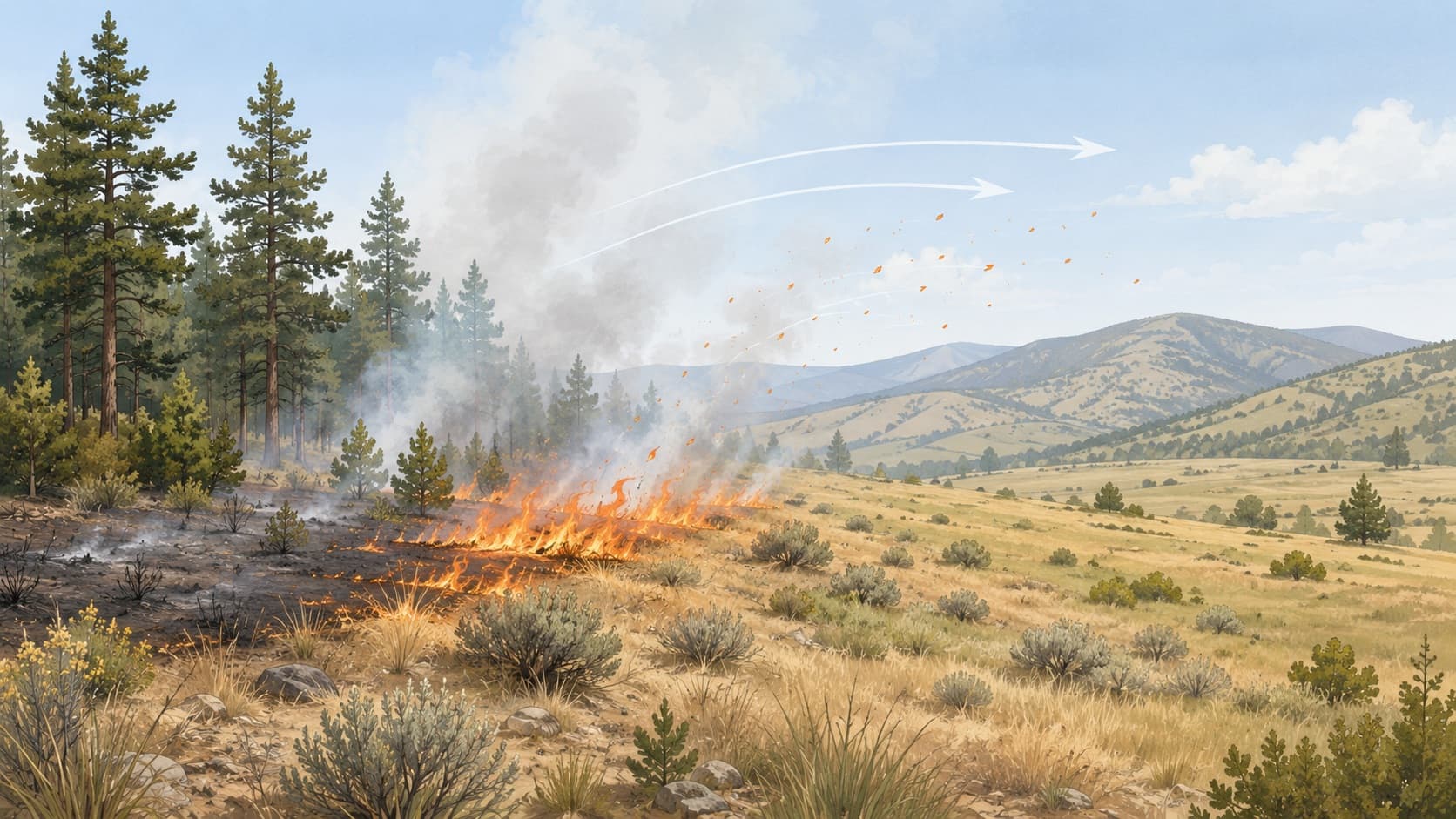
Wildfires are unplanned fires that burn in natural areas such as forests, grasslands, shrublands, prairies, and other landscapes with vegetation. They can spread through dry grass, brush, fallen leaves, forest litter, trees, roots, and sometimes into communities near wildland areas. Ready.gov defines wildfires as unplanned fires that burn out of control in natural areas and notes that they can spread quickly and affect communities. (Ready.gov)
Wildfires are part weather event, part chemistry, part landscape process, and part human-risk problem. To understand them, it helps to ask four basic questions:
- What started the fire?
- What is burning?
- What is the weather doing?
- What does the land shape do to the fire?
Preparedness note: This page is educational. For an active wildfire, follow official alerts, evacuation instructions, local emergency management, fire agencies, air quality agencies, and trusted public sources.
What Is a Wildfire?
A wildfire is a fire that burns through vegetation outside a controlled structure. Wildfires can occur in forests, grasslands, brushlands, deserts with dry vegetation, mountains, wetlands during dry periods, and areas where homes meet natural vegetation.
Different terms are often used depending on the landscape:
| Term | Plain-English Meaning |
|---|---|
| Wildfire | A general term for an uncontrolled fire burning in vegetation |
| Wildland fire | A broader fire-management term for fire in natural vegetation |
| Forest fire | A wildfire burning mainly in forested areas |
| Brush fire | A wildfire burning mainly in shrubs or brush |
| Grass fire | A wildfire burning mainly in grassland or prairie |
| Peat fire | A slow, smoldering fire burning organic soil or peat |
| WUI fire | A fire affecting the wildland-urban interface, where homes and development meet vegetation |
The wildland-urban interface, often shortened to WUI, is especially important because it is where homes, roads, power lines, vehicles, fences, sheds, and landscaping are close to wildland vegetation. Fires in these areas can involve both natural fuels and human-made materials.
Fire Basics: The Fire Triangle
For any fire to start and continue burning, it needs three basic things:
| Fire Triangle Element | What It Means |
|---|---|
| Heat | Enough energy to ignite material |
| Fuel | Something that can burn |
| Oxygen | Air supply that supports combustion |
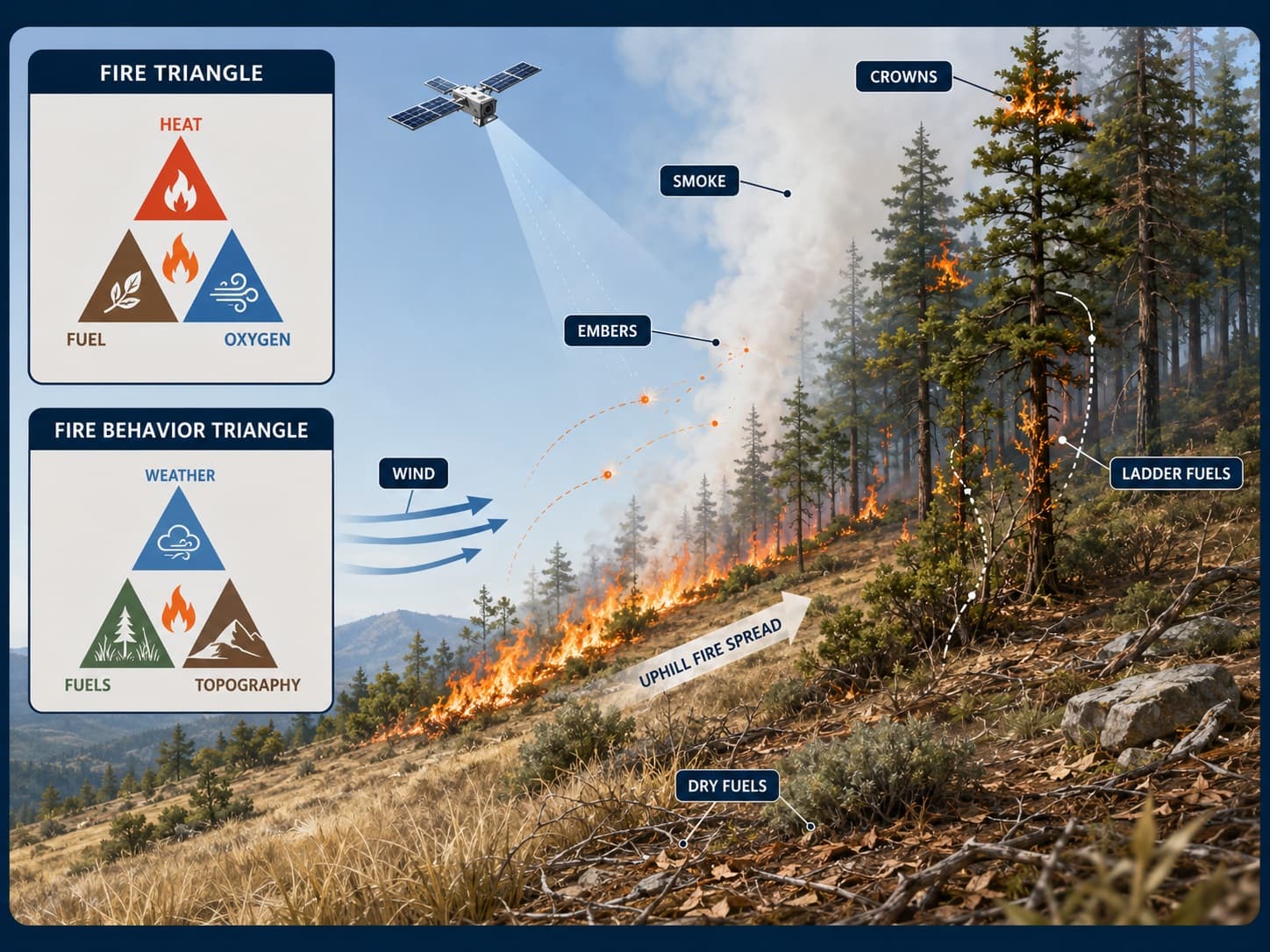
USGS describes the Fire Triangle as the three requirements needed to start and maintain a fire, and the Fire Behavior Triangle as the three main factors that affect wildland fire behavior: fuels, weather, and topography. (USGS)
A wildfire starts when heat reaches fuel in the presence of oxygen. A lightning strike, a spark, an ember, a campfire, equipment, power line issue, or other ignition source can provide the heat. If nearby fuel is dry enough, the fire can begin spreading.
Combustion: What Is Actually Happening?
Fire is a chemical reaction called combustion. During combustion, fuel reacts with oxygen and releases heat, light, gases, and particles.
In a wildfire, the fuel is usually plant material, such as:
- Dry grass
- Leaves
- Pine needles
- Twigs
- Branches
- Shrubs
- Tree bark
- Fallen logs
- Roots
- Organic soil
- Dead vegetation
- Live vegetation that has become dry enough to burn
Combustion does not happen all at once. As fuel heats up, it dries, breaks down, releases gases, and eventually ignites if conditions are right.
A simple sequence looks like this:
- Preheating: Fuel warms up.
- Drying: Moisture evaporates from the fuel.
- Pyrolysis: Heat breaks down plant material and releases flammable gases.
- Ignition: The gases and fuel begin burning.
- Flaming or smoldering: The fire continues as long as heat, fuel, and oxygen remain.
Fire Triangle vs. Fire Behavior Triangle
The fire triangle explains what a fire needs to exist. The fire behavior triangle explains how a wildfire behaves once it exists.
| Triangle | Parts | Main Question |
|---|---|---|
| Fire Triangle | Heat, fuel, oxygen | Can fire start and keep burning? |
| Fire Behavior Triangle | Fuel, weather, topography | How fast, hot, and intensely will a wildfire spread? |
The National Park Service explains that wildland fire behavior is shaped by fuels, weather, and topography, and that these factors work together rather than separately. (National Park Service)
The Fire Behavior Triangle
1. Fuel
Fuel is anything that can burn. In wildland fire science, fuel includes both dead and living vegetation.
Important fuel traits include:
| Fuel Trait | Why It Matters |
|---|---|
| Fuel type | Grass, brush, timber, leaves, needles, logs, and peat burn differently |
| Fuel moisture | Wetter fuel is harder to ignite; drier fuel burns more easily |
| Fuel size | Fine fuels like grass and needles ignite faster than large logs |
| Fuel continuity | Connected fuels allow fire to spread more easily |
| Fuel loading | More available fuel can support more intense burning |
| Vertical arrangement | “Ladder fuels” can carry fire from the ground into trees |
| Live vs. dead fuel | Dead fuels often dry faster; live fuels can also burn when dry enough |
Fine fuels are especially important because they respond quickly to weather. Dry grass, pine needles, and small twigs can become flammable after short dry periods, even if larger logs remain damp.
2. Weather
Weather can change wildfire behavior quickly. The most important weather factors are:
| Weather Factor | Effect on Fire |
|---|---|
| Wind | Pushes flames, carries embers, supplies oxygen, and can speed up spread |
| Relative humidity | Low humidity dries fuels and makes ignition easier |
| Temperature | Hot air can dry vegetation and increase fire activity |
| Rainfall | Wet weather can reduce fire activity, but effects depend on amount and duration |
| Drought | Long dry periods reduce moisture in plants, soil, and dead fuels |
| Thunderstorms | Lightning can start fires; thunderstorm winds can shift fire direction |
| Atmospheric instability | Rising air can help smoke columns grow and fire behavior intensify |
Strong wind and low humidity are a particularly important combination. The National Weather Service issues Fire Weather Watches and Red Flag Warnings when dry fuels and weather conditions support extreme fire danger; local criteria vary by region. (National Weather Service)
3. Topography
Topography means the shape of the land.
Important topographic factors include:
| Topographic Factor | Effect on Fire |
|---|---|
| Slope | Fire usually spreads faster uphill because flames preheat fuel above them |
| Aspect | South- and west-facing slopes in the Northern Hemisphere often get more sun and may be drier |
| Elevation | Affects temperature, vegetation, snowpack, and moisture |
| Canyons | Can funnel wind and heat, sometimes increasing fire intensity |
| Valleys | Can trap smoke or channel winds |
| Ridges | Can affect wind patterns and fire spread direction |
A fire on flat ground may spread differently from a fire on a steep hillside. On slopes, flames lean toward unburned fuel above them, preheating it and helping the fire climb.
How Wildfires Start
Wildfires can start naturally or from human activity. Lightning is the main natural cause. Human-caused wildfires can result from many sources, including equipment, vehicles, power infrastructure, debris burning, campfires, fireworks, and other ignition sources.
The National Interagency Fire Center notes that wildfires are caused by nature, generally lightning, or by human activity; as of 2023, the 10-year average of human-caused fires accounted for 88 percent of all wildfires nationally. (National Interagency Fire Center)
| Ignition Source | Example |
|---|---|
| Lightning | A strike ignites dry vegetation |
| Equipment | Sparks from machinery or tools |
| Vehicles | Hot parts or sparks near dry grass |
| Power infrastructure | Electrical faults or damaged lines |
| Campfires | Fire not fully extinguished |
| Debris burning | Outdoor burning that escapes control |
| Fireworks | Sparks landing in dry vegetation |
| Arson | Intentionally set fire |
The cause of a wildfire is investigated by trained professionals. Public education usually focuses on reducing avoidable ignition sources, while active fire response decisions belong to fire agencies and local officials.
Types of Wildfire by Where They Burn
Wildfires do not all burn in the same way. They can burn below the surface, on the surface, in shrubs, or in tree crowns.
| Fire Type | Where It Burns | Typical Behavior |
|---|---|---|
| Ground fire | Organic soil, roots, peat, buried material | May smolder slowly and be hard to detect |
| Surface fire | Grass, leaves, needles, small shrubs, fallen branches | Common wildfire type; can spread quickly in fine fuels |
| Shrub fire | Brush and woody shrubs | Can burn intensely, especially in dry and windy conditions |
| Crown fire | Tree canopies | Can spread rapidly through treetops under extreme conditions |
| Spot fire | New fire started by embers ahead of the main fire | Can make a wildfire spread in jumps |
Crown fires and spotting are especially important because they can move fire beyond the visible flame front. Wind can carry burning embers ahead of the main fire, starting new fires in dry vegetation or other receptive fuels.
Flame Length, Rate of Spread, and Fire Intensity
Wildfire behavior is often described with several related terms.
| Term | Plain-English Meaning |
|---|---|
| Flame length | How long the flames are from base to tip |
| Rate of spread | How fast the fire front moves |
| Fire intensity | How much heat energy the fire releases |
| Fire severity | How much the fire changes soil, vegetation, and ecosystem conditions |
| Residence time | How long heat remains in one place |
| Spotting distance | How far embers travel and start new fires |
A fast-moving grass fire may have shorter residence time than a slow, heavy-fuel forest fire. A smoldering ground fire may move slowly but burn for a long time. Fire behavior depends on the fuel, weather, and terrain together.
Fine Fuels vs. Heavy Fuels
Fuel size changes how quickly material dries and burns.
| Fuel Type | Examples | How It Behaves |
|---|---|---|
| Fine fuels | Grass, leaves, pine needles, small twigs | Dry quickly, ignite easily, spread fire rapidly |
| Medium fuels | Small branches, shrubs | Can support stronger flames |
| Heavy fuels | Logs, stumps, large branches | Dry slowly, burn longer, hold heat |
| Ground fuels | Peat, roots, organic soil | Can smolder for long periods |
Fine fuels are often the “starter fuel” for wildfires. Heavy fuels may not ignite as quickly, but once they burn, they can produce long-lasting heat.
Fuel Moisture
Fuel moisture means how much water is in the vegetation or burnable material. It is one of the most important wildfire science concepts.
| Fuel Moisture Condition | Fire Meaning |
|---|---|
| High moisture | Fuel is harder to ignite |
| Moderate moisture | Fuel may burn if heat and weather support ignition |
| Low moisture | Fuel ignites more easily and burns more actively |
| Extremely low moisture | Fire can spread quickly, especially with wind |
There are two broad categories:
| Fuel Moisture Type | What It Means |
|---|---|
| Dead fuel moisture | Moisture in dead grass, leaves, twigs, branches, and logs |
| Live fuel moisture | Moisture in living plants |
The National Park Service explains that live fuel moisture is the water content of live herbaceous plants, and lower values indicate drier materials and higher fire danger. (National Park Service)
Why Wind Matters So Much
Wind can turn a small fire into a fast-moving wildfire because it affects fire in several ways at once.
Wind can:
- Push flames toward unburned fuel
- Supply oxygen
- Dry fuels
- Carry embers ahead of the main fire
- Change fire direction
- Increase flame length
- Make fire behavior more difficult to predict
Wind can also shift suddenly because of fronts, thunderstorms, mountain-valley breezes, sea breezes, or fire-generated weather. A fire moving in one direction can change direction if winds shift.
Why Fires Often Move Faster Uphill
Fire usually spreads faster uphill than downhill because flames and hot gases rise. When a fire burns on a slope, the flames lean toward fuel uphill. This preheats and dries the vegetation above the fire, making it easier to ignite.
Slope effect is one reason a fire at the bottom of a hill can become more active as it climbs.
| Slope Condition | Fire Behavior |
|---|---|
| Flat ground | Spread depends mostly on wind and fuel |
| Gentle slope | Fire may move somewhat faster uphill |
| Steep slope | Fire can preheat uphill fuels quickly and spread faster |
| Canyon or chimney | Heat and wind may be funneled upward |
Wildfire Weather
Fire weather is weather that affects wildfire ignition, spread, and intensity. It includes temperature, humidity, wind, rainfall, drought, clouds, lightning, and atmospheric stability.
Important fire-weather patterns include:
| Pattern | Why It Matters |
|---|---|
| Hot, dry, windy weather | Dries fuels and increases spread |
| Low relative humidity | Allows fine fuels to dry quickly |
| Drought | Reduces fuel moisture over longer periods |
| Dry thunderstorms | Lightning without much rain can start fires |
| Strong fronts | Can shift wind direction and increase winds |
| Downslope winds | Warm, dry winds can rapidly increase fire danger |
| Unstable atmosphere | Can support tall smoke columns and erratic fire behavior |
NOAA’s wildfire-climate information explains that wildfires require alignment of factors including temperature, humidity, and lack of moisture in fuels such as trees, shrubs, grasses, and forest debris. (NOAA)
Fire Weather Watches and Red Flag Warnings
Fire weather alerts are used to communicate periods when wildfire danger may increase because fuels are dry and weather conditions are favorable for rapid fire growth.
| Alert | General Meaning |
|---|---|
| Fire Weather Watch | Critical fire weather conditions are possible |
| Red Flag Warning | Critical fire weather conditions are occurring or expected soon |
| Fire Weather Outlook | Forecast discussion of possible fire-weather risk over a broader area |
A Red Flag Warning does not mean a fire is already burning. It means weather and fuel conditions could support dangerous fire behavior if a fire starts. The National Weather Service notes that these alerts are written for land and fire managers and that each local office sets criteria for its area. (National Weather Service)
Fire Danger Ratings
Fire danger ratings help land managers and the public understand how easily fires may start and spread under current or expected conditions.
The National Fire Danger Rating System uses weather, fuels, and fire occurrence data to calculate fire danger for a given area. (USFS Research & Development)
| Rating | Plain-English Meaning |
|---|---|
| Low | Fires are less likely to start and spread |
| Moderate | Fires can start, but conditions are not extreme |
| High | Fires can start more easily and may spread |
| Very High | Fires can start easily and spread quickly |
| Extreme | Fires can start quickly, spread rapidly, and burn intensely |
Fire danger ratings are not the same as evacuation orders or active fire maps. They describe potential fire conditions, not a specific fire’s exact behavior.
Wildfire Smoke
Wildfire smoke is a mixture of gases and tiny particles from burning vegetation and other materials. Smoke can travel far from the fire itself, sometimes affecting communities hundreds or even thousands of miles away.
The EPA explains that during a wildfire, smoke can make outdoor air unhealthy to breathe and that some smoke can enter homes and affect indoor air too. (US EPA)
Smoke can include:
- Fine particles
- Carbon monoxide
- Carbon dioxide
- Water vapor
- Nitrogen oxides
- Volatile organic compounds
- Ash
- Other materials depending on what burns
The smallest particles, often called PM2.5, are especially important because they can travel deep into the lungs. This page is not medical advice; during smoke events, people should follow air quality agencies, public health officials, and medical professionals for health-specific guidance.
Pyrocumulus and Fire-Generated Weather
Large, intense wildfires can heat the air above them so strongly that the rising smoke column behaves like a thunderstorm updraft. Under some conditions, this can form a pyrocumulus cloud, or even a pyrocumulonimbus cloud.
| Fire-Generated Feature | What It Means |
|---|---|
| Smoke column | Rising smoke and heated air above a fire |
| Pyrocumulus | Fire-generated cumulus cloud |
| Pyrocumulonimbus | Fire-generated thunderstorm-like cloud |
| Fire whirl | Rotating column of hot air and flame or smoke |
| Downdraft | Sinking air that can spread wind near the surface |
| Column collapse | When a smoke column weakens and pushes air outward |
Fire-generated weather can make fires more complex. It can create sudden winds, loft embers, and change smoke movement. These processes are studied by meteorologists and fire-behavior specialists.
The Wildland-Urban Interface
The wildland-urban interface is where homes and communities meet or mix with wildland vegetation. Fires in these areas are complex because they can involve both natural fuels and built materials.
| Wildland Fuel | Built Environment Fuel |
|---|---|
| Grass | Fences |
| Shrubs | Decks |
| Trees | Sheds |
| Leaves and needles | Roofs and gutters |
| Dead branches | Vehicles |
| Logs | Outdoor furniture |
| Mulch | Utility infrastructure |
In WUI areas, wind-blown embers can be a major problem. Embers may travel ahead of the main fire and ignite dry leaves, mulch, fences, decks, or other receptive materials.
Wildfire Ecology: Fire Can Be Natural, But Risk Still Matters
Fire is a natural part of many ecosystems. Some plants and animals have adapted to periodic fire. Fire can recycle nutrients, open space for new growth, and maintain certain habitats.
However, not every fire has the same effect. Fire impacts depend on:
- Fire intensity
- Fire severity
- Season
- Frequency
- Soil moisture
- Vegetation type
- Slope
- Weather after the fire
- Previous land management
- Invasive species
- Development patterns
USGS describes wildland fire as a natural part of ecosystems while also noting that wildfire has increased significantly in the western United States over the past two decades. (USGS)
Fire Severity vs. Fire Intensity
These terms sound similar, but they mean different things.
| Term | Meaning | Example |
|---|---|---|
| Fire intensity | How much heat energy the fire releases while burning | Tall flames and strong heat output |
| Fire severity | How much the fire changes the land afterward | Soil heating, tree mortality, vegetation loss |
A fire can be intense for a short time but leave lower long-term damage in some areas. Another fire may burn slowly but heat soil or roots for a long time, causing higher severity.
Burn Scars and Post-Fire Hazards
After a wildfire, the landscape may change in ways that affect water, soil, and slope stability.
Possible post-fire effects include:
| Effect | Why It Matters |
|---|---|
| Less vegetation | Rain reaches soil more directly |
| Water-repellent soil | Water may run off instead of soaking in |
| Loose ash and soil | Material can move downhill |
| Burned roots | Soil may be less stable |
| Debris flows | Fast-moving mixtures of water, soil, rocks, ash, and debris can occur |
| Increased runoff | Streams may rise more quickly after rain |
Post-fire flooding and debris flows are separate hazards that can occur after the flames are out. For local risk, follow official post-fire guidance from emergency management, land managers, weather agencies, and geologic agencies.
How Wildfire Forecasting Works
Wildfire forecasting is not one forecast. It includes several related questions:
| Forecast Question | What Scientists and Forecasters Look At |
|---|---|
| Fire danger | Are fuels and weather favorable for ignition or spread? |
| Fire weather | Will wind, humidity, temperature, or lightning increase risk? |
| Ignition risk | Are natural or human ignition sources likely? |
| Fire behavior | If a fire starts, how might it spread? |
| Smoke movement | Where will smoke travel? |
| Fire growth | How large could a fire become under expected conditions? |
| Long-term potential | How might drought, vegetation, and climate affect the season? |
Wildfire forecasts combine meteorology, fuel science, topography, land cover, satellite data, field observations, and computer models.
Technology Used to Detect Wildfires
Modern wildfire detection uses many tools. No single tool sees everything perfectly, so agencies combine multiple sources.
| Tool | What It Does | Strength |
|---|---|---|
| Human reports | People see smoke or flames and report them | Fast when people are nearby |
| Lookout towers | Observers scan for smoke | Useful in some landscapes |
| Aircraft | Pilots or sensors detect smoke, heat, or fire perimeter | Flexible and detailed |
| Drones | Small aircraft collect imagery where allowed and safe | Useful for local mapping |
| Ground cameras | Cameras scan landscapes for smoke or flame | Continuous local monitoring |
| Lightning detection networks | Locate lightning strikes that may start fires | Helps identify possible ignition areas |
| Satellites | Detect heat, smoke, burned area, and fire movement | Wide-area coverage, including remote regions |
| Infrared sensors | Detect heat signatures through some smoke or darkness | Useful for active fire mapping |
NASA’s FIRMS system provides access to global near-real-time satellite imagery, active fire or hotspot locations, and related data. (NASA Earthdata)
Satellites and Wildfire Detection
Satellites changed wildfire science because they allow wide-area monitoring from above. Fires often occur in remote areas where ground reports may be limited. Satellites can detect heat, smoke, burned area, vegetation conditions, and fire growth.
Important satellite tools include:
| Satellite/Sensor Type | What It Helps Detect |
|---|---|
| Visible imagery | Smoke plumes, burn scars, cloud-free fire scenes |
| Infrared imagery | Heat from active fires |
| Thermal sensors | Fire hotspots and fire intensity estimates |
| Microwave sensors | Some surface and moisture conditions |
| Lightning sensors | Lightning that may ignite fires |
| Aerosol/smoke products | Smoke movement and air quality impacts |
| Vegetation indices | Greenness, dryness, and fuel condition |
NOAA explains that its GOES active fire detection data provide frequent observations, including 5-minute observations over the continental U.S. imaging sector and 10-minute full-disk observations over the western hemisphere. (NOAA OSPO)
NOAA’s GOES-R fire product provides information such as fire-pixel location, estimated fire size, temperature, radiative power, ecosystem type, and classification flags. (NOAA / NESDIS / STAR website)
What Is a Hotspot?
A satellite hotspot is a location where a sensor detects unusually high heat compared with the surrounding area. Hotspots can indicate active fire, but they are not always perfect ground truth.
Possible hotspot sources include:
- Wildfires
- Prescribed fires
- Agricultural burning
- Industrial heat sources
- Volcanoes
- Sensor artifacts or false positives in some cases
This is why wildfire maps often include notes about satellite detection limits. A hotspot is evidence that something hot was detected; trained analysts and official agencies interpret the data in context.
Fire Perimeter Mapping
A fire perimeter is the outer boundary of a burned or actively burning area. Perimeters help show where a fire has been, but they may not show every active flame at the exact current moment.
Fire perimeters can be mapped using:
- Aircraft infrared imagery
- Satellite imagery
- Field reports
- GPS observations
- Drones where authorized
- Incident mapping teams
- Fire behavior models
Infrared mapping is especially useful because heat can be detected even when smoke or darkness limits visible observation.
Smoke Forecasting
Smoke forecasting estimates where smoke may move and how concentrated it may become. Smoke movement depends on fire intensity, fuel type, wind speed, wind direction, atmospheric stability, terrain, and the height of the smoke plume.
NOAA uses a Smoke Forecasting System to predict the transport and dispersion of wildfire smoke over the United States, Alaska, and Hawaii. (Air Resources Laboratory)
Smoke models may use:
- Fire location
- Estimated emissions
- Weather forecasts
- Wind at different heights
- Atmospheric mixing
- Terrain
- Satellite smoke observations
- Air quality monitoring data
Smoke forecasts are useful because smoke may affect areas far from active fire.
Computer Models for Wildfire Behavior
Wildfire models use math, physics, maps, weather data, and fuel information to estimate how a fire may behave.
The U.S. Forest Service explains that fire behavior research supports models used in fire prediction, planning, and training. (USFS Research & Development)
Models may estimate:
| Model Output | Meaning |
|---|---|
| Rate of spread | How fast fire may move |
| Flame length | How large flames may become |
| Fireline intensity | Heat output along the fire front |
| Crown fire potential | Chance of fire moving into treetops |
| Spotting distance | How far embers may start new fires |
| Burn probability | Chance an area could burn under modeled conditions |
| Smoke transport | Where smoke may travel |
| Fire growth | Possible future fire perimeter |
Wildfire models are decision-support tools. They do not remove uncertainty. Fire behavior can change quickly if wind shifts, humidity drops, fuels change, or new spot fires start.
Data Used in Wildfire Models
Wildfire models need many kinds of data.
| Data Type | Why It Matters |
|---|---|
| Weather forecasts | Wind, temperature, humidity, rainfall, lightning |
| Fuel maps | What vegetation is available to burn |
| Fuel moisture | How dry vegetation is |
| Topography | Slope, aspect, elevation, canyons |
| Fire perimeter | Current known fire boundary |
| Satellite hotspots | Active fire detections |
| Land cover | Forest, grassland, shrubland, urban areas |
| Drought data | Longer-term dryness |
| Historical fire data | Past fire behavior and burn areas |
| Suppression features | Roads, firebreaks, water sources, previous burns |
The Department of the Interior describes LANDFIRE as a data source that supports fire modeling systems such as the Wildland Fire Decision Support System by providing consistent all-lands data. (U.S. Department of the Interior)
Wildland Fire Decision Support Systems
Fire agencies use decision-support systems to organize data, model possible outcomes, and support planning. These tools are designed for trained fire professionals, not as standalone public instructions.
The Wildland Fire Decision Support System, or WFDSS, is described by the U.S. Forest Service as a web-based application that allows interagency fire staff to access a suite of decision-support tools, including certain fire models. (USFS Research & Development)
Decision-support systems can combine:
- Fire perimeter data
- Weather forecasts
- Fuels data
- Topography
- Values at risk
- Fire behavior modeling
- Probability modeling
- Incident documentation
- Maps and planning tools
How Wildfire Technology Has Changed Over Time
Wildfire science has changed from local observation and hand-drawn maps to satellites, infrared sensors, computer models, digital maps, and near-real-time data systems.
| Era | Main Tools | What Changed |
|---|---|---|
| Before modern instruments | Local knowledge, visible smoke, hand tools, natural landmarks | People detected and described fires mostly by direct observation |
| Late 1800s–early 1900s | Fire lookouts, telegraph, early maps | Reports could be shared faster across regions |
| Mid-1900s | Radio communication, aircraft patrols, weather stations | Fire detection and coordination improved |
| 1960s–1970s | Early satellites, aerial infrared, fire-danger rating systems | Scientists began using broader weather and landscape data |
| 1980s–1990s | GIS mapping, improved remote sensing, digital weather data | Fire maps became more detailed and data-driven |
| 2000s | MODIS satellite fire detections, web mapping, better fire models | Near-real-time fire information became more accessible |
| 2010s | VIIRS, improved GOES satellites, high-resolution weather models, mobile alerts | Detection became more frequent and detailed |
| 2020s | AI-assisted detection, drone mapping, cloud computing, integrated data portals | Fire monitoring increasingly combines satellite, aircraft, ground sensors, models, and machine learning |
NASA’s Earthdata fire resources, NOAA’s satellite fire products, and modern decision-support systems show how wildfire monitoring has become more data-rich and more connected than earlier observation-based systems. (NASA Earthdata)
From Lookout Towers to Satellites
For much of modern fire history, detection depended heavily on people seeing smoke from lookout towers, aircraft, roads, or communities. That still matters, but satellites now provide wide-area coverage that can detect fires in remote places.
| Detection Method | Strength | Limitation |
|---|---|---|
| Human observation | Can report context quickly | Limited by visibility, distance, and access |
| Lookout tower | Continuous view of a region | Smoke, terrain, and staffing limit coverage |
| Aircraft patrol | Can inspect large areas | Weather, cost, and availability matter |
| Ground camera | Continuous local monitoring | Limited field of view |
| Satellite | Wide-area and remote coverage | May miss small fires, fires under clouds, or fires between passes |
| Drone | Detailed local mapping | Requires authorization, safe airspace, and trained operation |
The biggest change is not that one tool replaced another. The biggest change is that many tools now work together.
Artificial Intelligence and Machine Learning
AI and machine learning are increasingly used to help analyze wildfire data. They can scan large amounts of satellite imagery, camera imagery, weather data, and historical fire data to look for patterns.
Possible uses include:
- Detecting smoke in camera feeds
- Finding hotspots in satellite imagery
- Mapping fire perimeters
- Estimating burned area
- Predicting fire spread
- Identifying high-risk conditions
- Combining weather, fuel, and terrain data
- Supporting smoke plume analysis
AI is not a magic wildfire forecast system. It depends on training data, sensor quality, assumptions, and expert review. It is best understood as another tool that can help process large datasets faster.
Recent research continues to explore deep learning for satellite-based fire detection, burned-area mapping, and short-term wildfire progression prediction, using inputs such as satellite imagery, weather, topography, land cover, and fuel information. (arXiv)
Why Wildfire Forecasting Is Difficult
Wildfire forecasting is difficult because fires respond to many variables that can change quickly.
| Challenge | Why It Matters |
|---|---|
| Wind shifts | Can change fire direction quickly |
| Spot fires | Embers can start new fires ahead of the main fire |
| Fuel variation | Grass, shrubs, and timber burn differently |
| Fuel moisture | Moisture can vary by slope, time of day, and vegetation type |
| Terrain | Canyons, ridges, and slopes change wind and spread |
| Smoke columns | Large fires can influence local winds |
| Limited observations | Remote areas may have fewer sensors |
| Human factors | Ignition sources and suppression actions are difficult to model |
| Weather uncertainty | Small forecast changes can alter fire behavior |
| Built environment | WUI fires involve structures and vegetation together |
A model may estimate likely fire growth, but actual behavior can differ if winds shift, humidity drops, embers cross a road, or fuels are different from the map.
Wildfire and Climate Change
Wildfires are influenced by weather, fuels, ignition sources, land management, development patterns, and climate. Climate change does not mean every wildfire has a single cause, but it can affect the background conditions that make some fires more likely or more intense.
NOAA explains that climate change, including increased heat, extended drought, and a “thirsty atmosphere,” has been a key driver in increasing wildfire risk and extent in the western United States during the last two decades. (NOAA)
| Climate-Related Factor | Possible Fire Effect |
|---|---|
| Higher temperatures | Fuels may dry faster |
| Longer dry seasons | More time for fuels to become flammable |
| Drought | Lower moisture in soil and vegetation |
| Earlier snowmelt | Longer period of dry vegetation in some regions |
| Extreme heat | Greater stress on plants and soils |
| Changing precipitation | Can affect vegetation growth and later drying |
| More severe fire weather in some areas | Increased chance of rapid spread |
Climate is one part of the wildfire picture. Land use, ignition patterns, vegetation, development in fire-prone areas, and fire management also matter.
Wildfires, Drought, and Vegetation
Drought can increase wildfire risk by drying fuels. But the relationship is not always simple.
In some landscapes, wet periods can grow more grass or brush. Later, if that vegetation dries out, it becomes fuel. In other landscapes, long drought can dry forests, stress trees, and lower fuel moisture.
| Pattern | Possible Fire Effect |
|---|---|
| Wet growing season followed by dry weather | More fine fuel, then easier ignition |
| Long drought | Dry vegetation and stressed trees |
| Hot, dry wind event | Rapid spread once ignition occurs |
| Repeated dry years | Lower live and dead fuel moisture |
| Heavy rain after fire | Possible flooding, erosion, or debris flows |
Wildfire risk depends not only on whether a place is dry today, but also on what happened in previous weeks, months, and years.
Prescribed Fire and Cultural Burning
Not all fire is wildfire. Some fires are intentionally planned and managed by trained professionals under specific conditions. These may include prescribed fires or cultural burning practices.
Educationally, the key distinction is:
| Fire Type | Meaning |
|---|---|
| Wildfire | Unplanned fire burning in vegetation |
| Prescribed fire | Planned fire used by trained professionals under defined conditions |
| Cultural burning | Fire use guided by Indigenous knowledge, cultural goals, and stewardship practices |
| Pile burning | Burning collected vegetation under controlled conditions |
Prescribed fire and cultural burning are complex practices that require knowledge, authorization, weather windows, trained crews, and local rules. This page does not provide instructions for conducting fire; it only explains the science distinction.
Common Wildfire Misunderstandings
| Misunderstanding | Better Explanation |
|---|---|
| “Wildfires only happen in forests.” | Wildfires can burn in grasslands, brushlands, prairies, deserts with dry vegetation, wetlands during dry periods, and WUI areas. |
| “If there is no flame nearby, there is no danger.” | Embers can travel ahead of the main fire and start spot fires. Smoke can also affect areas far from flames. |
| “Rain always ends fire risk immediately.” | Light rain may not wet larger fuels or may dry quickly under wind and heat. |
| “Only huge fires matter.” | Small fires can become serious if wind, dry fuels, and terrain support rapid spread. |
| “The fire line on a map is exact and current.” | Perimeters and hotspots are best available data, but they can lag behind real conditions. |
| “A Red Flag Warning means a fire is already burning.” | It means weather and fuel conditions could support dangerous fire behavior if a fire starts. |
| “Smoke only affects people near the fire.” | Smoke can travel long distances depending on winds and atmospheric conditions. |
| “Technology can predict exactly where a fire will go.” | Models help estimate possibilities, but wildfire behavior still has uncertainty. |
Key Wildfire Vocabulary
| Term | Plain-English Meaning |
|---|---|
| Combustion | Chemical reaction that produces fire |
| Fire triangle | Heat, fuel, and oxygen |
| Fire behavior triangle | Fuel, weather, and topography |
| Fuel | Material that can burn |
| Fine fuel | Small material such as grass, needles, leaves, and small twigs |
| Fuel moisture | Amount of water in burnable material |
| Ladder fuel | Fuel that can carry fire from the ground into tree crowns |
| Surface fire | Fire burning near the ground |
| Crown fire | Fire burning through treetops |
| Spot fire | New fire started by embers ahead of the main fire |
| Ember | Small burning piece of material carried by wind |
| Fireline intensity | Heat released along the fire front |
| Fire severity | Long-term effect of fire on soil and vegetation |
| Red Flag Warning | Alert for critical fire weather and fuel conditions |
| WUI | Wildland-urban interface |
| Hotspot | Satellite-detected heat source |
| Fire perimeter | Mapped boundary of a fire area |
| Burn scar | Area affected by a previous fire |
| Pyrocumulus | Fire-generated cloud |
| Smoke plume | Column or layer of smoke moving through the atmosphere |
Technology Summary
Wildfire science has become much more advanced over time. Earlier wildfire detection depended mostly on people seeing smoke, fire lookouts, aircraft patrols, local weather knowledge, and paper maps. Today, wildfire monitoring and forecasting use satellite hotspots, infrared imagery, fire weather models, fuel moisture data, lightning detection, GIS maps, smoke models, drones, cameras, and decision-support systems.
Modern systems can help answer questions such as:
- Where are active fires?
- Where is smoke moving?
- How dry are fuels?
- What is the fire weather risk?
- How might terrain affect fire spread?
- Where could embers start spot fires?
- What areas may be affected by smoke?
- How might a fire grow under forecast conditions?
Even with better technology, wildfire behavior remains complex. Wind shifts, fuel changes, terrain effects, smoke columns, and ember spotting can create uncertainty.
Science Summary
Wildfires begin when heat, fuel, and oxygen come together. Once a wildfire starts, its behavior is shaped mainly by fuel, weather, and topography. Dry fine fuels ignite quickly. Wind pushes flames and embers. Low humidity dries vegetation. Slopes help fires move uphill. Canyons and ridges can change winds and fire movement.
Wildfires can burn as ground fires, surface fires, shrub fires, crown fires, or spot fires. They can produce smoke that travels far from the flames. After a fire, burn scars may increase flood, erosion, and debris-flow risk during heavy rain.
Forecasting and detection have improved greatly because of satellites, weather models, fire-danger rating systems, infrared sensors, GIS maps, smoke models, and decision-support tools. These systems help scientists and fire professionals understand risk and track changing conditions, but they do not remove uncertainty.
The safest way to use wildfire science is to understand the basic forces at work while relying on official local alerts, evacuation instructions, fire agencies, weather forecasts, and air quality guidance during real events.