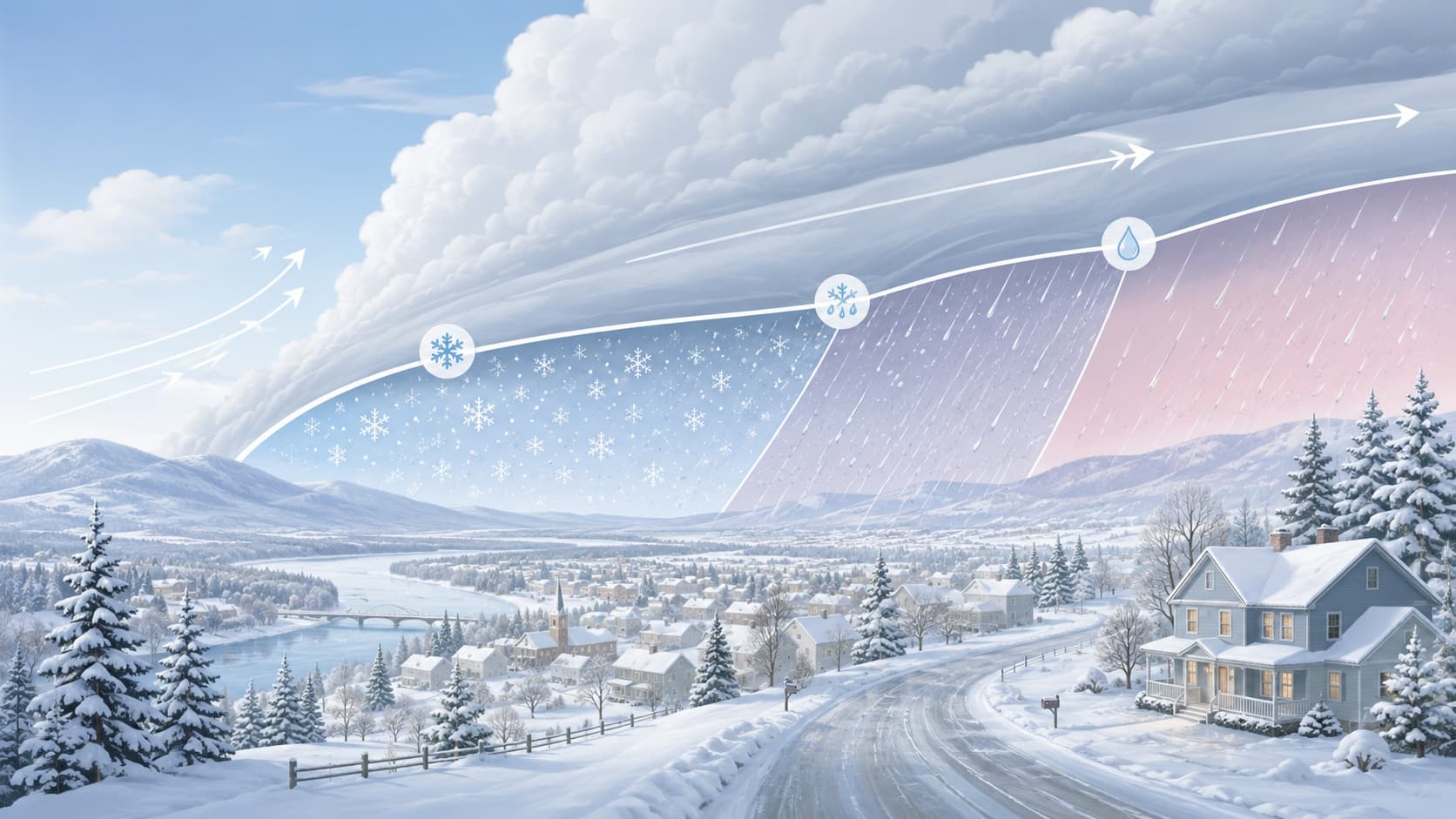
Winter storms happen when cold air, moisture, lift, and wind combine to create hazardous winter weather. They can bring snow, sleet, freezing rain, strong winds, blowing snow, extreme cold, coastal flooding, dangerous travel conditions, and power outages. A winter storm is not just “a snowstorm.” It is a weather system where several winter hazards may overlap.
NOAA’s National Severe Storms Laboratory describes a winter storm as a combination of heavy snow, blowing snow, and/or dangerous wind chills. It also describes blizzards as winter storms with blowing snow and wind that create very low visibility. (NOAA National Severe Storms Laboratory)
Preparedness note: This page is educational. For an active winter storm, follow official alerts from the National Weather Service, local emergency management, transportation departments, utility providers, and local officials.
What Is a Winter Storm?
A winter storm is a weather system that produces hazardous winter conditions. It may include snow, sleet, freezing rain, high winds, blowing snow, dangerous cold, or a mix of these.
Winter storms can form from many types of low-pressure systems. Some develop over land. Some strengthen near coasts. Some form when cold air meets warm, moist air. Others are smaller but still hazardous, such as lake-effect snow bands or snow squalls.
A useful way to think about a winter storm is this:
A winter storm needs cold air, moisture, lift, and the right temperature pattern from the clouds to the ground.
| Ingredient | What It Means | Why It Matters |
|---|---|---|
| Cold air | Air near or below freezing | Allows snow or ice to reach the ground |
| Moisture | Water vapor in the air | Provides material for clouds and precipitation |
| Lift | Air rising into colder layers | Helps clouds and precipitation form |
| Temperature profile | Temperature from cloud level to the ground | Determines whether precipitation becomes snow, sleet, freezing rain, or rain |
| Wind | Moving air near the surface and aloft | Can create blowing snow, drifting, wind chill, and coastal impacts |
| Storm track | Path of the low-pressure system | Controls where warm air, cold air, snow, ice, and rain fall |
The Main Types of Winter Weather
Winter storms can produce several kinds of precipitation and hazards.
| Type | What It Is | Main Hazard |
|---|---|---|
| Snow | Ice crystals that remain frozen from cloud to ground | Accumulation, travel impacts, snow load, reduced visibility |
| Sleet | Partly melted snow that refreezes before reaching the ground | Icy roads, compacted pellets, difficult travel |
| Freezing rain | Liquid rain that freezes on contact with cold surfaces | Glaze ice on roads, trees, power lines, sidewalks |
| Ice storm | Significant freezing rain accumulation | Tree damage, power outages, hazardous travel |
| Blizzard | Snow or blowing snow with strong winds and very low visibility | Whiteout conditions, drifting snow, dangerous travel |
| Snow squall | Brief, intense burst of snow and gusty wind | Sudden whiteout and quick road icing |
| Lake-effect snow | Snow created when cold air moves over relatively warmer lake water | Narrow but intense snow bands |
| Wind chill | How cold wind makes air feel on exposed skin | Increased cold stress risk |
| Ground blizzard | Existing snow is lifted by strong wind | Low visibility even when new snow is not falling |
Snow, Sleet, Freezing Rain, and Rain: Why the Difference Matters
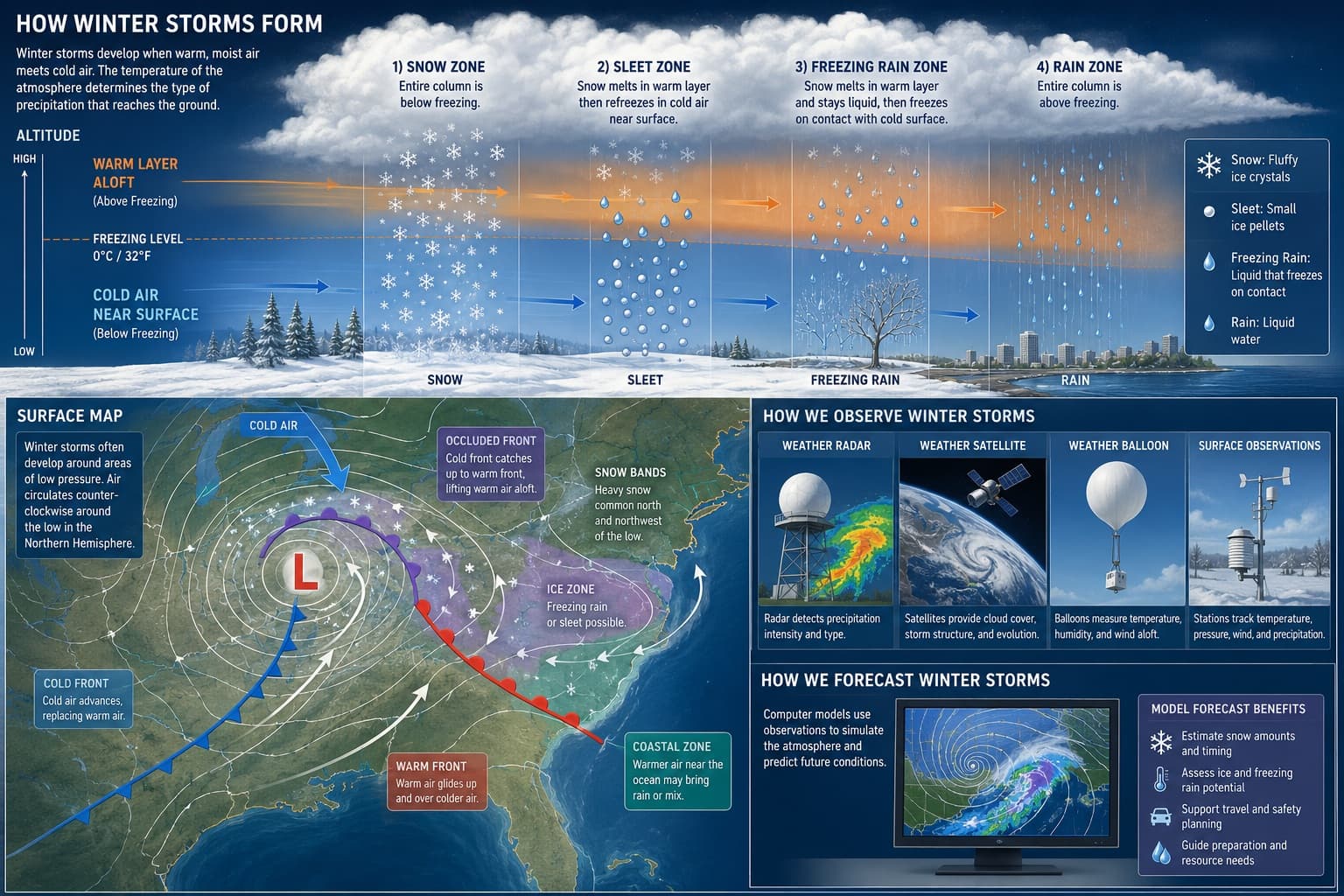
Most winter precipitation begins high in the cloud as snow. What happens next depends on the temperature layers the snowflakes fall through. The vertical temperature profile is one of the most important factors in deciding whether the ground receives snow, sleet, freezing rain, or rain. (National Weather Service)
| Precipitation Type | Temperature Pattern | What Reaches the Ground |
|---|---|---|
| Snow | Freezing or below-freezing air from cloud to ground | Snowflakes |
| Sleet | Snow partially melts in a shallow warm layer, then refreezes in deeper cold air | Ice pellets that bounce |
| Freezing rain | Snow melts completely in warm air, then falls through a shallow cold layer near the ground | Supercooled liquid drops that freeze on contact |
| Rain | Snow melts and stays liquid through above-freezing air near the ground | Liquid rain |
The difference between sleet and freezing rain can be only a few degrees and a few hundred feet of atmosphere. That is why winter precipitation forecasts can be difficult, especially near the rain-snow line.
How Snow Forms
Snow forms when water vapor in a cloud turns directly into ice crystals, usually in cold cloud layers. These ice crystals grow as more water vapor freezes onto them. When enough crystals join together, they become snowflakes.
Snow reaches the ground when the air remains cold enough from the cloud base to the surface. The National Weather Service explains that most winter precipitation starts as snow because the upper part of the storm is usually cold enough for snowflakes to form. Snow continues falling as snow when temperatures remain at or below freezing from the cloud to the ground. (National Weather Service)
Snowflakes can look different depending on temperature and humidity. Some are light and fluffy. Others are wet and heavy. The difference matters because the same amount of liquid water can produce different snow depths.
| Snow Type | Common Conditions | Why It Matters |
|---|---|---|
| Light, fluffy snow | Colder air, lower water content | Blows around easily and can create drifting |
| Wet, heavy snow | Temperatures near freezing, higher water content | Harder to shovel, heavier on trees and power lines |
| Powdery snow | Cold, dry conditions | Can accumulate deeply but may contain less water |
| Compact snow | Wind-packed or sleet-mixed snow | Can become dense and icy |
Snow-to-Liquid Ratio
The snow-to-liquid ratio compares snow depth to the amount of water it contains. A common classroom example is 10 inches of snow from 1 inch of liquid water, called a 10:1 ratio, but real storms can be much different.
| Snow-to-Liquid Ratio | What It Means | Typical Feel |
|---|---|---|
| 5:1 | 5 inches snow from 1 inch liquid | Wet, heavy snow |
| 10:1 | 10 inches snow from 1 inch liquid | Common reference value |
| 15:1 | 15 inches snow from 1 inch liquid | Fluffier snow |
| 20:1 or higher | 20+ inches snow from 1 inch liquid | Very light, powdery snow |
A forecast of “1 inch of liquid equivalent” could mean several inches of heavy wet snow or well over a foot of fluffy snow, depending on the temperature profile and snow crystal growth.
Sleet
Sleet forms when snowflakes fall through a shallow warm layer and partially melt, then pass through a deeper below-freezing layer and refreeze before reaching the ground. Sleet usually bounces when it hits the surface. (National Weather Service)
Sleet can make roads and sidewalks slippery. It usually does not coat trees and power lines as efficiently as freezing rain, but it can pack down into a dense icy layer.
| Feature | Sleet |
|---|---|
| Surface form | Ice pellets |
| Sound | Often pings or bounces |
| Main impact | Slippery travel surfaces |
| Accumulation style | Can pile up like small pellets |
| Key atmosphere pattern | Warm layer aloft, deeper freezing layer below |
Freezing Rain
Freezing rain forms when snowflakes melt completely into raindrops in a warm layer aloft, then fall through a shallow freezing layer near the surface. The drops do not have time to refreeze in the air. Instead, they become supercooled liquid and freeze when they touch surfaces at or below freezing. (National Weather Service)
Freezing rain can create a clear, smooth glaze of ice on:
- Roads
- Sidewalks
- Trees
- Power lines
- Railings
- Vehicles
- Bridges
- Steps
- Driveways
Even light freezing rain can make travel difficult. Heavier ice can weigh down branches and power lines. NOAA describes an ice storm as a storm that results in at least 0.25 inch of ice accumulation on exposed surfaces. (NOAA National Severe Storms Laboratory)
Ice Storms
An ice storm is a winter storm where freezing rain accumulates enough ice to create serious impacts. Ice storms are often more damaging than snowstorms because ice sticks to surfaces and adds weight.
| Ice Accumulation | Possible Impact |
|---|---|
| Trace | Slick spots, especially untreated roads and sidewalks |
| 0.01–0.10 inch | Hazardous walking and driving surfaces |
| 0.10–0.25 inch | Increasing tree and power line stress |
| 0.25 inch or more | Ice storm conditions; tree and power line damage possible |
| 0.50 inch or more | Significant damage and outages possible, especially with wind |
The amount of ice is not the only factor. Wind, tree health, surface temperature, and how long freezing rain lasts also matter.
Blizzards
A blizzard is not defined only by how much snow falls. It is defined by wind and visibility. NOAA describes blizzard conditions as winds over 35 mph with snow or blowing snow reducing visibility to one-quarter mile or less for at least three hours. (NOAA National Severe Storms Laboratory)
| Blizzard Requirement | Meaning |
|---|---|
| Strong wind | Sustained wind or frequent gusts near or above 35 mph |
| Snow or blowing snow | Snow falling or already on the ground being lifted by wind |
| Low visibility | Visibility reduced to one-quarter mile or less |
| Duration | Conditions last at least 3 hours |
A blizzard can happen with falling snow, or it can happen as a ground blizzard, where strong wind picks up snow that has already fallen.
Snow Squalls
A snow squall is a short, intense burst of snow with gusty winds. Snow squalls often move through quickly, but they can suddenly reduce visibility and make roads icy in minutes. The National Weather Service explains that snow squalls usually last less than an hour and can occur even when there is no large winter storm underway. (National Weather Service)
| Feature | Snow Squall | Larger Snowstorm |
|---|---|---|
| Duration | Often 30–60 minutes | Several hours to days |
| Area | Localized and narrow | Wider region |
| Snow amount | Often light to moderate | Can be heavy |
| Visibility | Can drop suddenly to near whiteout | Often reduced more gradually |
| Travel impact | Sudden and severe | Often forecast with more lead time |
Snow squalls are important because they can create high-impact travel conditions even when total snow accumulation is small.
Lake-Effect Snow
Lake-effect snow forms when cold air moves across relatively warmer lake water. The air picks up heat and moisture from the lake. As that air moves over land and rises, the moisture can fall as snow.
NOAA explains that lake-effect storms are not low-pressure-system storms in the usual sense. They form when cold, dry air moves over the Great Lakes, picks up moisture, and then drops that moisture as snow, usually south and east of the lakes. (NOAA National Severe Storms Laboratory)
Lake-effect snow can be very localized. One town may receive heavy snow while a nearby town has much less.
Important lake-effect ingredients include:
| Ingredient | Why It Matters |
|---|---|
| Cold air over warmer water | Creates instability and evaporation |
| Long fetch | Air travels over more lake water and gains more moisture |
| Wind direction | Controls where snow bands go |
| Atmospheric instability | Helps air rise and form snow clouds |
| Topography | Hills can lift air and enhance snow |
| Ice cover | More lake ice can reduce available moisture |
Nor’easters and Coastal Winter Storms
A nor’easter is a strong storm along or near the East Coast of North America, often named for winds that blow from the northeast along the coast. Nor’easters can bring heavy snow, rain, coastal flooding, strong wind, and beach erosion.
A coastal winter storm can be especially powerful because it may draw moisture from the ocean while cold air remains over land. If the storm track is just right, heavy snow can fall inland while rain or mixed precipitation falls closer to the coast.
| Storm Track | Common Result |
|---|---|
| Far offshore | Lighter snow or missed precipitation inland |
| Near the coast | Heavy snow inland, rain/mix near coast |
| Inland track | Warmer air moves inland; more rain or mixed precipitation |
| Slow-moving coastal storm | Longer-duration snow, wind, coastal flooding risk |
The Science of Winter Storm Formation
Many winter storms form near boundaries between cold and warm air. These boundaries are called fronts. Low-pressure systems develop and strengthen when air masses interact and upper-level winds support rising motion.
A simplified winter storm process looks like this:
- Cold air settles near the surface.
- Moist air moves into the region.
- A low-pressure system develops or strengthens.
- Air rises along fronts or terrain.
- Clouds and precipitation form.
- The temperature profile determines snow, sleet, freezing rain, or rain.
- Wind may create blowing snow, drifting, coastal flooding, or wind chill impacts.
The storm’s exact track matters greatly. A shift of only 25 to 50 miles can move the heavy snow band, ice zone, or rain-snow line.
Low Pressure, Fronts, and Lift
Winter storms often form around low-pressure systems. Air flows inward toward low pressure and rises. Rising air cools, and water vapor condenses or freezes into cloud particles.
| Feature | What It Does |
|---|---|
| Low-pressure center | Organizes rising air, clouds, wind, and precipitation |
| Warm front | Warm air rises over colder air, often creating widespread precipitation |
| Cold front | Cold air pushes under warmer air, sometimes creating squalls |
| Occluded front | A mature storm structure where cold air wraps around the system |
| Upper-level trough | Supports rising motion and storm development |
| Jet stream | Fast winds aloft that can help strengthen storms |
The strongest precipitation often forms where moisture, lift, and cold air overlap.
The Jet Stream
The jet stream is a fast-moving river of air high in the atmosphere. It helps steer winter storms and can help them strengthen. When the jet stream dips south, cold air can move into lower latitudes. When it curves north, warmer air can move into colder regions.
The jet stream matters because it affects:
- Where storms form
- How fast storms move
- Where cold air travels
- Where moisture travels
- Where strong lifting occurs
- Where heavy snow bands may develop
A strong jet stream can help create a powerful storm by increasing rising motion in certain areas.
The Temperature Profile: The Hidden Layer Cake
A winter storm forecast depends heavily on the atmosphere above the ground, not just the temperature at the surface. Meteorologists often look at temperature like a vertical layer cake.
| Layer | Why It Matters |
|---|---|
| Cloud layer | Where snowflakes usually form |
| Warm layer aloft | Can melt snowflakes into raindrops |
| Cold layer near surface | Can refreeze drops into sleet or allow freezing rain |
| Surface temperature | Controls whether rain freezes on contact |
| Ground temperature | Affects road and sidewalk icing |
Two places can both have a surface temperature of 31°F, but one may receive snow while the other receives freezing rain because the air above them is different.
Why Winter Storm Forecasts Can Change
Winter storms are sensitive to small changes. A tiny shift in temperature, storm track, moisture, or timing can change the outcome.
| Forecast Challenge | Why It Matters |
|---|---|
| Rain-snow line | A small shift can change snow to rain or ice |
| Warm nose aloft | A shallow warm layer can turn snow into sleet or freezing rain |
| Dry air | Can delay precipitation or reduce amounts |
| Banding | Narrow heavy snow bands can double totals in one area |
| Surface temperature | Roads may ice even when air temperatures are near freezing |
| Storm speed | Slower storms can produce more accumulation |
| Wind | Can create drifting, blizzard conditions, or coastal flooding |
| Elevation | Higher terrain may be colder and snowier |
| Lake or ocean influence | Water can add moisture and change local temperature |
This is why winter forecasts often include ranges, probabilities, and updates as the storm gets closer.
Winter Storm Hazards
Winter storms are multi-hazard events. Snow amount is only one part of the risk.
| Hazard | What It Is | Why It Matters |
|---|---|---|
| Heavy snow | Large snow accumulation | Can make travel difficult and add weight to roofs, trees, and lines |
| Wet snow load | Dense snow with high water content | Heavier on trees, roofs, and power lines |
| Ice accumulation | Freezing rain glaze | Creates slick surfaces and can damage trees and utilities |
| Sleet | Ice pellets | Creates compacted, slippery surfaces |
| Blowing snow | Wind lifts falling or fallen snow | Reduces visibility and creates drifts |
| Blizzard conditions | Strong wind and very low visibility | Travel can become dangerous even if new snow is limited |
| Wind chill | Wind increases heat loss from exposed skin | Makes cold feel more severe |
| Extreme cold | Very low air temperature | Can stress heating systems, pipes, vehicles, and people |
| Coastal flooding | Water pushed inland by storm wind and pressure | Affects coastlines during some winter storms |
| Snow squalls | Brief intense snow and wind bursts | Sudden whiteouts and flash-freezing road conditions |
| Avalanches | Snow slides on steep terrain | Mountain hazard requiring expert local guidance |
| Ice jams | River ice blocks flow | Can cause flooding during freeze-thaw periods |
Wind Chill
Wind chill describes how cold the air feels on exposed skin when wind removes body heat faster. Wind chill does not change the actual air temperature, but it changes how quickly exposed skin and bodies lose heat.
| Condition | Effect |
|---|---|
| Calm cold air | Heat is lost more slowly |
| Windy cold air | Heat is removed faster |
| Wet clothing plus wind | Heat loss increases |
| Exposed skin | More vulnerable to cold stress |
This page does not provide medical advice. During dangerous cold, follow official public health and weather guidance, and consult qualified professionals for health-specific concerns.
Snow Load
Snow load is the weight of snow on a surface. Wet snow can weigh much more than fluffy snow. Ice, rain-on-snow, and repeated storms can increase load.
| Snow Condition | Load Concern |
|---|---|
| Light powder | Lower water content, less weight |
| Wet snow | Higher water content, heavier |
| Snow followed by rain | Snow absorbs water and becomes heavier |
| Ice on snow | Adds weight and hard layers |
| Repeated storms | Snowpack accumulates over time |
The Weather Prediction Center’s Winter Storm Severity Index includes snow load as one component, along with snow amount, ice accumulation, and blowing snow. (Weather Prediction Center)
Winter Storm Watches, Warnings, and Advisories
Winter weather alerts help communicate timing, confidence, and expected impact. Exact criteria vary by region because the same snow amount may have different impacts in different places.
| Alert Type | General Meaning |
|---|---|
| Winter Storm Watch | Significant hazardous winter weather is possible |
| Winter Storm Warning | Significant hazardous winter weather is occurring or imminent |
| Winter Weather Advisory | Winter weather is expected to cause inconvenience or hazards, but conditions may be less severe than warning level |
| Blizzard Warning | Blizzard conditions are occurring or expected |
| Ice Storm Warning | Significant ice accumulation is occurring or expected |
| Snow Squall Warning | A short-lived intense snow burst may cause sudden low visibility and flash freezing |
| Cold Weather Advisory / Extreme Cold Warning | Dangerous cold or wind chill is expected, based on local criteria |
The National Weather Service describes a Winter Storm Watch as potential significant hazardous winter weather, a Winter Storm Warning as significant hazardous winter weather occurring or imminent, and a Winter Weather Advisory as expected winter conditions that can cause significant inconvenience but are not serious enough for a warning. (National Weather Service)
How Winter Storm Forecasting Works
Winter storm forecasting combines observations, computer models, expert analysis, and communication.
A simplified forecast process looks like this:
- Observe current conditions
- Surface temperature
- * Wind
- * Pressure
- * Humidity
- * Radar returns
- * Satellite imagery
- * Weather balloon data
- * Snowpack and ground conditions
- Analyze the atmosphere
- Where is cold air?
- * Where is warm air aloft?
- * Where is moisture coming from?
- * Where is the jet stream?
- * Where is lift strongest?
- Run and compare models
- Global models
- * Regional models
- * High-resolution models
- * Ensemble models
- Forecast precipitation type and amount
- Snow
- * Sleet
- * Freezing rain
- * Rain
- * Mixed precipitation
- * Snow-to-liquid ratio
- * Ice accumulation
- Estimate impacts
- Travel
- * Visibility
- * Snow load
- * Ice accretion
- * Wind
- * Coastal flooding
- * Cold
- Communicate uncertainty
- Expected totals
- * Reasonable ranges
- * Most likely outcome
- * Worst-case possibility
- * Timing
- * Watches, warnings, or advisories
Tools Used to Forecast Winter Storms
Modern winter storm forecasting uses many tools at once.
| Tool | What It Shows | Why It Helps |
|---|---|---|
| Surface weather stations | Temperature, wind, pressure, humidity | Shows what is happening at ground level |
| Weather balloons | Temperature, moisture, and wind through the atmosphere | Reveals the vertical profile that controls precipitation type |
| Radar | Precipitation location, intensity, and movement | Tracks snow bands, rain, sleet, and storm structure |
| Dual-polarization radar | Size and shape of particles | Helps identify rain, snow, hail, and ice pellets |
| Satellites | Clouds, moisture, storm movement, snow cover | Provides broad views over land and ocean |
| Aircraft observations | Conditions along flight paths | Adds upper-air data, especially near airports and busy routes |
| Road weather sensors | Pavement temperature and road conditions | Helps assess icing risk |
| Computer models | Future atmosphere simulation | Estimates storm track, temperature, precipitation, and wind |
| Ensembles | Many model runs with small differences | Shows uncertainty and possible outcomes |
| Public reports | Ground truth from people and trained observers | Helps verify what is actually falling |
NOAA explains that forecasts are built from large amounts of data, including satellites, buoys, weather balloons, stream gauges, aircraft, and Doppler radar, then processed by supercomputers and numerical models. (NOAA Satellite Services)
Radar and Winter Storms
Weather radar sends out energy pulses and measures what bounces back from precipitation particles. Radar helps meteorologists see where precipitation is falling and how intense it may be.
In winter storms, radar can help show:
- Snow bands
- Mixed precipitation areas
- Rain-snow transitions
- Sleet or ice pellet signatures
- Heavy precipitation rates
- Fronts and wind shifts
- Lake-effect snow bands
- Snow squalls
Dual-polarization radar is especially useful because it sends and receives pulses in more than one orientation, giving forecasters more information about the size and shape of particles. NSSL explains that dual-pol radar can help distinguish rain, hail, snow, and ice pellets, and that algorithms combine radar observations with temperature information to help identify precipitation type. (NOAA National Severe Storms Laboratory)
Why Radar Has Limits in Winter Weather
Radar is powerful, but it does not see everything perfectly.
| Radar Limitation | Why It Matters |
|---|---|
| Beam height | Radar beam gets higher above the ground with distance |
| Mountains | Terrain can block or distort radar coverage |
| Dry snow | Light snow may reflect weakly |
| Bright banding | Melting snow can look like heavier precipitation |
| Mixed precipitation | Precipitation type can change below the radar beam |
| Shallow cold layers | Freezing rain may form close to the ground where radar cannot directly sample |
| Distance from radar | Farther areas may have less accurate detail |
Because precipitation can melt or refreeze below the radar beam, forecasters also use weather balloons, surface reports, model soundings, and ground observations.
Satellites and Winter Storms
Satellites help meteorologists monitor winter storms from above. This is especially useful over oceans, mountains, remote areas, and regions between surface observations.
Satellites can show:
- Cloud structure
- Moisture flow
- Storm rotation
- Snow cover
- Lake-effect cloud bands
- Atmospheric rivers
- Cold cloud tops
- Sea surface temperatures
- Large-scale storm tracks
Geostationary satellites provide frequent images of the same region, helping forecasters watch storm development. Polar-orbiting satellites pass over different parts of Earth and provide detailed information about temperature, moisture, clouds, snow cover, and atmospheric structure.
Satellites are especially useful before a storm reaches land. A coastal storm may draw moisture from the ocean long before radar can see all of its precipitation.
Weather Balloons and the Vertical Profile
Weather balloons carry instruments called radiosondes into the atmosphere. These instruments measure temperature, moisture, pressure, and wind as they rise.
For winter storms, balloon data is especially important because precipitation type depends on temperature layers above the ground.
A weather balloon can help answer:
- Is there a warm layer aloft?
- How deep is the cold layer near the surface?
- Is the atmosphere moist enough for snow?
- Where are strong winds aloft?
- Is dry air moving in?
- How stable or unstable is the atmosphere?
A surface temperature of 30°F does not automatically mean snow. If a warm layer exists above the ground, freezing rain or sleet may occur instead.
Computer Models
Computer weather models use physics equations to simulate the atmosphere. They divide the atmosphere into a three-dimensional grid and calculate how temperature, pressure, wind, moisture, and precipitation may change over time.
The National Weather Service explains that atmospheric computer models use mathematical equations to simulate air motions, allowing meteorologists to forecast temperature, pressure, wind, and weather. More grid points and more computing power allow smaller-scale details to be represented better. (National Weather Service)
| Model Type | Use in Winter Storm Forecasting |
|---|---|
| Global models | Large-scale storm track and multi-day pattern |
| Regional models | More detailed precipitation and temperature patterns |
| High-resolution models | Snow bands, terrain effects, lake-effect snow, short-term details |
| Ensemble models | Range of possible storm tracks, amounts, and precipitation types |
| Statistical guidance | Pattern-based estimates from past weather and model output |
| AI-assisted guidance | Pattern recognition and short-term forecast support |
Ensemble Forecasting
An ensemble forecast runs a model many times with small changes in starting conditions or model physics. Instead of one single forecast, it gives a group of possible outcomes.
This is useful because winter storms can be very sensitive to small differences.
| Ensemble Signal | Plain-English Meaning |
|---|---|
| Members agree on heavy snow | Higher confidence in snow risk |
| Members split between snow and rain | Lower confidence in precipitation type |
| Members show different storm tracks | Track forecast is uncertain |
| Wide range of totals | Accumulation forecast has high uncertainty |
| Narrow range of totals | Accumulation forecast is more confident |
Ensembles help forecasters talk about probabilities, reasonable worst-case scenarios, and likely ranges.
Probabilistic Winter Forecasts
Winter forecasts increasingly use probabilities instead of only one number.
For example, a forecast may show:
- Chance of at least 1 inch of snow
- Chance of at least 4 inches of snow
- Chance of at least 8 inches of snow
- Chance of at least 0.10 inch of ice
- Most likely snowfall
- Reasonable low-end and high-end amounts
The Weather Prediction Center produces winter products including the Winter Storm Severity Index and Probabilistic Winter Precipitation Forecasts. (NOAA)
Probabilistic forecasts are useful because they show uncertainty. A single snowfall number may look precise, but the real atmosphere often supports a range of outcomes.
Winter Storm Severity Index
The Winter Storm Severity Index, or WSSI, is a tool from the Weather Prediction Center that highlights potential winter storm impacts. It includes categories such as snow amount, snow load, ice accumulation, and blowing snow. WPC notes that WSSI does not depict official warnings and should be used in context with official NWS forecasts and warnings. (Weather Prediction Center)
| WSSI Component | What It Focuses On |
|---|---|
| Snow amount | Impact from snow amount and snow rate |
| Snow load | Impact from heavy snow weight |
| Ice accumulation | Impact from ice plus wind |
| Blowing snow | Impact from falling snow combined with wind |
| Overall impact | Highest impact from the components |
This kind of tool helps shift attention from “how many inches?” to “what impacts are possible?”
How Winter Storm Forecasting Technology Has Changed Over Time
Winter storm forecasting has changed dramatically. It moved from local observation and hand-drawn weather maps to satellites, radar, supercomputers, high-resolution models, and probabilistic impact tools.
| Era | Main Tools | What Changed |
|---|---|---|
| Before modern instruments | Local signs, sky conditions, wind direction, temperature feel | Forecasts were mostly short-term and local |
| 1800s | Thermometers, barometers, telegraph, early weather maps | Weather observations could be shared over distance |
| Early 1900s | Surface station networks, radios, ship reports | Larger-scale storm tracking improved |
| Mid-1900s | Weather balloons, aircraft reports, early radar | Forecasters could observe storms and upper-air patterns better |
| 1950s–1960s | Early computers and first weather satellites | Numerical weather prediction and space-based observation began growing |
| 1970s–1980s | Improved satellites, radar networks, stronger models | Storm structure and track forecasting improved |
| 1990s | NEXRAD Doppler radar, better model data assimilation | Precipitation and wind detection became more detailed |
| 2000s | Higher-resolution models, web forecasts, improved satellite data | Public access and short-term forecasting improved |
| 2010s | Dual-polarization radar, advanced satellites, ensemble forecasting | Precipitation-type detection and uncertainty communication improved |
| 2020s | AI-assisted forecasting, cloud computing, high-resolution ensembles, impact-based products | Forecasts increasingly combine observations, models, probabilities, and impact tools |
The biggest change is not just better computers. It is the combination of many systems: observations, models, radar, satellites, reports, forecaster experience, and communication tools.
From Observation to “Nowcasting”
Nowcasting means forecasting what will happen in the very short term, usually the next few minutes to a few hours. It is especially important for snow squalls, rain-snow transitions, lake-effect bands, and freezing rain.
Nowcasting may use:
- Radar loops
- Satellite imagery
- Surface weather stations
- Road sensors
- Weather balloons
- Aircraft data
- Public reports
- High-resolution models
- Machine learning tools
A winter storm forecast issued the day before may describe the general storm. Nowcasting helps update what is happening right now.
Public Reports and Ground Truth
Winter precipitation can change over short distances. One neighborhood may have snow while another has sleet or freezing rain. That is why ground reports matter.
NSSL’s winter weather detection work includes mPING, a project where volunteers submit reports of what is actually falling at their location. These reports help refine radar algorithms that detect frozen precipitation. (NOAA National Severe Storms Laboratory)
Ground truth helps forecasters answer:
- Is precipitation reaching the ground?
- Is it snow, sleet, freezing rain, or rain?
- Are roads icing?
- Is snow accumulating?
- Is heavy snow banding occurring?
- Are winds causing blowing snow?
Road Weather Technology
Road conditions depend on more than air temperature. Pavement temperature, treatment, traffic, sun angle, shade, wind, and precipitation type all matter.
Road weather systems may use:
| Tool | What It Measures |
|---|---|
| Pavement sensors | Road surface temperature and moisture |
| Cameras | Visibility and road coverage |
| Weather stations | Air temperature, wind, humidity |
| Vehicle sensors | Road friction, temperature, and conditions |
| Forecast models | Expected road icing, snow, and temperature trends |
| Transportation reports | Real-world road conditions |
A road can freeze even when the air temperature is slightly above 32°F, especially if the road surface is colder, shaded, elevated, or untreated.
Technology Used for Ice Forecasting
Ice forecasting is difficult because small temperature differences matter. Freezing rain can occur when the ground is below freezing while warmer air exists above.
Forecasters look at:
- Surface temperature
- Road temperature
- Depth of cold air near the ground
- Warm layer strength aloft
- Rainfall rate
- Wind speed
- Ground conditions
- Tree and power line exposure
- Duration of freezing rain
Ice accumulation forecasts are especially important because even small amounts can affect travel, while larger amounts can damage trees and power infrastructure.
Technology Used for Snow Load Forecasting
Snow load forecasting estimates the weight of snow on surfaces. It uses snow amount, snow water content, temperature, wind, compaction, and sometimes rain-on-snow potential.
Snow load matters most for:
- Roofs
- Trees
- Power lines
- Solar panels
- Greenhouses
- Carports
- Temporary structures
- Mountain snowpack
Wet snow near 32°F can be much heavier than dry powder in very cold air.
Artificial Intelligence and Machine Learning
AI and machine learning are increasingly used in weather forecasting research and some operational support systems. They can help identify patterns in large datasets, improve short-term forecasts, estimate precipitation type, and process radar or satellite information.
Potential winter-weather uses include:
- Short-term precipitation nowcasting
- Snow band detection
- Rain-snow line tracking
- Road icing risk tools
- Satellite image interpretation
- Model bias correction
- Ensemble post-processing
- Impact-based forecast support
AI does not replace meteorologists or official forecasts. It depends on data quality, training examples, local conditions, and expert review. Winter weather is especially challenging because a small vertical temperature difference can change snow to sleet or freezing rain.
Why Winter Storm Forecasting Is Difficult
Winter storm forecasting is difficult because several small details can change the outcome.
| Challenge | Why It Matters |
|---|---|
| Storm track | Controls where cold air, warm air, moisture, and lift overlap |
| Temperature profile | Determines snow, sleet, freezing rain, or rain |
| Ground temperature | Affects icing and accumulation |
| Snow ratio | Changes how much snow falls from the same liquid amount |
| Dry slots | Can reduce precipitation suddenly |
| Banding | Narrow snow bands can produce much higher totals |
| Lake effects | Local snow bands can be very narrow and intense |
| Terrain | Mountains can enhance or block precipitation |
| Coastal influence | Ocean air can change precipitation type near shore |
| Model disagreement | Different models may show different storm paths |
| Timing | Rush hour, overnight freezing, and storm duration affect impacts |
A forecast may be very good at the regional level but still miss the exact location of the heaviest snow band by a few towns.
Winter Storms and Climate Change
Climate change does not eliminate winter storms. Snowstorms need two basic things: moisture and freezing air. In many regions, freezing air still occurs, and warmer air can hold more moisture when conditions are right. NOAA Climate.gov explains that record snowstorms are not proof that global warming is not happening, because snowstorms require both moisture and freezing temperatures. (climate.gov)
At the same time, warming affects winter weather in complicated ways.
| Climate-Related Factor | Possible Winter Storm Effect |
|---|---|
| Warmer air | Can hold more moisture, supporting heavier precipitation when air is cold enough |
| Warmer winters | More events may fall as rain instead of snow in some places |
| Shorter snow season | Snow cover may melt earlier or last for fewer days in some regions |
| Warmer lakes | Can support lake-effect snow when cold air crosses open water |
| Sea level rise | Can worsen coastal flooding during coastal storms |
| More variable patterns | Some regions may see shifts in storm tracks, snowpack, and rain-snow timing |
NOAA’s National Centers for Environmental Information notes that heavy seasonal snow and extreme snowstorms can still occur as climate warms, and that extreme snowstorms in the eastern two-thirds of the contiguous United States increased over the past century. (NCEI)
The careful takeaway is that “warmer climate” does not mean “no winter storms.” It means the ingredients and impacts can change by region and season.
Common Winter Storm Misunderstandings
| Misunderstanding | Better Explanation |
|---|---|
| “A blizzard means a huge amount of snow.” | Blizzard conditions are defined mainly by wind, blowing snow, low visibility, and duration. |
| “If it is below freezing at the surface, it must snow.” | Warm air aloft can melt snow into rain, leading to sleet or freezing rain. |
| “Freezing rain is just cold rain.” | Freezing rain is supercooled liquid that freezes on contact with cold surfaces. |
| “Sleet and freezing rain are the same.” | Sleet refreezes before hitting the ground; freezing rain freezes after contact. |
| “A small ice amount is not important.” | Even light ice can create hazardous travel conditions. |
| “The forecast changed, so it was wrong.” | Winter storms are sensitive to small changes; updates reflect new data. |
| “Snow totals tell the whole story.” | Wind, ice, timing, snow load, visibility, and cold also matter. |
| “The storm is over when snow stops.” | Blowing snow, falling temperatures, icy roads, and power impacts may continue. |
| “Roads are safe if the air is above freezing.” | Pavement can be colder than air, especially on bridges, shaded roads, and untreated surfaces. |
Key Winter Storm Vocabulary
| Term | Plain-English Meaning |
|---|---|
| Low pressure | Area where air tends to rise and storms can organize |
| Front | Boundary between air masses |
| Jet stream | Fast-moving river of air high in the atmosphere |
| Lift | Rising air that helps clouds and precipitation form |
| Temperature profile | Temperature pattern from the clouds to the ground |
| Warm nose | Layer of above-freezing air aloft that can melt snowflakes |
| Dendritic growth zone | Cold cloud layer where snow crystals grow efficiently |
| Snow-to-liquid ratio | Snow depth compared with melted water content |
| Sleet | Ice pellets that refreeze before reaching the ground |
| Freezing rain | Rain that freezes on contact with cold surfaces |
| Ice accretion | Ice buildup on surfaces |
| Blizzard | Strong winds and snow or blowing snow causing very low visibility for several hours |
| Ground blizzard | Blowing snow from existing snowpack |
| Snow squall | Brief intense burst of snow and wind |
| Lake-effect snow | Snow produced when cold air crosses warmer lake water |
| Wind chill | Apparent cold from air temperature plus wind |
| Ensemble forecast | Group of model forecasts showing possible outcomes |
| Nowcasting | Very short-term forecasting using current observations |
| WSSI | Winter Storm Severity Index, an impact-focused winter storm tool |
Technology Summary
Winter storm forecasting has improved because scientists can now observe the atmosphere in many ways and process that data with powerful models.
Modern winter storm forecasting uses:
- Weather balloons to measure the vertical temperature profile
- Surface stations to track cold air, wind, pressure, and humidity
- Radar to locate precipitation and snow bands
- Dual-polarization radar to help identify precipitation type
- Satellites to track clouds, moisture, snow cover, and storm development
- Aircraft and road sensors to add real-world observations
- Computer models to simulate storm track, precipitation, wind, and temperature
- Ensemble forecasts to show uncertainty
- Public reports to confirm what is reaching the ground
- Impact tools such as the Winter Storm Severity Index
Technology has made forecasts more detailed and useful, but winter storms still contain uncertainty because small temperature, track, and moisture changes can lead to very different outcomes.
Science Summary
Winter storms happen when cold air, moisture, lift, and wind come together. The type of precipitation depends on the temperature pattern from the clouds to the ground. Snow occurs when the air stays cold enough all the way down. Sleet forms when snow partly melts and then refreezes before reaching the surface. Freezing rain forms when snow melts into rain and freezes on contact with cold surfaces.
Winter storms can bring heavy snow, ice, blizzard conditions, snow squalls, lake-effect snow, dangerous cold, coastal flooding, and travel hazards. Snow amount is important, but it is not the whole story. Ice, wind, visibility, timing, temperature, and snow weight can matter just as much.
Forecasting winter storms has changed from simple observation and hand-drawn maps to satellites, radar, dual-polarization technology, weather balloons, supercomputers, ensemble models, public reports, and impact-based forecast tools. Even with modern technology, winter weather remains challenging because small changes in the atmosphere can shift a storm from snow to sleet, freezing rain, or rain.
For real events, use this science as background knowledge and rely on official local forecasts, alerts, transportation updates, utility information, and emergency instructions.