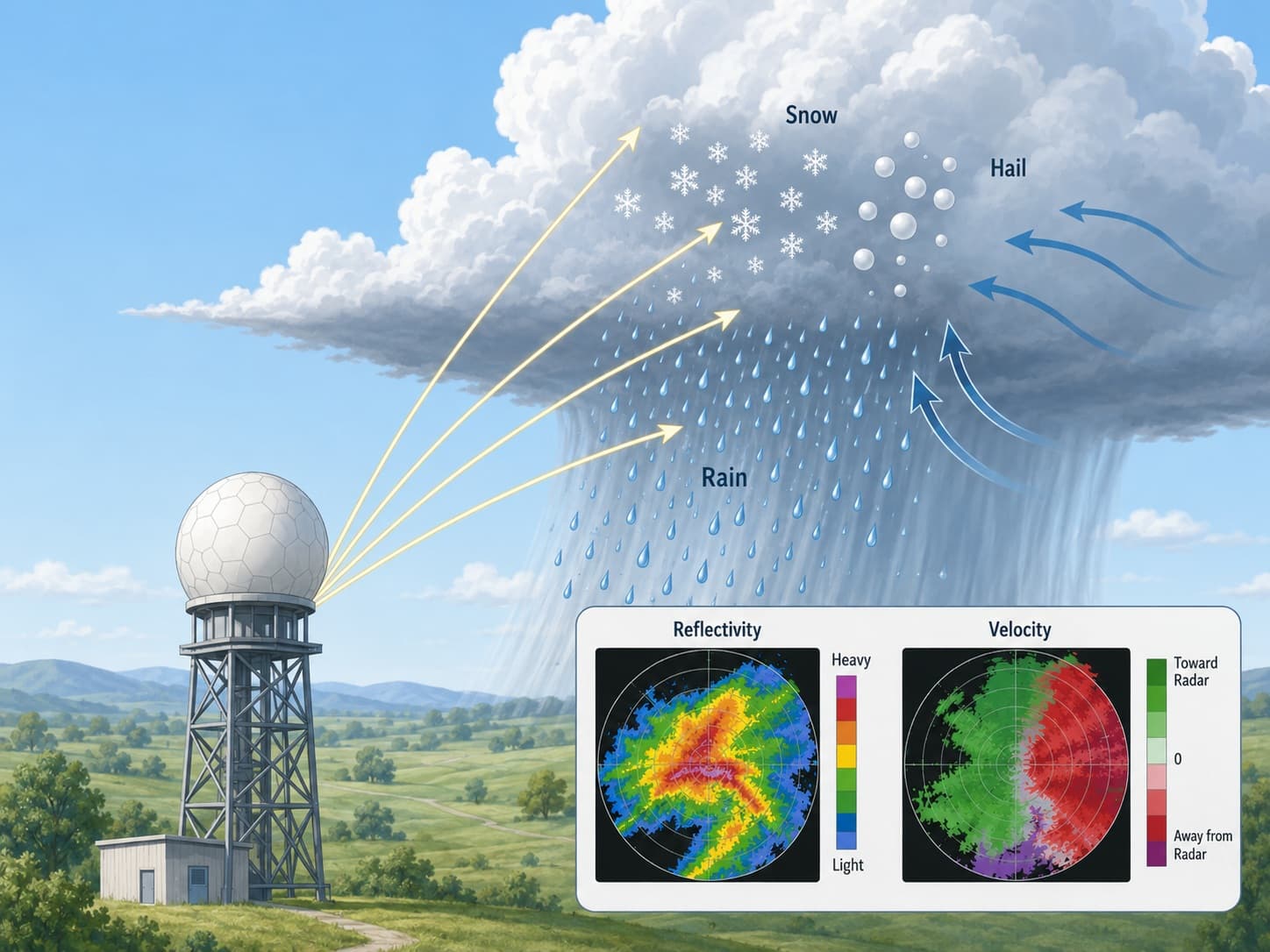
Weather radar is one of the most important tools in modern forecasting. It helps meteorologists see where rain, snow, hail, and severe storms are happening, how fast they are moving, and whether a storm may be producing dangerous winds or rotation.
Unlike a regular camera, radar does not need daylight or clear skies. It sends out invisible radio waves and listens for echoes from objects in the atmosphere.
What is weather radar?
Radar stands for radio detection and ranging. A radar system sends out short bursts of energy and measures how long the returned echo takes to arrive. That echo helps reveal where precipitation or other targets are, how strong they are, and in some cases how they are moving.
A weather radar image is not a direct photograph of the sky. It is a processed map made from returned radio signals and shown with colors that represent different radar measurements.
A brief history of weather radar
Radar technology developed rapidly in the 1930s and 1940s, largely because of military needs. Operators noticed that rain and snow created echoes on radar screens, and that unwanted signal eventually became a useful weather tool.
After World War II, surplus radar equipment was adapted for civilian weather use. Systems such as the WSR-57 and later WSR-74 improved national storm monitoring, but they mainly showed precipitation location and intensity.
Doppler radar added the ability to estimate motion toward or away from the radar, making it easier to identify storm rotation and strong winds. The NEXRAD network, built around the WSR-88D radar, became a foundation of modern warning operations.
Later dual-polarization upgrades gave forecasters more clues about precipitation type, rainfall estimates, and even tornado debris signatures.
How weather radar works
- The radar sends a pulse of energy into the atmosphere and then listens for the return.
- If the beam hits raindrops, snowflakes, hailstones, insects, birds, or debris, some energy scatters back.
- The radar measures distance from how long the echo takes to return.
- The antenna angle and rotation let computers place the echo on a map.
- Software turns the measurements into radar products people can understand.
Key radar measurements
Reflectivity shows how much energy is returning to the radar. Higher values often mean heavier rain or hail. Velocity uses the Doppler effect to estimate motion toward or away from the radar, which helps reveal wind patterns. Dual-polarization adds more information about the shape and type of targets.
Together, these measurements help forecasters understand where storms are, how they are changing, and whether they may be producing hazardous conditions.
Why radar colors matter
Radar colors are a visual shortcut. Cooler colors usually represent lighter precipitation, while warmer colors often represent heavier precipitation or stronger echoes. Color scales vary by site, so a red or purple area should always be interpreted in context.
Where radar is especially useful
Radar is important during severe thunderstorms, flash flood events, winter storms, and tropical systems. It can show storm location, movement, heavy rainfall, hail potential, wind signatures, rotation, and sometimes tornado debris.
It is also useful during winter weather, where dual-pol radar can help identify rain, snow, ice pellets, and mixed precipitation. During hurricanes, radar can show rain bands and eyewall structure when the storm is close enough to land-based radar coverage.
Limits of weather radar
Radar beams rise with distance, so faraway storms may be sampled higher above the ground. Terrain, buildings, and other obstacles can block or weaken signals. Radar can also see non-weather targets such as birds, insects, dust, and ground clutter.
Radar estimates are powerful, but they are not perfect ground truth. Forecasters combine radar with surface observations, satellite imagery, weather balloons, storm reports, and official warnings.
Why weather radar matters
Weather radar changed forecasting because it gave meteorologists a way to watch storms as they happened. It improved warning confidence, helped identify dangerous storm structures, and made it easier to spot hazards before they reached the ground.
Future radar systems may scan faster and provide even more detail, but the core goal remains the same: earlier detection, better warnings, and clearer information for the public.
Page summary
Weather radar uses radio waves to detect precipitation and storm motion. It evolved from early military radar into Doppler, NEXRAD, and dual-pol systems that support modern forecasting, severe weather warning, winter storm analysis, and tropical weather monitoring.